
















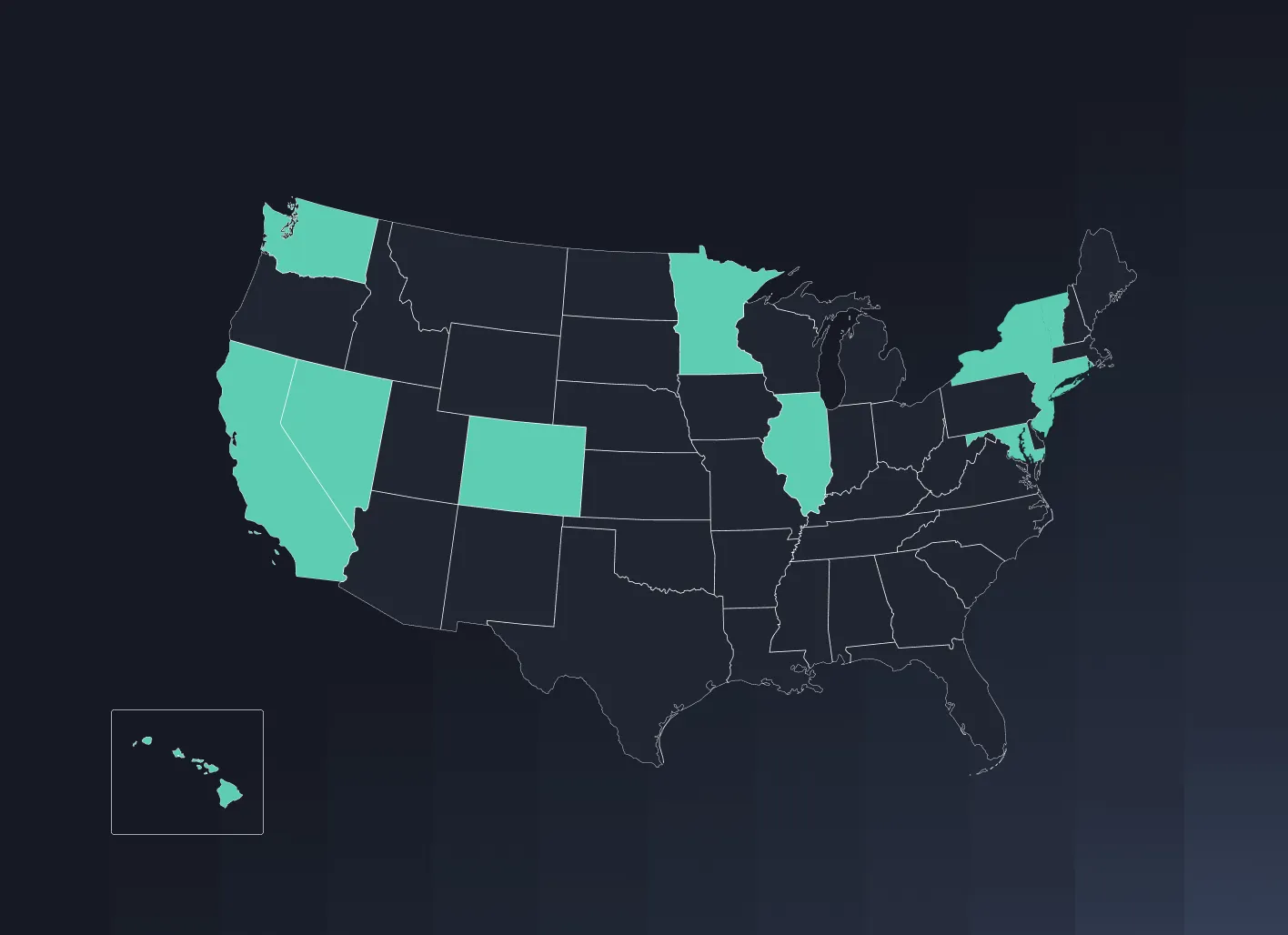
Pay transparency laws continue to expand across the United States. Today, 15 U.S. states (including Washington, D.C.), along with several counties and cities, require employers to provide some form of pay transparency during the hiring process. While requirements vary by jurisdiction, the dominant and rapidly emerging standard is the disclosure of salary ranges in job postings.
Some states, such as Nevada and Rhode Island, require pay range information only upon an applicant’s request, prior to discussing compensation, or after an interview, but the broader trend — and growing expectation among job seekers — is proactive early disclosure. As additional states consider similar legislation, employers must navigate a complex and evolving patchwork of requirements.
A common feature across these laws is the expectation that employers provide a “good faith” pay range for each role. This standard emerged in response to early enforcement challenges, particularly after Colorado’s initial salary range disclosure law, where some employers posted excessively wide ranges with little practical meaning.
While ambiguity remains around what precisely constitutes a good-faith estimate, regulators and applicants alike expect ranges to reflect realistic compensation outcomes based on job responsibilities, location, and internal pay structures. Research also shows that overly broad ranges undermine employer credibility, deter qualified candidates, and increase the volume of under-qualified applicants — driving up recruiting costs and time to hire.
This tracker is designed to help employers stay ahead of current requirements and monitor new and emerging U.S. pay transparency laws as they evolve.
| State/City | Law | Requirements | Applicability | Effective Date | Guide | Blog |
|---|---|---|---|---|---|---|
| California | Cal. Labor Code § 432.3 (as amended by SB 1162 & SB 642) |
|
|
Jan. 1, 2023 | California Guide | California Blog |
| Colorado | Equal Pay for Equal Work Act (C.R.S. § 8-5-101 et seq.) |
Must disclose in good faith in all job postings, including for jobs that can be done remotely from the state:
|
Employers with at least one employee working in Colorado. | Jan. 1, 2021 | Colorado Guide | Colorado Blog |
| Connecticut | CT Gen Stat § 31-40z (as amended by HB 6380) |
Must provide wage range information to an applicant upon the earliest of:
|
Employers with at least one employee working in Connecticut. | Oct. 1, 2021 | Connecticut Guide | Connecticut Blog |
| Delaware | Del. Code § 709C (HB 105) |
|
Employers with more than 25 employees. |
Sept. 26, 2027 |
N/A | Delaware Blog |
| Hawaii | HI Rev Stat § 378-2.8 (2024) (as added by Act 203 (SB 1057)) |
Must disclose salary ranges and hourly rates in external job postings that must “reasonably reflect” actual expected compensation for jobs that could be performed in Hawaii. |
Employers with 50 or more employees (job postings). |
Jan. 1, 2024 | Hawaii Guide | Hawaii Blog |
| Illinois | Equal Pay Act of 2003, 820 ILCS 112 (as amended by PA 103-0539 (HB 3129)) | Must include pay range and benefits in all postings for all jobs performed, at least in part, in the state and jobs outside of the state that report to a supervisor, office, or other work site in Illinois. Promotion opportunities must be announced or posted to current employees within two weeks of posting the job externally. | Employers with 15 or more employees. | Jan. 1, 2025 | Illinois Guide | Illinois Blog |
| Maryland | Annotated Code of Maryland §§ 3-301, 3-304.2 (as amended by SB 525) | Good faith pay range (minimum and maximum) must be included in internal and external job postings, along with information about benefits and any other compensation offered, if the position will be physically performed, at least in part, in Maryland. Employers are prohibited from discriminating against job candidates or candidates for promotion who do not disclose their salary history. | Any employer engaged in business in the state of Maryland. | Oct. 1, 2024 | Maryland Guide | Maryland Blog |
| Massachusetts | Section 105F of Chap. 149 of the General Laws (as added by An Act Relative to Salary Range Transparency) | Employers must disclose the pay range that the employer reasonably and in good faith expects to pay for such position in every job posting. The employer must also disclose the pay range to an employee who is offered a promotion or transfer to a new position. | Employers with 25 or more employees in Massachusetts. | Oct. 29, 2025 | Massachusetts Guide | Massachusetts Blog |
| Minnesota | Minnesota Statutes § 181.173 (as added by 2024 c 110, art. 7, § 2 (SF 3852)) | Employers must provide a starting salary range on all job postings, as well as a general description of all benefits and other compensation. The range must be a “good faith estimate.” | Employers with 30 or more employees at one or more sites in Minnesota. | Jan. 1, 2025 | Minnesota Guide | Minnesota Blog |
| Nevada |
NRS 613.133 (as added by SB 293) |
Employers are required to disclose the salary range or pay rate for a position in Nevada to a job applicant who has completed an interview for the position. Additionally, current employees who are seeking promotion or transfer to a new position are also entitled to the pay range or rate if they:
|
All employers in Nevada. | Oct. 1, 2021 | Nevada Guide | Nevada Blog |
| New Jersey | N.J.S.A. 34:6B-23 (P.L. 2024, c. 91) | Employers are required to disclose the hourly wage or salary, or a range of the hourly wage or salary, for the position along with a general description of benefits and other compensation programs for which an employee would be eligible on all postings for new jobs and transfer opportunities. The law also applies to job postings through a third party. Employers are required to make “reasonable efforts” to announce, post, or otherwise make known opportunities for promotion to all current employees in affected departments prior to making a promotion decision. | Employers with 10 or more employees over 20 calendar weeks and does business, employs persons, or takes applications for employment within New Jersey. | June 1, 2025 | New Jersey Guide | New Jersey Blog |
| New Jersey (Jersey City) | Jersey City Code §148-4.1 (as amended by Jersey City Ord. No. 22-026 and Ord. No. 22-045) | Employers must provide the minimum and maximum annual salary or hourly wage that the employer in good faith believes at the time of the posting it would pay in all ads for any job, transfer, or promotion opportunity. | Employers with five or more employees (including independent contractors) within Jersey City. | June 15, 2022 | N/A | N/A |
| New York | New York State Labor Law Section 194-b | Employers must disclose the compensation or a range of compensation in any advertisement for a job, promotion, or transfer opportunity. This applies if the position will be physically performed, at least in part, in New York or if the position will report to a supervisor, office, or other work site in the state. The employer must also provide the job description for such job, promotion, or transfer opportunity, if such a description exists. These ranges consist of the minimum and maximum annual salary or hourly compensation that the employer in good faith believes to be accurate at the time of posting. | Employers with four or more employees. | Sept. 17, 2023 | New York Guide | New York Blog |
| New York (New York City) | NYC Human Rights Law, Admin Code §§ 8-102, 8-107 (as amended by Law 2022/032 and Law 2022/059) | Employers are obligated to disclose in job advertisements a minimum and maximum annual salary or hourly wage range that the employer in good faith believes at the time of the posting that it would pay. Employers covered under the law are those that post a job, promotion, or transfer opportunity for a position that can or will be performed, at least in part, in New York City. | Employers with four or more employees (including independent contractors), with at least one employee in New York City. | Nov. 1, 2022 | New York City Guide | New York City Blog |
| New York (Ithaca) | City Code Ithaca § 215-3 (as added by Ithaca Ordinance 2022-23) | Employers are required to provide the minimum and maximum hourly or salary range the employer in good faith believes at the time of the posting it would pay on all job postings, including promotion and transfer opportunities. | Employers with four or more employees for positions for which the standard work location will be in the city of Ithaca. | Sept. 1, 2022 | Ithaca Guide | N/A |
| New York (Westchester County) | Laws of Westchester County § 700.03 (as amended by Local Law 2022-119) | Employers must provide minimum and maximum salary ranges on all job postings, transfer listings, or promotion opportunities. Each salary range must be based on what the employer “in good faith believes” it will pay at the time of the posting. | All employers and any employer who posts for positions that can or will be performed, in whole or in part, in Westchester County. | Nov. 6, 2022 | Westchester Guide | N/A |
| Ohio (Cincinnati) | Cincinnati Municipal Code, Ch. 804 (as added by Cincinnati Ordinance No. 83) | Employers must, upon reasonable request, provide a pay range for a position for which an applicant has been provided a conditional offer of employment. An “applicant” is any person applying for employment to be performed within Cincinnati, and whose application, in whole or in part, will be solicited, received, processed, or considered in Cincinnati. | Employers with 15 or more employees located within the city. | March 13, 2020 | Cincinnati Guide | N/A |
| Ohio (Cleveland) | Codified Ordinances, §§ 669.01-669.07 and 669.99 (as amended by Ordinance No. 104-2025) | Employers must provide pay ranges in job postings for employment to be performed within Cleveland, and whose applications, in whole or in part, will be solicited, received, processed, or considered in Cleveland. | Employers with 15 or more employees in Cleveland. | Oct. 27, 2025 | N/A | N/A |
| Ohio (Columbus) |
Code Chapter 2335.03 (as amended by Ord. No. 2898-2025) |
Employers must provide a reasonable salary range or scale for potential employment in all postings for positions to be performed within city limits and whose application, in whole or in part, will be solicited, received, processed, or considered in the City of Columbus.. |
Employers that employ 15 or more persons on a qualifying wage, commission, or other compensation basis within the City of Columbus. |
Jan. 1, 2027 | N/A | N/A |
| Ohio (Toledo) | Chapter 768 of the Pay Equity Act | Employers must, upon reasonable request, provide the pay range for a position to a job applicant who has been provided a conditional offer of employment by the employer. A job applicant includes any person applying for employment to be performed within Toledo, and whose application, in whole or in part, will be solicited, received, processed, or considered in Toledo. | Employers with 15 or more employees in Toledo. | June 25, 2020 | Toledo Guide | N/A |
| Rhode Island | General Laws, §§ 28-6-17 to 28-6-24 (as amended by SB 270A) |
Employers must disclose wage information to employees under the following circumstances:
|
All employers employing any person in the state of Rhode Island. | Jan. 1, 2023 | Rhode Island Guide | Rhode Island Blog |
| Vermont | 21 V.S.A. § 495p (as added by Act 155) |
Employers must:
|
Employers with five or more employees and at least one working in Vermont. | July 1, 2025 | N/A | Vermont Blog |
| Washington | Equal Pay and Opportunities Act, RCW 49.58.110 |
Employers are required to provide a salary range and general description of all the benefits and other compensation to be offered to the hired candidate on all job postings. The law applies to any postings done through a third party as well, and requires employers to provide a pay range to employees for any internal transfers or promotion opportunities.
|
Employers with 15 or more employees, if they have one or more Washington-based employees or if they engage in business in Washington or recruit for jobs that could be filled by a Washington-based employee, including remote jobs. | Jan. 1, 2023 | Washington Guide | Washington Blog |
| Washington D.C. | Wage Transparency Act of 2014 (D.C. Law 20-19; D.C. Official Code § 32-1451 et seq., as amended by the Wage Transparency Omnibus Amendment Act of 2023 (D.C. Act 25-367)) | Employers must provide the minimum and maximum projected salary or hourly pay that the employer in good faith believes it would pay in all job listings and position descriptions advertised (including internal announcements). Employers must disclose the existence of healthcare benefits that employees may receive before the first interview. Employers are prohibited from asking about salary history and retaliating against employees who discuss compensation. | Any employer with at least one employee in Washington D.C. | June 30, 2024 | N/A | Washington D.C. Blog |
How Trusaic Can Help
Trusaic’s PayParity® and Salary Range Finder® solutions work in tandem to help employers comply with pay transparency requirements while advancing meaningful pay equity.
- PayParity® identifies pay inequities across gender, race/ethnicity, age, and more using intersectional, regression-based analyses. It also supports remediation planning, ensuring your compensation decisions are both fair and legally-defensible.
- Our Remediation Optimization Spend Agent (R.O.S.A.) works as PayParity’s AI remediation partner to find the most cost-effective way to close pay gaps.
- Salary Range Finder® empowers HR and compensation teams to create data-driven salary bands that are competitive, equitable, and transparent. Real-time guidance ensures new hire offers are aligned with both market rates and your internal pay structures — helping you attract talent while maintaining trust within your workforce.
- Pay Decisions: Generate fair, competitive offers instantly from Workday.
With real-time pay guidance, managers, recruiters, and HR teams can make fair and competitive pay decisions faster — reducing time-to-hire, improving offer acceptance rates, and ensuring salary offers are aligned with your pay equity goals.