



















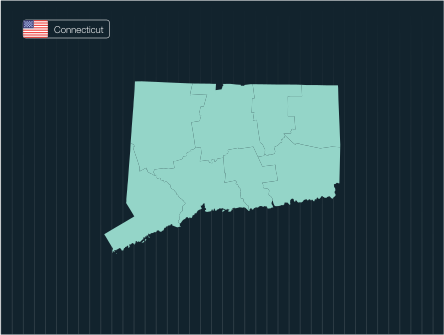
Effective Oct. 1, 2026, under P.A. 26-12, amending Conn. Gen. Stat. § 31-40z, all Connecticut employers must disclose wage information in public and internal job advertisements.
From Oct. 1, 2021 to Sept. 30, 2026, employers were only required to disclose wage range information to applicants upon request or prior to or at the time of making a job offer.
What are Connecticut’s pay transparency requirements?
As of Oct. 1, 2026, employers with at least one employee working in Connecticut must provide a wage or wage range as well as a general description of benefits in public and internal job advertisements. If there is no internal or public job advertisement, this information must be provided upon the earliest of the applicant’s request or prior to any discussion of compensation with the applicant or an offer of compensation to the applicant.
Additional changes as of Oct. 1, 2026:
- The wage range must be set in good faith.
- Clarification that the requirements apply to any positions performed in Connecticut, and positions performed outside Connecticut if the employee reports directly to a Connecticut supervisor, office, or other worksite.
The law continues to require an employer to provide an employee the wage range for the employee’s position upon (a) the hiring of the employee, (b) a change in the employee’s position with the employer, or (c) the employee’s first request for a wage range. As of Oct. 1, 2026, this disclosure must also include a general description of benefits to be offered with such position.
According to the law, wage range is defined as: the range of wages an employer anticipates relying on when setting wages for a position, and may include reference to any applicable pay scale, previously determined range of wages for the position, actual range of wages for those employees currently holding comparable positions or the employer’s budgeted amount for the position. Benefits are defined as “health insurance benefits, retirement benefits, fringe benefits, paid leave and any other compensation other than wages to be offered with a position.”
What are Connecticut’s employment equity standards?
In 2021, Connecticut broadened the pool of comparable employees for purposes of equal pay violations. Previously, organizations in Connecticut were prohibited from discriminating on the basis of sex in the payment of wages to employees performing equal work, “the performance of which requires equal skill, effort, and responsibility and which are performed under similar working conditions.” This language echoes and reinforces the requirements of the federal Equal Pay Act of 1963.
However, like many other states across the U.S. whose legislatures have determined the Equal Pay Act is insufficient in its protections against sex-based pay discrimination, Connecticut broadened this language to prohibit pay discrimination on the basis of sex for comparable work on a job, when viewed as a composite of skill, effort, and responsibility, and performed under similar working conditions.
This change from “equal” to “comparable” is important in that it potentially allows aggrieved employees or applicants to select from a broader pool of comparators when making equal pay claims.
What are the risks of non-compliance?
There is no set penalty under the law for non-compliance. However, penalties can be severe. Aggrieved applicants or employees can sue for compensatory damages, attorney’s fees and costs, and punitive damages. The statute of limitations to sue is two years from the last violation.
How can Trusaic assist with Connecticut’s pay transparency law requirements?
Pay transparency laws in the U.S. are quickly becoming the norm rather than the exception. While Connecticut already had a pay transparency law on the books, the updated version aligns them with other states requiring salary range disclosure in job postings.
Publishing ranges without first understanding your underlying pay structures can expose existing disparities and invite scrutiny. The organizations best positioned for laws like Connecticut’s are those that treat transparency not as a posting exercise, but as an outcome of sound pay equity practices.
That’s where Trusaic comes in.
Trusaic’s PayParity®, R.O.S.A.™, and Salary Range Finder® work together to help employers meet Connecticut’s requirements while advancing meaningful pay equity.
- PayParity identifies pay inequities across gender, race/ethnicity, age, and more using intersectional, regression-based analysis. Its defensible methodology gives you a clear, evidence-based picture of where disparities exist before you publish a single range.
- Remediation Optimization Spend Analysis (R.O.S.A.) works as PayParity’s remediation engine to find the most cost-effective way to close pay gaps, so the ranges you disclose reflect a genuinely equitable pay structure.
- Salary Range Finder prevents pay inequities before they start. It combines your pay equity analysis with internal ranges and market benchmarks to generate equitable pay recommendations that are externally competitive.
With real-time pay guidance, recruiters, managers, and HR teams can make fair, competitive pay decisions faster, reducing time-to-hire, improving offer acceptance, and keeping every posted range aligned with your pay equity goals.
Meet with one of our experts today to see how we can support your organization in developing a sound pay transparency strategy.