





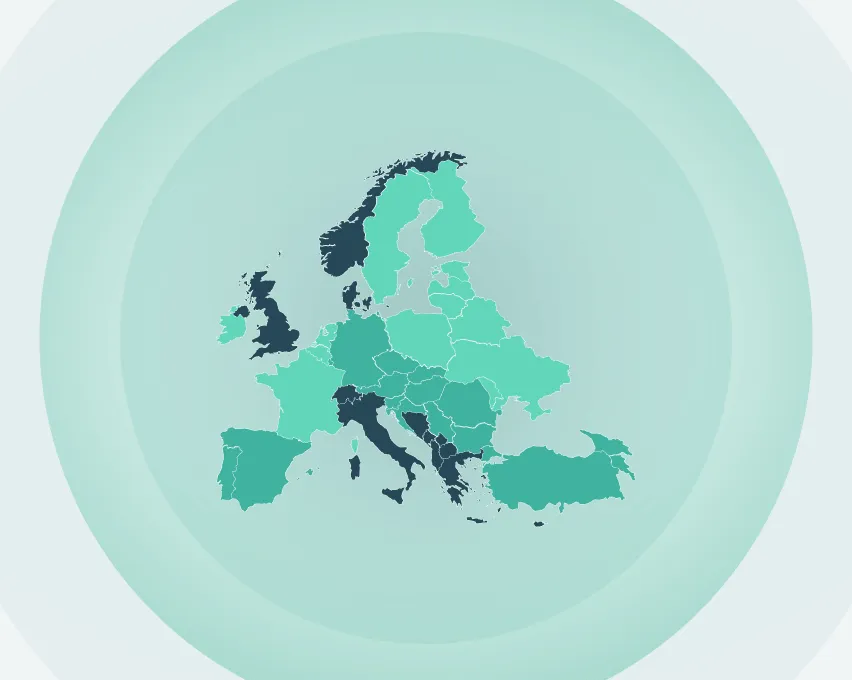









The 7 June 2026 transposition deadline for the EU Pay Transparency Directive has now passed, and the map of national compliance is uneven. A small group of Member States transposed on time. A larger group has published draft legislation but is openly targeting a later entry into force. Others have partially transposed, signaled delay, or have yet to produce a full draft at all.
This blog breaks down where each Member State stands a week removed from the deadline: who has transposed, who is positioned to follow this year, who has deferred entry into force to 2027, who is on hold, and where the legal and operational risk lies for employers regardless of their local transposition status.
Which Member States Have Fully Transposed the EU Pay Transparency Directive?
Four Member States — Slovakia, Lithuania, Italy, and Malta — have passed legislation or implementing regulations fully transposing the Directive. Each took a different legislative path, and the nuances matter for employers operating across borders.
Slovakia
Slovakia was the first Member State to fully transpose. The National Council approved the law on 15 April 2026 and it was published in the Collection of Laws on 8 May 2026, with an effective date of 7 June 2026. Key nuances:
- Two-track Right to Information (RTI). Individual pay-level information is available from 7 June 2026, but average pay levels by worker category must be provided for the first time for the year 2027 — meaning employees can effectively exercise that part of the right only from 1 January 2028, since it is based on prior calendar year data.
- Expanded access routes and tighter follow-ups. RTI requests may be channeled through worker representatives or the Slovak National Centre for Human Rights, and employers face a 30-day deadline for follow-up explanatory responses.
- Pay-structure compliance. Internal remuneration structures must support comparison of work of equal value, with pay criteria agreed with employee representatives.
- Penalties and reporting cadence. Fines run from €4,000–€8,000 for non-submission of pay-gap reports, with a 15-day rectification window. Reports are due by a fixed date in the year following the reporting period.
Lithuania
Lithuania was the second to fully transpose, adopting Law No. XV-969 on 21 May 2026 (published 25 May 2026). Rather than delay the whole package, it adopted a split effective-date structure:
- 7 June 2026: the majority of requirements enter into force.
- 31 December 2026: deadline for employers to confirm or update compliant pay systems.
- 1 January 2027: RTI requirements take effect, alongside the start of monthly data submission to Sodra (the State Social Insurance Fund).
The RTI delay is structural, not merely political: fulfilling RTI requests depends on Sodra-supplied data that will not begin flowing until after January 2027. Employers should treat RTI readiness in Lithuania as a process that requires coordination with the national data-submission system, not just an internal HR function.
Italy
Italy published its legislative decree on 1 June 2026, with entry into force on 7 June 2026. Key nuances:
- “Pay level” excludes non-structural elements. Italy defines pay level as gross annual and corresponding gross hourly remuneration limited to continuous and fixed elements, excluding non-structural individual benefits such as individual superminimums, one-off bonuses, and ad personam allowances.
- Reporting aligns with the Directive’s thresholds and timeline. First reports 7 June 2027 for employers with 150+ employees; 7 June 2031 for 100–149.
- Implementing decrees to follow. The Ministry of Labour and Social Policies must issue further decrees on data collection and reporting, after consulting the data protection authority, within 90 days of entry into force.
- Remediation. Employers must provide a reasoned response within 60 days to clarification requests on reported data and remedy unjustified pay gaps.
Malta
Malta reached full transposition through a two-step process. It first partially transposed certain pre-employment transparency and limited RTI requirements (Legal Notice 112 of 2025, effective 27 August 2025), with RTI limited to “same” work and no breakdown by sex. Parliament dissolved on 27 April, and a general election was held on 30 May.
Despite a 15 April 2026 request for postponed implementation by the Malta Employers’ Association, the new government then published the Equal Pay (Transparency and Reporting) Regulations, 2026 on 5 June 2026, which came into force the same day, fully transposing the Directive. Malta requires an 8-day turnaround on employee RTI requests, with enforcement proceedings triggered after 45 days.
What About the Partial Transpositions in Belgium and Poland?
Two Member States have partially transposed and should not be read as either fully compliant or fully delayed.
Poland
Poland brought general pay transparency provisions into force on 24 December 2025. The current provisions allow employers to communicate a salary range to applicants at any point in recruitment as long as it is provided in a manner that ensures an informed and transparent negotiation of pay (there is no requirement to include it in the job posting) and prohibit asking about salary history. The remaining Directive requirements — including RTI and reporting — are being handled separately, with a delayed effective date.
Belgium
Belgium has partial public-sector transposition at the sub-federal level rather than a single national framework. The French Community has applied RTI and general pay transparency obligations to public-sector employers since 1 January 2025, and the Flemish Region has moved on public-sector provisions as well.
At the federal level, however, Belgium has requested a six-month delay and has not produced a full transposition. Employers should confirm which obligations apply to which entities and regions.
Which Member States Are Expected to Transpose Later in 2026?
Several Member States have not met the deadline but show legislative momentum or have signaled intent to complete transposition this year:
- Bulgaria — consultation period ends 18 June 2026.
- Croatia — no published draft yet, but unofficially projecting implementation in October/November 2026.
- Cyprus — draft published; progressing.
- Finland — government proposal expected in early July 2026.
- France — transposition is more likely later in the year (December 2026 or early 2027).
- Greece — consultation period ends 17 June 2026.
- Ireland — planning a phased approach to transposition.
- Latvia — progressing.
- Romania — draft published; a minimalist approach with tighter RTI (30 working days) and remediation timelines.
Which Member States Have Deferred Entry Into Force to 2027?
A separate group has draft legislation in motion but has openly targeted entry into force in 2027 rather than June 2026:
- Belgium (Federal) — requested a six-month delay.
- Czechia — general entry into force 1 January 2027, with most substantive obligations (RTI, reporting, joint pay assessments) deferred to 1 January 2028 and some provisions to 2031.
- Denmark — proposed 1 January 2027 effective date.
- The Netherlands — bill submitted to Parliament on 21 May 2026, targeting entry into force on 1 January 2027.
- Poland — once enacted remaining requirements will enter into effect on a 6-month delay.
Which Member States Are on Hold?
Two Member States are effectively on hold, seeking postponement and renegotiation rather than near-term transposition:
- Sweden — seeking postponement and renegotiation of the Directive’s administrative scope.
- Estonia — seeking postponement and renegotiation, while intending to move forward with a limited transposition of certain pre-employment requirements and codifying equal pay for equal work in core labor law.
Which Member States Are Still TBD?
The remaining Member States have not yet published a full transposition draft:
- Austria
- Germany
- Hungary
- Luxembourg
- Portugal
- Slovenia
- Spain.
Notably, Germany has indicated that it is targeting 2027 for entry into force but RTI would be delayed to 2028. Employers with operations in these jurisdictions should monitor closely, as several could move quickly under infringement pressure.
Where Does the Risk Lie if Transposition Is Delayed?
A delayed transposition does not make the Directive irrelevant for employers in that jurisdiction. The question of “effect” — vertical versus horizontal — determines how exposure plays out, and it differs sharply between private and public employers.
A foundational point of EU law: directives do not have horizontal direct effect. That means an individual generally cannot rely on the Directive’s provisions directly in a dispute with another private party — including a private-sector employer — until those provisions are transposed into national law (Article 288 of the Treaty on the Functioning of the EU). That absence of horizontal direct effect is precisely why delay feels like breathing room for private employers. But it is not the whole picture.
Impact of Delays: Private Employers
Even without horizontal direct effect, several risks remain in play for private employers in delayed jurisdictions:
- Indirect effect. As of the 7 June 2026 deadline, national courts in each Member State must interpret existing domestic legislation as closely as possible to the Directive’s principles and spirit. For example, under Article 157 TFEU, every Member State must already ensure the right to equal pay for equal work or work of equal value. That right and any current legal framework around that right in each Member State will now be read in line with the Directive.
- External acceleration. The European Commission reiterated in May that the transposition deadline would not change, meaning infringement proceedings can be expected against non-compliant Member States. The prospect of penalties may push domestic transposition onto expedited legislative paths, compressing the preparatory runway for employers.
- Compressed timelines. Reporting deadlines are set by the Directive itself. For employers with 150 or more employees, reporting begins in June 2027 — so preparing against that deadline is essential even where local transposition is delayed.
Beyond the legal mechanics, there is reputation risk and employee friction. Employees will begin asking about these rights, if they haven’t already. A communication plan, and concrete steps toward alignment with the Directive ahead of transposition, can be an effective strategy.
Delay is also valuable preparation time. Employers can use it to conduct internal pay equity analyses and remediate in advance of RTI and reporting disclosures; continue to assess the defensibility of how employees are categorized by work of equal value; ensure recruitment policies and pay criteria are objective, gender-neutral, and ready for disclosure; and assess data readiness and collection capabilities.
Impact of Delays: Public Employers
Public employers face a different equation. As “emanations of the state,” they cannot shelter behind the absence of horizontal direct effect. Under certain conditions, employees of public and semi-public entities may be able to rely directly on provisions of the Directive — provided those provisions are sufficiently clear and unconditional (vertical direct effect).
It is important to confirm the status of each legal entity with counsel. The Netherlands recently analyzed the relative risk that a claim based on each of the Directive’s provisions could succeed against a state employer. As the Ministry there noted, the answer would ultimately depend on a court’s determination.
How Trusaic Can Help
At Trusaic, we provide employers across the EU with solutions to comply confidently with the Directive.
Our Complete EU Pay Transparency Solution enables compliant pay systems, ensures gender-neutral job evaluations, and automates complex reporting obligations to keep you one step ahead of EU pay transparency enforcement.
- PayParity® analyzes your rewards data (compensation/benefits in kind) and quickly identifies any potential unjustified inequities. It enables you to more easily comply with Article 7 (right to information) and Article 6 requirements (pay setting and progression policy).
- Our Remediation Optimization Spend Analysis (R.O.S.A.) works as PayParity’s remediation engine to find the most cost-effective way to close nominal pay gaps to ensure compliance.
- Automated RTI workflows: Our bi-directional integrations with global HCM platforms allow pay equity data to flow securely from the Trusaic platform back into the HCM. Employees can then access their RTI reports directly within their existing HR systems. This eliminates manual report generation and reduces compliance risk.
- For organizations that prefer platform-based access, RTI reports can also be generated and delivered securely through the PayParity platform, with role-based permissions and full auditability.
- Salary Range Finder® ensures equitable pay at the point of hire to prevent any increases in pay gap and enables you to easily comply with the Directive’s salary range disclosure and salary history ban requirements.
- Pay Decisions: Generate fair, competitive offers instantly from Workday.
- Regulatory and Pay Transparency Reporting™ captures your pay equity findings and generates compliant reports.
Trusaic is GDPR compliant and can assist any organization in any EU state in meeting its obligations under both the EU Corporate Sustainability Reporting Directive and the EU Pay Transparency Directive.
Visit our always updated Member State Transposition Monitor to stay on top of the latest EU Pay Transparency Directive developments.