
















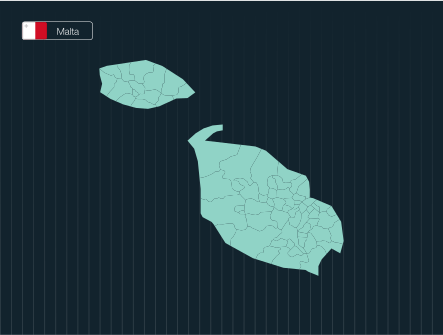
Malta has fully transposed the EU Pay Transparency Directive (EUPTD) into national law. On 5 June 2026 — just under the wire of the Directive’s 7 June 2026 transposition deadline — Malta published the Equal Pay (Transparency and Reporting) Regulations, 2026 (Legal Notice 173 of 2026). The regulations entered into force immediately upon publication on 5 June 2026 and cover the full range of the Directive’s requirements.
Malta had moved early on parts of the Directive. Effective 27 August 2025, it had partially transposed two requirements: initial pay transparency (information required to be provided before the start of employment) and a limited Right to Information allowing workers to request their own pay level and the pay levels of colleagues performing the “same” work — without a breakdown by gender and without the concept of work of equal value. The 2026 regulations cover those same requirements in fully compliant form and add the reporting, Joint Pay Assessment, enforcement, and transparency obligations needed for complete transposition.
Of particular note, Malta has built a staged process for Right to Information requests, requiring employers to respond to workers within eight days and creating an escalating sequence from there if they fail to do so — with non-compliance proceedings beginning at 45 days. The regulations also impose a general duty on employers to use appropriate means to bring the provisions to the attention of their workers (Regulation 18). Employers with operations in Malta must act now to comply with obligations that are already in effect.
Track the latest EU Member State transposition developments with our monitor.
What are Malta’s reporting requirements?
Who needs to report?
Reporting obligations are phased by employer size, in line with the Directive:
- 250 or more employees: Annual gender pay gap reporting. The first report is due 7 June 2027 and covers the full 2026 calendar year, then annually thereafter.
- 150–249 employees: Triennial gender pay gap reporting. The first report is due 7 June 2027 and covers the full 2026 calendar year, then every three years thereafter.
- 100–149 employees: Triennial gender pay gap reporting. The first report is due 7 June 2031 and covers the full 2030 calendar year, then every three years thereafter.
- Fewer than 100 employees: On a voluntary basis; not subject to mandatory gender pay gap reporting (though all employers remain subject to the pay transparency, Right to Information, and equal pay obligations described below).
Because the first reports for employers with 150 or more employees cover the full 2026 calendar year, the relevant measurement period has already begun — making accurate pay data and a defensible job-evaluation methodology an immediate priority.
What to report?
The required contents align with Article 9 of the EUPTD. Employers must report:
- The gender pay gap;
- The gender pay gap in complementary or variable components of pay;
- The median gender pay gap;
- The median gender pay gap in complementary or variable components;
- The proportion of female and male workers receiving complementary or variable components;
- The proportion of female and male workers in each quartile pay band; and
- The gender pay gap between workers by category of workers, broken down by ordinary basic wage or salary and complementary or variable components.
The accuracy of the reporting must be confirmed by the employer’s management after consultation with the employees’ representatives, who must have access to the methodologies the employer applied. Workers, employees’ representatives, the Monitoring Body, and the Equality Body may all request additional clarifications and details regarding any of the data provided, and the employer must respond within a reasonable time with a substantiated reply. Where pay differences are not justified, the employer must remedy the situation within a reasonable time in consultation with the Monitoring Body.
Where and when to report?
- Recipient: Reports are submitted to the Monitoring Body — the Department for Industrial and Employment Relations (DIER), which prescribes the format of the reports.
- First report: Due 7 June 2027 for employers with 150 or more employees (covering the full 2026 calendar year); due 7 June 2031 for employers with 100–149 employees (covering the full 2030 calendar year).
- Subsequent reports: After the first reporting year, the submission deadline is within 14 working days from the end of the relevant yearly period.
Internal disclosure
Employers must provide the pay gaps by category of workers to their workers and to employees’ representatives. Employers may publish the other reported indicators. As noted above, the accuracy of the reported data must be confirmed by management after consultation with employees’ representatives, who are entitled to access the methodologies used.
Joint Pay Assessment
Where reporting identifies a gender pay gap of 5% or more in any category of workers that has not been satisfactorily justified and has not been remedied within six months of reporting, the employer must conduct a Joint Pay Assessment (JPA) in consultation with employees’ representatives (Regulation 10). The contents of the assessment align with Article 10(2) of the EUPTD.
- The completed JPA must be made available to workers and employees’ representatives, and communicated to the Monitoring Body within 10 working days of completion.
- Remediation must be carried out within such time as is determined with the employees’ representatives.
- Dispute resolution: In case of disagreement during the JPA process, the employer or the employees’ representatives may request that the Monitoring Body attend a conciliation meeting between the parties. Failing final agreement, the matter is referred to the Tribunal for determination under the processes governed by the Employment and Industrial Relations Act.
What are Malta’s pay transparency requirements?
Malta’s regulations mandate pay transparency across hiring and employment. Employers are required to:
- Disclose initial pay before recruitment concludes: The initial pay level or its range, together with the relevant provisions of any applicable collective agreements, must be provided in a manner that ensures an informed and transparent negotiation on pay, prior to the conclusion of the recruitment process.
- Refrain from requesting salary history from candidates (aligned with the EUPTD).
- Use gender-neutral, non-discriminatory job postings, job titles, and recruitment processes.
- Maintain accessible pay criteria: Employers must maintain accessible policies on the criteria used for pay, pay levels, and pay progression, based on objective, gender-neutral criteria.
- Note the under-50 exemption — with a documentation catch: Employers with fewer than 50 employees are exempt from the requirement to provide pay progression criteria to workers. However, employers with 25 or more workers must still internally document those criteria.
- Ensure accessibility: Information provided under the regulations must be in a format accessible to persons with disabilities, having regard to their particular needs (Regulation 7).
What are Malta’s Right to Information (Article 7) requirements?
Workers have a statutory right to request and receive information in writing on their own individual pay level and on the average pay levels — broken down by sex — for categories of workers performing the same work or work of equal value (Regulation 6). Information requested in 2026 relates only to pay for the year 2026, and employers must maintain the underlying information for five years.
Malta’s distinctive feature is its staged, escalating response process:
- Eight-day response deadline: The employer has eight days to respond to an RTI request — far shorter than the Directive’s two-month default.
- Escalation to employee representatives: If the employer fails to respond in time, an employees’ representative may, within 12 days of the response deadline, submit a request for the same information on the worker’s behalf.
- Escalation to the Equality Body: If the employer still fails to respond, the worker may request and receive the information through the Equality Body (the National Commission for the Promotion of Equality).
- Right to further clarification: If the information is inaccurate or incomplete, the worker may request additional and reasonable clarifications and details. No fixed deadline is set for the substantiated reply.
- Enforcement trigger at 45 days: If an accurate and complete response is not provided within 45 days of the initial request, the failure is treated as an offence and proceedings may be initiated against the employer.
- Annual reminder: Employers must remind workers annually of the right and of the steps to exercise it.
- Data protection and privacy safeguards (Regulation 19): All personal data processed under the regulations must comply with the GDPR and may be used only to apply the principle of equal pay for equal work or work of equal value. Workers may also be required to use information received (other than about their own pay) only to exercise their right to equal pay. Where disclosure under Right to Information, reporting, or Joint Pay Assessment obligations would directly or indirectly reveal the pay of an identifiable worker, only the employees’ representatives, the Equality Body, and the Monitoring Body may access that information; they advise workers on a possible claim without disclosing the actual pay levels of individual workers.
What are Malta’s employment equity standards?
Malta’s regulations require equal pay for equal work or work of equal value, assessed using objective, gender-neutral criteria. Pay structures must enable an assessment of whether workers are in a comparable situation with regard to the value of their work, based on criteria agreed with employees’ representatives where they exist (Regulation 3).
Those criteria must not be based, directly or indirectly, on a worker’s sex, and must include skills, effort, responsibility, and working conditions — and, where appropriate, any other factors relevant to the specific job or position. They must be applied in an objective, gender-neutral manner that excludes any direct or indirect discrimination based on sex, and must take soft skills into account. A “category of workers” means workers performing the same work or work of equal value, grouped in a non-arbitrary manner on the basis of these criteria, by the employer and, where applicable, in cooperation with employees’ representatives.
What are the risks of non-compliance?
Enforcement measures under Malta’s regulations include:
- Reversal of the burden of proof in pay discrimination cases — where a worker establishes facts from which discrimination may be presumed, the employer must prove that no direct or indirect discrimination occurred. The burden also shifts where an employer has not met its transparency obligations, unless the breach was manifestly unintentional and minor (Regulation 15).
- Equal pay claims and full compensation (Regulation 14): A worker who has sustained a loss in pay as a result of a breach of the equal pay principle may refer the matter to the Industrial Tribunal for redress. Remedies include full recovery of back pay and related bonuses or payments in kind, plus real and effective compensation that is dissuasive and proportionate — including compensation for lost opportunities, non-material damage, and damage caused by other relevant factors, which may include intersectional discrimination.
- Administrative fines (Regulation 20):
- Violations of the regulations: €2,500–€5,000
- Where the offence is connected with a breach of the principle of equal pay for equal work or work of equal value: €5,000–€7,000
- The court takes into account whether the infringement is recurring.
- Oversight by the Monitoring Body (the Department for Industrial and Employment Relations) and the Equality Body (the National Commission for the Promotion of Equality).
How can Trusaic help employers comply with Malta’s EU Pay Transparency requirements?
Trusaic provides solutions to help employers operating in Malta comply confidently with the Directive. With first reports for employers of 150+ already capturing the full 2026 calendar year, and an eight-day clock on Right to Information requests, the pressure on accurate data and fast, defensible responses is immediate — areas where Trusaic delivers direct value.
Our Complete EU Pay Transparency Solution enables compliant pay systems, ensures gender-neutral job evaluations, and automates complex reporting obligations to keep you one step ahead of EU pay transparency enforcement.
- PayParity® analyzes your rewards data (compensation/benefits in kind) and quickly identifies any potential unjustified inequities. It enables you to more easily comply with Regulation 6 (right to information) and pay-setting and pay-progression requirements, and to identify and address any worker-category gaps of 5% or more before they trigger a Joint Pay Assessment.
- Our Remediation Optimization Spend Analysis (R.O.S.A.) works as PayParity’s remediation engine to find the most cost-effective way to close nominal pay gaps and ensure compliance.
- Automated RTI workflows: Our bi-directional integrations with global HCM platforms allow pay equity data to flow securely from the Trusaic platform back into the HCM, so employees can access their RTI reports directly within existing HR systems. This eliminates manual report generation and reduces compliance risk — particularly valuable given Malta’s eight-day RTI response window and the escalating enforcement process that follows.
- For organizations that prefer platform-based access, RTI reports can also be generated and delivered securely through the PayParity platform, with role-based permissions and full auditability.
- Salary Range Finder® ensures equitable pay at the point of hire to prevent any increase in pay gaps and enables you to easily comply with the Directive’s salary range disclosure and salary history ban requirements.
- Pay Decisions: Generate fair, competitive offers instantly from Workday.
- Regulatory and Pay Transparency Reporting™ (RAPTR) captures your pay equity findings and generates compliant reports, helping you determine applicability, meet deadlines, and maintain audit-ready records across EU jurisdictions.
Trusaic is GDPR compliant and can assist any organization in any EU state in meeting its obligations under both the EU Corporate Sustainability Reporting Directive and the EU Pay Transparency Directive.