
















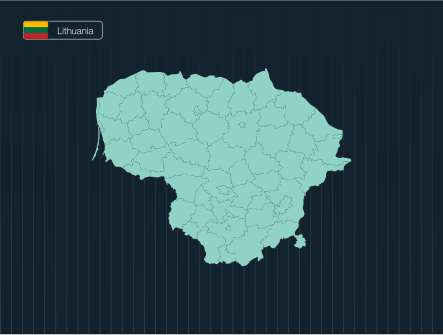
Lithuania has transposed the EU Pay Transparency Directive (EUPTD) into national law. Law No. XV-969 was adopted by the Lithuanian Parliament (Seimas) on 21 May 2026, signed by the President, and published in the Register of Legal Acts on 25 May 2026. The law amends Lithuania’s Labour Code and enters into force on 7 June 2026, with several of the more administratively demanding employer obligations phased in through 2027.
Rather than a strict minimal transposition, Lithuania goes beyond the Directive’s baseline in key respects — introducing a centralized, government-calculated reporting model run through the Board of the State Social Insurance Fund (Sodra), requiring monthly employer data submissions, and tightening certain response deadlines relative to the Directive’s defaults. Employers with operations in Lithuania must now act to comply with obligations that begin to take effect 7 June 2026. The Ministry of Social Security and Labour (SADM) must adopt implementing legal acts by 31 July 2026
Track the latest EU Member State transposition developments with our monitor.
What are Lithuania’s reporting requirements?
Who needs to report?
Lithuania operates a two-tier framework: a pre-existing internal disclosure obligation, plus new EUPTD indicator reporting calculated by Sodra.
- Existing obligation (20 or more employees): Annual internal disclosure to the works council or, where none exists, the employer-level trade union. This obligation is unchanged under the new law.
- 250 or more employees: Annual pay gap reporting. Sodra calculates the required indicators for employers for the first time by 1 March 2028, with all but the pay gaps by worker category published by 1 April 2028.
- 150–249 employees: Triennial indicator reporting. First Sodra calculation by 1 March 2028, with all but the pay gaps by worker category published by 1 April 2028.
- 100–149 employees: Triennial indicator reporting. First Sodra calculation by 1 March 2031, with all but the pay gaps by worker category published by 1 April 2031.
- Fewer than 100 employees: Not subject to the new pay gap reporting (though employers with 20+ employees remain subject to the existing internal disclosure obligation).
What to report?
Unlike most Member States, Lithuanian employers do not calculate the gender pay gap indicators themselves. Instead, employers submit underlying monthly data and Sodra computes the seven indicators required by Article 9 of the EUPTD:
- The gender pay gap;
- The gender pay gap by complementary and variable pay (as specified in Items 2-6 of Art. 139(2) and Art. 144(1-4));
- The median gender pay gap;
- The median gender pay gap by complementary and variable pay;
- The proportion of men and women receiving complementary and variable pay;
- The proportion of men and women in each salary bracket; and
- The gender pay gap in terms of basic (tariff) salary and complementary and variable pay by job category.
Complementary or variable pay includes: pay beyond the basic salary set out by mutual agreement or paid under labour law provisions or under the system of remuneration applicable at the workplace; bonuses for qualifications acquired; allowances for additional work or the execution of additional duties or tasks; bonus payments for work performed, set by mutual agreement or paid under labour law provisions or under the system of remuneration applicable at the workplace; bonus payment allocated on the initiative of the employer to incentivise an employee for work well done or for the activities or performance results of an employee, an enterprise, a department, or a group of employees; and payments for work on days off, holidays, overtime, and work at night.
The first six of these indicators are published publicly by Sodra; gender pay gaps by worker category are provided to employees where there are more than two employees of the respective gender in the category.
If a gender pay gap of 5% or more is identified within a worker category and is not justified or corrected within six months of the employer receiving the data, employers must conduct a Joint Pay Assessment (general wage assessment) in cooperation with employee representatives. The completed assessment must be submitted to employees, employee representatives, and the State Labour Inspectorate. Exact procedures will be established by the Minister of Social Security and Labour.
Where and when to report?
- Monthly data submission: Beginning 1 January 2027, employers must submit monthly data to the Board of the State Social Insurance Fund (Sodra), under the Ministry of Social Security and Labour (SADM), on wages, working hours, and worker categories as specified in the employer’s remuneration system. This data is also shared with the State Labour Inspectorate and the Office of the Equal Opportunities Ombudsman.
- Sodra calculation and return: Sodra uses this data to calculate the required indicators and returns them to employers — annually for employers with 250+ employees, and every three years for employers with 100–249 employees.
- Publication: Indicators 1–6 shall be published by 1 April 2028 for employers with 150+ employees; by 1 April 2031 for employers with 100–149 employees). Separately, Sodra publishes monthly the average hourly wage of male and female employees of employers with at least 8 employees (more than three women and more than three men).
- Temporary employees: Employers complete the required reporting for temporary employees themselves, annually or every three years depending on size.
The procedure for collecting, calculating, submitting, and publishing this data will be established by SADM, which must adopt implementing legal acts by 31 July 2026.
Internal disclosure
Employers must provide:
- Existing obligation (20+ employees): Annual, anonymized average remuneration by occupational group and gender — excluding managerial positions — where there are more than two employees in the group, provided to the works council or trade union.
- New obligation: Gender pay gaps by worker category provided to employees where there are more than two employees of the respective gender in the category.
- Explanations for pay differences: Employees and their representatives may request an explanation of wage differences between genders. Employers must respond within a reasonable period, no later than one month.
What are Lithuania’s pay transparency requirements?
Lithuania’s framework, reinforced by Law No. XV-969, mandates pay transparency across hiring and employment. Employers are required to:
- Disclose the amount and/or range of basic (rate) remuneration in the job notice (Article 25, already in effect — salary ranges have been required in job advertisements since July 2019). Information about relevant collective agreement provisions must also be provided before concluding the employment contract, in a way that ensures reasonable and transparent salary negotiations (Article 41).
- Refrain from requesting salary history from candidates (Article 41).
- Use objective, gender-neutral criteria for pay and pay progression.
- Make the remuneration system accessible to all employees (Article 140). The pay structure must set out forms of remuneration by position group, wage amounts or limits (minimum and maximum), the grounds and procedure for additional payments (bonuses and premiums), and criteria for indexation and pay increases. Pay structures are established by collective agreement; failing that, the employer must approve the system after consultation with employee representatives.
- Note the under-50 exemption: Employers with fewer than 50 employees are exempt from providing pay-increase (pay progression) criteria to employees.
- Ensure remuneration systems are compliant with Article 140 by 31 December 2026.
Right to Information (Article 7)
Employees have a statutory right to request information about their own annual salary, monthly and annual average hourly wage, and the annual average wage and hourly wage of their worker category, broken down by sex. Because Lithuania’s model relies on Sodra-calculated data, the RTI provisions enter into force on 1 January 2027, but employers are only obligated to provide requested RTI data to employees after Sodra first supplies that data to the employer.For example, Sodra will first provide the annual average wage and hourly wage per employee and worker category to employers on 1 March 2028.
Key provisions include:
- One-month response deadline: Employers must respond to pay information requests within one month — shorter than the Directive’s two-month default.
- Pay level: Defined as the employee’s annual salary, monthly and annual average hourly wages, and the corresponding averages for the employee’s worker category.
- Right to further explanation: If the data is inaccurate or incomplete, the employer must provide additional explanations within two months.
- Independent request channels: Requests may be submitted directly, through employee representatives, the State Labour Inspectorate, or the Equal Opportunities Ombudsman’s Office. The employer must comply with a request from the Inspectorate or Ombudsman within 10 working days.
- Temporary workers: May request this information from the temporary work agency or the temporary work user.
- Privacy safeguards: Where another employee’s pay could be identified, the data may only be provided to employee representatives, the State Labour Inspectorate, or the Equal Opportunities Ombudsman. Where the data shows a difference of at least 5% in a group’s average salary, without disclosing other individuals’ pay, the employee must be informed and advised on the option to request further information and, if unjustified, on bringing a claim.
- Limited use of data: Employers may require that employees use the received data only to pursue equal pay rights for the same work or work of equal value.
Employment equity standards
Lithuania’s Labour Code requires equal pay for equal work or work of equal value, and the Law on Equal Treatment prohibits discrimination based on gender and other protected characteristics. Law No. XV-969 adds structured reporting, transparency mechanisms, and stronger enforcement to these protections.
Under Article 140, the value of work is assessed using objective, gender-neutral criteria — skills, qualifications, effort, responsibility, and working conditions — with “qualifications” added beyond the four standard criteria. For pay discrimination cases, (1) comparators may be drawn from a single source where terms are centrally determined across subsidiaries of a parent company, (2) where no real comparator exists, statistical data or a hypothetical comparator may be used, and (3) comparators do not need to have been employed at the same time.
The risks of non-compliance
Enforcement measures under Lithuania’s transposition law include:
- Reversal of the burden of proof in discrimination cases — where an employee establishes facts suggesting discrimination, the employer must prove none occurred (Articles 26(5) of the Labour Code).
- Full compensation for employees (Article 219(2)), including recovery of unpaid wages or payments in kind, material and non-material (moral) damages — including damage from discrimination on multiple grounds — and compensation for lost work-related opportunities, plus interest on any backpay owed (Article 147).
- Administrative fines under the Code of Administrative Offenses:
- Equal pay violation: €500–€1,450
- Repeated violation: €1,450–€3,000
- Intentional violation: €2,700–€6,000
- Failure to provide required information to employees: €460–€700, rising to €700–€1,400 for repeated violations
- Oversight by Sodra, the State Labour Inspectorate, the Equal Opportunities Ombudsman, and the Ministry of Social Security and Labour.
How can Trusaic help employers comply with Lithuania’s EU Pay Transparency requirements?
Trusaic provides solutions to help employers operating in Lithuania comply confidently with the Directive. Even though Sodra performs the core indicator calculations, employers remain fully responsible for compliant pay systems, accurate monthly data, RTI responses, clarifications, and remediation — areas where Trusaic delivers direct value.
Our Complete EU Pay Transparency Solution enables compliant pay systems, ensures gender-neutral job evaluations, and automates complex reporting obligations to keep you one step ahead of EU pay transparency enforcement.
- PayParity® analyzes your rewards data (compensation/benefits in kind) and quickly identifies any potential unjustified inequities. It enables you to more easily comply with Article 7 (right to information) and Article 6 requirements (pay setting and progression policy), and to identify and address any worker-category gaps of 5% or more before they trigger a Joint Pay Assessment.
- Our Remediation Optimization Spend Analysis (R.O.S.A.) works as PayParity’s remediation engine to find the most cost-effective way to close nominal pay gaps and ensure compliance.
- Automated RTI workflows: Our bi-directional integrations with global HCM platforms allow pay equity data to flow securely from the Trusaic platform back into the HCM, so employees can access their RTI reports directly within existing HR systems. This eliminates manual report generation and reduces compliance risk — particularly valuable given Lithuania’s one-month RTI response window.
- For organizations that prefer platform-based access, RTI reports can also be generated and delivered securely through the PayParity platform, with role-based permissions and full auditability.
- Salary Range Finder® ensures equitable pay at the point of hire to prevent any increase in pay gaps and enables you to easily comply with the Directive’s salary range disclosure and salary history ban requirements.
- Pay Decisions: Generate fair, competitive offers instantly from Workday.
- Regulatory and Pay Transparency Reporting™ (RAPTR) captures your pay equity findings and generates compliant reports, helping you determine applicability, meet deadlines, and maintain audit-ready records across EU jurisdictions.
Trusaic is GDPR compliant and can assist any organization in any EU state in meeting its obligations under both the EU Corporate Sustainability Reporting Directive and the EU Pay Transparency Directive.
FAQs
-
Who must report gender pay gap data in Lithuania?
Lithuania uses a two-tier system. Employers with 20 or more employees must already share anonymized pay data internally with works councils or trade unions annually. Under the new gender pay gap reporting, Sodra calculates gender pay gap indicators for employers with 250+ employees (annually) and 150–249 employees (triennially) beginning with a first calculation by 1 March 2028, and for employers with 100–149 employees (triennially) beginning by 1 March 2031.
-
Has Lithuania published its transposition law?
Yes. Law No. XV-969 was adopted by the Lithuanian Parliament on 21 May 2026, signed by the President, and published in the Register of Legal Acts on 25 May 2026. It enters into force on 7 June 2026, with certain obligations phased in through 2027.
-
What gender pay gap metrics are required?
Sodra calculates the seven indicators required by Article 9 of the EUPTD from employer-submitted data, including: mean and median gender pay gaps (total and variable pay); the proportion of men and women receiving variable pay; gender distribution across pay quartiles; and pay gaps by category of workers. The first six indicators are published; worker-category gender pay gaps are shared with employees.
-
What happens if a 5% pay gap is detected?
If a pay gap of 5% or more exists in a worker category and is not justified or corrected within six months of receiving the data, a Joint Pay Assessment must be conducted with employee representatives and submitted to employees, their representatives, and the State Labour Inspectorate.
-
Will employees be able to request pay information?
Yes. Employees have a statutory right to request information about their own annual salary, monthly and annual average hourly wage, and the annual average wage and hourly wage of their worker category, broken down by sex.RTI provisions take effect 1 January 2027, but employers respond only after Sodra first supplies the relevant data. Employers must respond within one month, with follow-up explanations within two months where data is inaccurate or incomplete.
-
Are salary ranges required in job postings?
Yes. Salary ranges have been required in Lithuanian job advertisements since July 2019, and employers must disclose the amount and/or range of basic remuneration in the job notice. Collective agreement information must also be provided before the employment contract is concluded.
-
Can employers ask candidates about their salary history?
No. Under the new law (Article 41), employers are prohibited from requesting salary history during recruitment. Candidates may raise their own pay expectations voluntarily.
-
What are the penalties for non-compliance?
Administrative fines for equal pay violations range from €500–€1,450, rising to €1,450–€3,000 for repeated violations and €2,700–€6,000 for intentional violations. Failure to provide required information to employees carries fines of €460–€700, or €700–€1,400 for repeated violations.
-
How can employers get started now?
Employers can begin by:
- Auditing current pay structures against gender-neutral criteria to ensure remuneration systems are compliant with Article 140 by 31 December 2026
- Ensuring pay, pay level, and (where applicable) pay progression criteria are accessible to all employees
- Updating recruitment processes to confirm salary range disclosure, enforce the salary history ban, and remove any pay secrecy clauses
- Preparing data systems for monthly Sodra submissions beginning 1 January 2027 and for RTI responses once Sodra begins supplying data