
















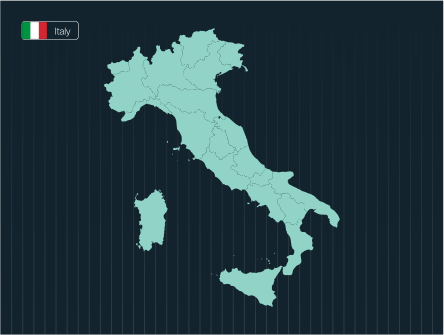
Italy has transposed the EU Pay Transparency Directive (EUPTD) into national law. Following an enabling act adopted in February 2024 (Law 15/2024, Article 9), the Council of Ministers approved a draft legislative decree in preliminary examination on 5 February 2026 and in final examination on 30 April 2026. Legislative Decree No. 96 of 7 May 2026 was published in the Official Journal on 1 June 2026 and enters into force on 7 June 2026.
Italy’s law transposes the EUPTD’s core requirements and definitions while leaving some of the operational detail to follow-on implementing decrees and ministerial circulars. The transposition framework supplements Italy’s existing Code of Equal Opportunities for Men and Women (Legislative Decree 198/2006). Its most notable national features are (1) the requirement to include the starting salary or its range and relevant collective bargaining agreement provisions in job advertisements; (2) the use of collective bargaining agreement (CCNL) classifications as the default reference tool for assessing work of equal value; (3) the limitation of the Right to Information (RTI) to once per year; and (4) a narrow definition of “pay level” as used in the calculations for RTI and the gender pay gap for reporting.
Track the latest EU Member State transposition developments with our monitor.
What are Italy’s reporting requirements?
Who needs to report?
Under Italy’s transposition law, the gender pay gap reporting threshold is set at 100 employees, phased in by company size:
- 250 or more employees: Annual reporting, with the first report due 7 June 2027
- 150–249 employees: Triennial reporting, with the first report due 7 June 2027
- 100–149 employees: Triennial reporting, with the first report due 7 June 2031
For the purposes of determining whether an employer falls under the relevant thresholds, the decree applies to subordinate employment contracts (fixed-term and permanent, including part-time and managerial positions), and excludes domestic, agency, and intermittent workers.
This new EUPTD reporting sits alongside Italy’s pre-existing biennial gender equality report obligation under Law 162/2021, which amended the Code of Equal Opportunities for Men and Women (Legislative Decree 11 April 2006, No. 198), which continues to apply to public and private employers with 50 or more employees.
What to report?
Reporting contents align with Article 9 of the EUPTD. Employers are required to report gender pay gap information, including:
- Mean and median gender pay gaps for total pay
- Mean and median gender pay gaps in complementary or variable pay components
- Proportion of male and female workers receiving complementary or variable pay
- Proportion of male and female workers in each pay quartile
- Gender pay gaps by category of workers, broken down by basic pay and complementary or variable pay
The accuracy of the reported information must be confirmed by the employer after consulting with worker representatives, who are given access to the methodologies applied. Employers may aggregate reporting at the national level where this provides a more reliable representation of the data. The precise data points employers must communicate, along with the collection methodology, will be established in one or more implementing decrees of the Ministry of Labour and Social Policies (after consultation with the data protection authority), to be issued within 90 days of the decree’s entry into force.
Where and when to report?
First reports are due 7 June 2027 for employers with 150 or more employees and 7 June 2031 for employers with 100–149 employees. The required data and collection procedure will be specified in the forthcoming implementing decrees rather than fixed in the decree itself. A designated monitoring body at the Ministry of Labour and Social Policies will publish the reported data, enabling sectoral and other comparisons, with the exception of gender pay gaps by worker category.
Internal disclosure
Employers must provide gender pay gaps by category of workers to their employees and worker representatives; this category-level data may also be made publicly available by the employer at its discretion. Where a request for clarification of reported data is made, employers must provide a reasoned response within 60 days and the employer must remedy any unjustified pay gaps.
Joint Pay Assessments
Where reporting reveals a gender pay gap of 5% or more within a category of workers that is not justified by objective, gender-neutral factors and is not remedied within six months of reporting, the employer must conduct a Joint Pay Assessment in close cooperation with worker representatives.
Following the assessment, the employer must adopt — within a reasonable timeframe — the measures necessary to eliminate the unjustified pay differences, again in close cooperation with employee representatives. These corrective measures must include an analysis of the organization’s existing job evaluation and classification systems. Where no agreement is reached within the company, the Labour Inspectorate and the local equality body may be invited to participate in implementing the measures.
What are Italy’s pay transparency requirements?
Italy’s law, effective 7 June 2026, introduces pay transparency obligations in hiring and employment. Employers are required to:
- Disclose the starting salary or salary range, together with the relevant provisions of the applicable collective bargaining agreement, through the notices and announcements advertising job opportunities.
- Refrain from requesting salary history from candidates.
- Use objective, gender-neutral criteria in job descriptions, pay setting, and pay determination.
- Make the criteria used for pay and pay levels easily accessible to workers. Employers with 50 or more employees must additionally make available the criteria for pay progression; employers with fewer than 50 employees are exempt from making available to employees its criteria for pay-progression.
- This accessibility obligation can be satisfied by referring to the criteria set out in the applicable CCNL. The information provided to the employee at the start of the employment relationship (under Article 4(1)(a) of Legislative Decree No. 104 of 2022) — covering classification level, starting salary, applicable CCNL, and related salary determination criteria — constitutes the standard method of fulfilling these pay transparency obligations.
Right to Information (Article 7) in Italy
Employees have a statutory right to request information about the average pay levels of colleagues performing the same work or work of equal value, broken down by gender. Notably, Italy does not duplicate the right to one’s own individual pay level, because that is already required under existing Italian law (Legislative Decree No. 152 of 1997, as amended by Legislative Decree No. 104 of 2022).
Key provisions include:
- Two-month response deadline: Employers must respond to pay information requests within two months of the request.
- Once-per-year limit: The right to information may be exercised only once per calendar year.
- “Pay level”: Pay level is defined as gross annual remuneration and the corresponding gross hourly remuneration, comprising continuous and fixed pay elements — and excluding non-structural individual treatments such as pay components recognized on a personal, discretionary, or temporary basis that are not generalized within the same category of workers and are based on individual objective criteria. This excludes individual superminimums, one-off bonuses, and ad personam allowances.
- Right to further explanation: Where the information received is inaccurate or incomplete, employees may request further clarification, which the employer must provide (no fixed statutory deadline).
- Alternative publication option: Employers may satisfy the obligation by publishing the relevant information on the company intranet or in a reserved area of the company website. Information may also be drawn from data collected for reporting purposes under Article 9.
- Annual reminder: Employers must remind employees annually of their right to request this information.
- Privacy safeguards: Information received by employees other than one’s own pay may only be used to exercise the right to equal pay. Where disclosure would directly or indirectly reveal the remuneration of an identifiable worker, access is reserved for workers’ representatives, the Labour Inspectorate, and the equality body, who may advise employees on potential equal-pay complaints without disclosing individual pay levels. For employers with up to 49 employees, additional decrees (to be issued within 90 days of entry into force) may set out how information is provided to avoid identifying individual workers.
What are Italy’s employment equity standards?
The principle of equal pay for equal work or work of equal value is long established in Italian law: the Constitution of the Italian Republic (Article 37) prohibits gender-based discrimination, and the Code of Equal Opportunities for Men and Women (Legislative Decree 198/2006) provides the broader equal-treatment framework. Legislative Decree No. 96/2026 adds structured reporting, transparency mechanisms, and enforcement on top of these protections.
Under the new decree, the assessment of work of equal value is based on common, objective, and gender-neutral criteria — taking into account skills, responsibilities, and working conditions, as well as other factors relevant to the specific role. CCNL classification and job-classification systems established by law or national collective bargaining are treated as the reference tool for comparison and carry a presumption of compliance, though employer-established professional classification and evaluation systems are permitted as a supplement to the CCNL where they meet objective, gender-neutral criteria. Comparators may be drawn from a single source across different employers where pay conditions derive from the same law, collective agreement, company agreement, or rules established centrally for a corporate group.
What are the risks of non-compliance?
Enforcement measures under Italy’s transposition law include:
- Reversal of the burden of proof in discrimination cases — already established under the Code of Equal Opportunities, under which an employer must disprove discrimination once a claimant produces facts establishing a presumption of it
- Worker access to legal remedies under Book III, Title I, Chapter III of the Code of Equal Opportunities (Legislative Decree 198/2006)
- Administrative fines of €250 to €1,500 for relevant violations, consistent with Article 41 of Legislative Decree 198/2006
- Oversight by the Ministry of Labour and Social Policies, the Labour Inspectorate, and the equality body (equality councillors/advisors)
How can Trusaic help employers comply with Italy’s EU Pay Transparency requirements?
Trusaic provides solutions to help employers operating in Italy comply confidently with the Directive. While some of Italy’s operational detail is still to come through implementing decrees, employers remain fully responsible for compliant pay systems, accurate reporting, RTI responses, and remediation — areas where Trusaic delivers direct value.
Our Complete EU Pay Transparency Solution enables compliant pay systems, ensures gender-neutral job evaluations, and automates complex reporting obligations to keep you one step ahead of EU pay transparency enforcement.
- PayParity® analyzes your rewards data (compensation/benefits in kind) and quickly identifies any potential unjustified inequities. It enables you to more easily comply with Article 7 (right to information) and Article 6 requirements (pay setting and progression policy), and to identify and address worker-category gaps of 5% or more before they trigger a Joint Pay Assessment.
- Our Remediation Optimization Spend Analysis (R.O.S.A.) works as PayParity’s remediation engine to find the most cost-effective way to close nominal pay gaps and ensure compliance.
- Automated RTI workflows: Our bi-directional integrations with global HCM platforms allow pay equity data to flow securely from the Trusaic platform back into the HCM, so employees can access their RTI reports directly within existing HR systems. This eliminates manual report generation and reduces compliance risk.
- For organizations that prefer platform-based access, RTI reports can also be generated and delivered securely through the PayParity platform, with role-based permissions and full auditability.
- Salary Range Finder® ensures equitable pay at the point of hire to prevent any increase in pay gaps and enables you to easily comply with the Directive’s salary range disclosure and salary history ban requirements.
- Pay Decisions: Generate fair, competitive offers instantly from Workday.
- Regulatory and Pay Transparency Reporting™ captures your pay equity findings and generates compliant reports, helping you determine applicability, meet deadlines, and maintain audit-ready records across EU jurisdictions.
Trusaic is GDPR compliant and can assist any organization in any EU state in meeting its obligations under both the EU Corporate Sustainability Reporting Directive and the EU Pay Transparency Directive.