







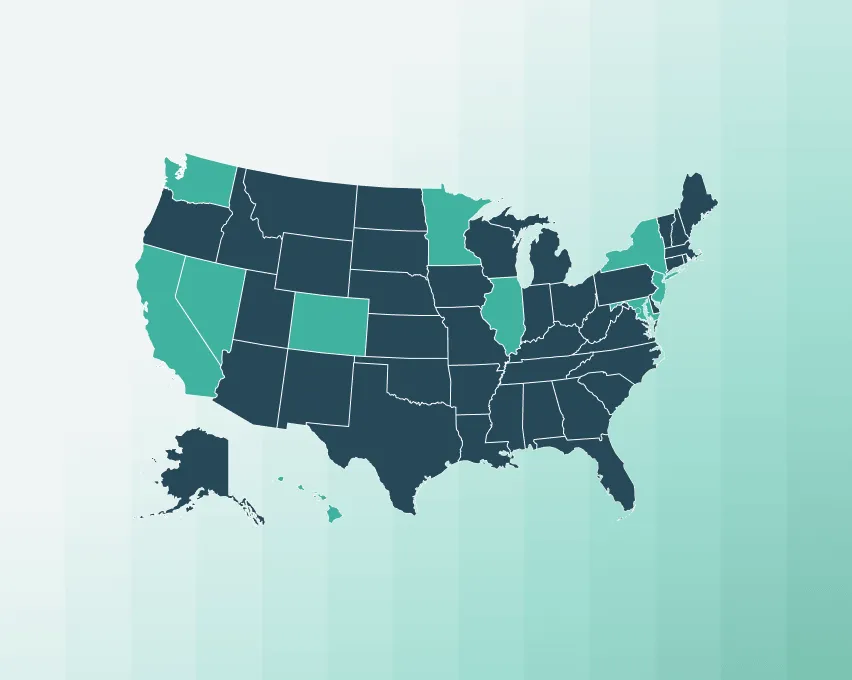



New Jersey requires employers to file ACA forms with the state by March 31, and that requirement starts when a New Jersey resident is enrolled in your self-insured health plan, whether they worked for you all year or just a few months.
This filing is separate from the federal ACA filing employers submit to the IRS, and it has its own rules. It applies to any employer with at least one New Jersey resident on a self-insured health plan, regardless of company size, including small employers exempt from the federal ALE mandate reporting.
The state accepts that filing one way: electronically, through its own system. There’s no paper option, no matter how many forms you’re submitting.
Who Has to File ACA Forms With New Jersey?
New Jersey’s filing requirement applies to any employer with a self-insured health plan that provided minimum essential coverage to a New Jersey resident during the year, whether that person lived in the state the full year or only part of it. A part-year resident is someone domiciled in New Jersey for at least 15 days in any given month.
The requirement applies regardless of where the employer is headquartered. An out-of-state employer with even one New Jersey resident on its self-insured plan has the same filing obligation as a New Jersey-based business.
This also includes employees who left the company partway through the year. If they were a New Jersey resident while covered on a self-insured health plan, they still count toward the filing requirement.
What Are the New Jersey ACA Filing Deadlines?
New Jersey sets two separate deadlines, and they don’t align with each other:
- March 2: Furnish forms to individuals. This matches the federal furnishing deadline.
- March 31: File with the New Jersey Division of Taxation. This is the state filing, separate from furnishing, and it’s where the electronic-only rule applies. New Jersey does not accept paper filing at all, regardless of how many forms an employer submits.
The Paperwork Burden Reduction Act lets employers meet the federal furnishing deadline by posting a website notice instead of mailing Form 1095-C. New Jersey does not accept that option.
Forms for New Jersey residents must still go out by mail or electronically with the individual’s consent, even if an employer uses the website notice everywhere else.
What Do Employers Actually Need to Submit?
New Jersey’s requirements are narrower than the full federal filing package:
- New Jersey only requires Parts I and III of Form 1095-C, not the complete form. It will also accept a fully completed 1095-A, 1095-B, or 1095-C, or its own NJ-1095 form, so employers already producing one of those federally don’t need a separate version.
- Filing goes through MFT SecureTransport, the same DORES system used for W-2 filings. It’s required for 50 or more forms, and available below that threshold too. Request login credentials from DORES well before the deadline; setup isn’t instant.
- Fully insured employers typically don’t need to file: carriers file Form 1095-B directly with New Jersey. It’s still worth confirming with the carrier, since the obligation falls back on the employer if they don’t.
What Happens If an Employer Doesn’t File?
New Jersey has not published a specific penalty structure for missed filing or furnishing. However, state tax penalties can still apply.
It’s also worth noting that relying on a carrier or multi-employer plan doesn’t remove an employer’s own responsibility. New Jersey’s guidance is direct on this point: if the carrier or plan fails to file on time, the employer shares liability and is required to send the 1095 forms itself.
Build the filing into your existing March reporting cycle, and confirm with your carrier directly, rather than waiting to see what happens if a filing is missed.
Why New Jersey’s Filing Rules Are Worth Building Into Your Process
New Jersey’s rules are specific: a 15-day residency threshold, a narrower form requirement, a separate furnishing rule that overrides the federal website notice option, and an electronic-only system on its own deadline. None of it is complicated once it’s mapped out, but it’s easy to miss if your process only accounts for the federal filing.
Trusaic’s ACA compliance solution tracks residency by employee, not just by employer location, so state filing requirements like New Jersey’s are handled as part of the same process as your federal filing, not as a separate scramble in March.