

















On May 15, 2026, the Centers for Medicare and Medicaid Services finalized two new qualified health plan (QHP) categories for public ACA exchanges: multi-year catastrophic plans and non-network plans.
Both expand the plan options available to employees and individuals on the ACA Exchange.
What Are the Two New ACA Exchange Coverage Types?
The HHS Notice of Benefit and Payment Parameters for 2027 final rule (CMS-9883-F) introduces two distinct plan structures to federal and state-based exchanges:
- Multi-Year Catastrophic Plans: QHPs with plan terms of up to 10 consecutive plan years, effective for plan years beginning January 1, 2027.
- Non-Network Qualified Health Plans: Reference-based pricing plans that operate without a contracted provider network, effective for plan years beginning January 1, 2028.
What Are Multi-Year Catastrophic Plans?
Catastrophic health plans occupy a specific tier within the ACA Marketplace. They carry low monthly premiums offset by very high deductibles, cover the same 10 essential health benefits as standard Marketplace plans, and provide coverage for at least three primary care visits per year before the deductible applies.
Catastrophic plans cannot be purchased using a Premium Tax Credit. Employees may, however, waive employer-sponsored coverage to seek these low-premium options on the exchange.
Who Was Eligible for Catastrophic Coverage Before CMS-9883-F?
Before the 2027 final rule, access to catastrophic plans was limited to a narrow population. Understanding the baseline eligibility provides context for how the 2027 rule expands access to these plans:
- Individuals under age 30.
- Individuals aged 30 and older who do not qualify for savings on a Marketplace plan.
- Individuals who qualify for a hardship or affordability exemption based on Marketplace or job-based coverage being unaffordable.
What Changes Under the 2027 ACA Final Rule?
Under revised 45 CFR § 156.155, catastrophic plans may now carry terms of up to 10 consecutive plan years rather than a single plan year. CMS structured this change to reduce administrative costs associated with annual marketing and enrollment cycles and encourage pricing models that reflect those efficiencies.
The agency further noted that longer enrollment continuity with a single issuer supports adherence to disease management programs and insulates enrollees from short-term premium volatility.
CMS also amended § 155.605 to expand the hardship exemption that unlocks catastrophic enrollment. Previously, individuals 30 and older had to prove a specific life crisis (such as eviction or bankruptcy) to qualify.
Under the 2027 rule, the exemption is now an automatic qualifier for anyone aged 30 and older with income below 100% or above 250% of the Federal Poverty Level (FPL).
Beginning for months after December 31, 2025, catastrophic and bronze plans are classified as HSA-compatible “high deductible health plans.” The combination of long-term plan stability, broader eligibility, and HSA pairing creates a substantially more accessible low-premium pathway — one that employees may increasingly select over employer-sponsored coverage.
What Are Non-Network Qualified Health Plans?
The final rule introduces 45 CFR § 156.236, allowing plans without a provider network to receive QHP certification beginning in plan year 2028. These non-network plans operate on a reference-based pricing model rather than negotiated in-network rates.
The structural mechanics include:
- Issuers set defined benefit amounts for covered services rather than contracting with specific providers.
- Enrollees may seek care from any provider willing to accept the plan’s benefit amount as payment in full.
- Issuers must demonstrate sufficient provider choice and reasonable access to Essential Community Providers.
As a new category of QHP on the exchange, non-network plans add to the range of coverage options available to employees who decline or are ineligible for employer-sponsored coverage.
Navigating the 2027 Exchange Shift with Trusaic
Multi-year catastrophic plans and non-network QHPs each expand the plan options available to employees, who may waive employer-sponsored coverage in favor of these potentially cheaper options.
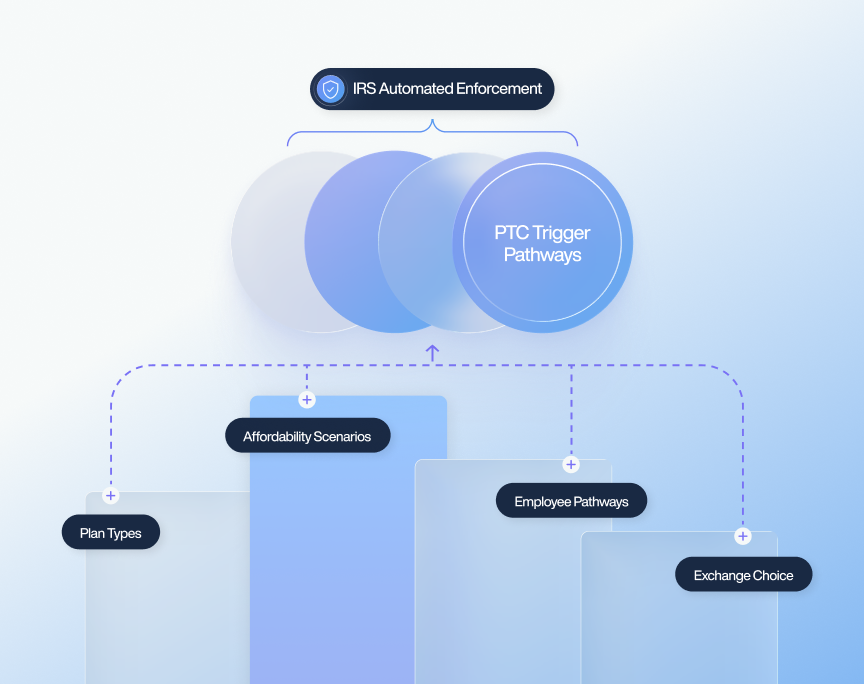
Employees who receive a PTC trigger an automated IRS Letter 226J audit, causing ALEs to reconcile against their Form 1095-C data. Reactive year-end reporting cannot validate every new plan code combination against the IRS AIRS System in time to prevent automated Letter 226J assessments.
Trusaic’s ACA Complete® integrates fragmented payroll, HR, and benefits systems into a unified record to validate every plan code combination before data transmission. This ensures audit-ready federal and state filings while arming your organization with the dedicated defense needed to instantly address proposed IRS assessments.