















This is the fourth blog of our EU Directive in Practice series. Access the full series on our Pay Equity Deep Dive page.
Most of the organizations we work with that have employees in the EU are currently focused on a single aspect of the EU Pay Transparency Directive: the Right to Information (RTI) requirement.
Under the RTI, workers have the right to information on their pay level and the average pay of those in the same worker category, broken down by gender. According to the Directive, the RTI must be transposed and go into effect on June 7, 2026, so this focus is certainly warranted. While it remains to be seen when it will go into effect for each member state, most of the organizations we work with are eager to ensure they are prepared to comply by June.
A key concern among organizations is that an RTI report will reveal to an individual worker that they are underpaid relative to their peers. To ensure that such differences are justified, many are conducting a pay equity analysis to identify and remediate unjustified pay differences before the RTI takes effect. A question that naturally arises is how best to do this.
Purpose of a Pay Equity Analysis
The primary purpose of a pay equity analysis is to determine whether there are systemic differences in pay based on gender (and other demographic characteristics), after accounting for objective, compensable Wage Influencing Factors (WIFs), such as job level, time with the organization, time in role, prior experience, performance, etc. Please see our earlier blog for additional detail.
The methodology at the heart of a pay equity analysis is multiple regression. This method allows for the (1) simultaneous control of multiple objective WIFs that affect pay, (2) estimation of the independent effect of each factor on pay, and (3) identification of pay differences associated with demographic characteristics (e.g., gender). This approach is consistent with methodologies accepted by courts, regulators, and economists.
Here is what a typical multiple regression model looks like:
Natural Log (Pay) = Function (Gender+Level+Tenure+Time in Role+Prior Experience+Performance)
Each WIF included in the model is assigned a coefficient (“factor weight”). These weights are not chosen manually; they are derived empirically from observed pay data and reflect an organization’s actual pay practices, rather than an organization’s stated policies or guidelines. These factor weights reveal what an organization values and rewards. See our blog on this topic for more information.
Note About Natural Log of Pay
It’s standard practice in a pay equity analysis to analyze the natural log of pay rather than raw pay. There are a few reasons for this:
- It reduces data skewness because pay data is usually right skewed, with a small number of very high earners affecting the distribution.
- It mitigates the influence of outliers such that the model better reflects the broader employee population.
- It aligns with regulatory and academic standards, strengthening the defensibility of the methodology.
- It better reflects how pay decisions are made by converting differences into relative percentage terms (i.e., percentage differences), which aligns with real-world pay-setting practices.
Systemic Pay Disparities
To identify systemic pay disparities for demographic characteristics included in the multiple regression analysis (e.g., gender), we evaluate whether the pay gap is statistically significant (i.e., whether the observed pay difference is unlikely to be due to chance) and whether the pay gap is practically significant (i.e., whether the size of the observed pay gap is practically meaningful and large enough to be of concern). Both statistical and practical significance are evaluated to determine whether further action is warranted.
As an illustrative example, in the box below are the regression results for an organization with two workforce segments: Individual Contributors and Management/Supervisory. The objective, compensable WIFs included in the analysis are Career Level, Organizational Tenure, Compensation Geographic Zone, and Prior Experience (using a proxy based on age at hire minus 18). For context, there are 295 employees in the Individual Contributor group (106 women/189 men) and 175 employees in the Management/Supervisory group (22 women/153 men).

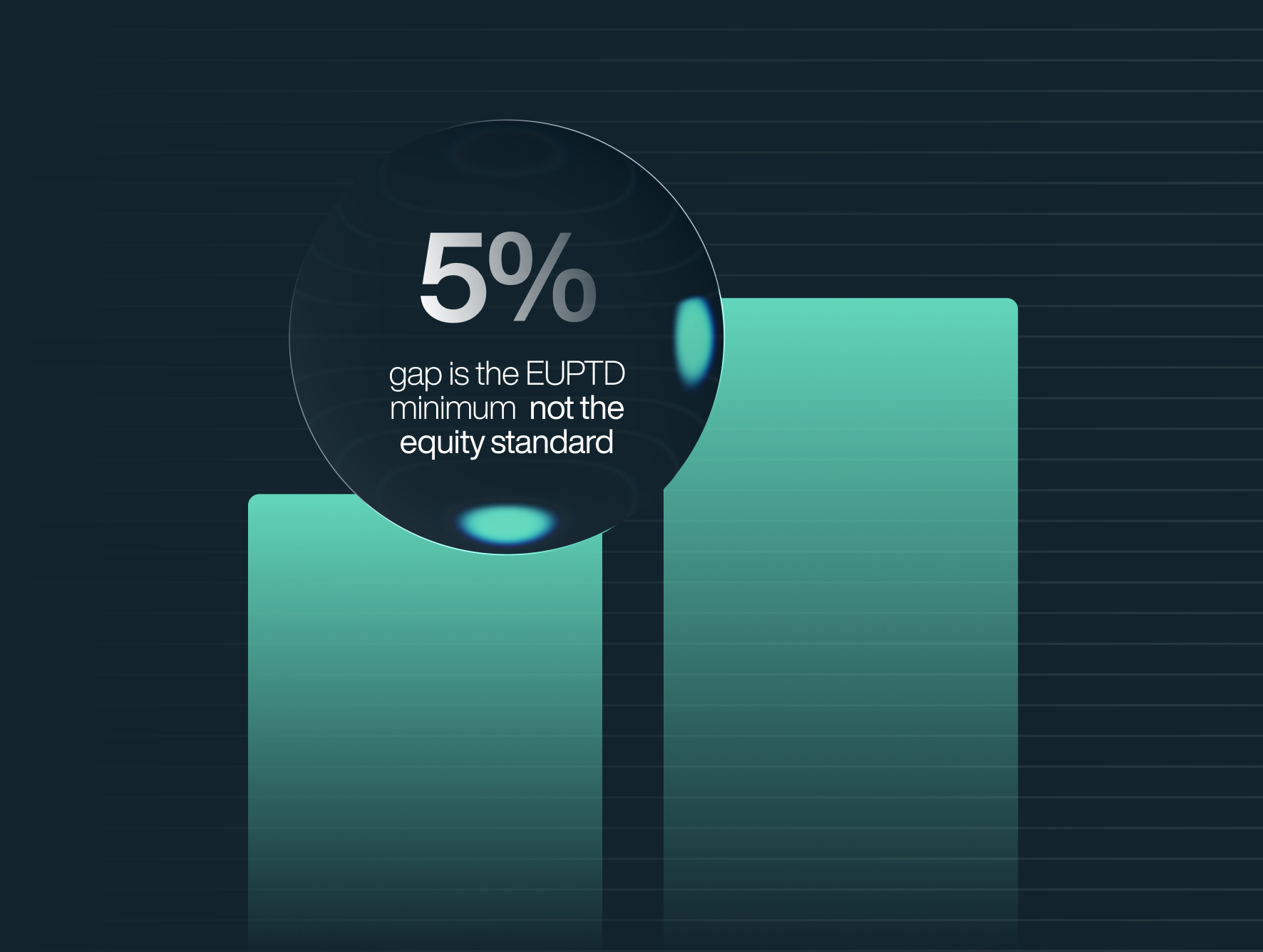
The multiple regression results show a 5% pay disparity against women in the Individual Contributor segment and a 1% pay disparity against women in the Management/Supervisory segment. You may see these pay disparities referred to as the unexplained pay gap, the adjusted pay gap, or the unjustified pay gap.
The 5% pay disparity in the Individual Contributor segment is statistically significant at the 5% level, which indicates that there is a 5% chance or less that the pay disparity we’re seeing is due to chance. A 5% significance level does not refer to the size of the pay disparity. It tells us whether the pay disparity we’ve identified, which could be of any magnitude, is statistically meaningful and unlikely to be due to chance. The 1% pay disparity in the Management/Supervisory segment is not statistically significant at the 5% significance level. For deeper insights into detecting pay disparities, please see our blog.
Predicted Pay
A by-product of running a pay equity analysis is that the regression model can be used to generate a predicted (expected) pay value for each employee included in the analysis. This predicted pay represents the expected level of pay for an employee given their specific characteristics as defined by the objective, compensable WIFs included in the analysis. The predicted pay value is neutral to an individual’s demographic characteristics, such that two people with the same characteristics will have the same predicted pay, regardless of their gender.
Here’s how it works (conceptually):
Predicted Pay = Base Value+(Career Level weight×1)
+ (Tenure weight×Years of Tenure)+(Geo Zone weight×1)
+(Prior Experience weight×Years of Prior Experience)
For categorical factors (e.g., Career Level), the factor weight is multiplied by one. For numeric factors, the weight is multiplied by the relevant number (e.g., years of tenure).
Predicted pay provides a standardized benchmark to assess whether individuals are compensated consistently relative to peers performing comparable work.
Remediation
Continuing with our illustrative example above, let’s assume that because the 5% pay disparity in the Individual Contributor segment is both statistically significant and practically meaningful, we decide to implement a remediation plan. There are a variety of different remediation options to consider. We’ll cover two key ones here.
Option 1: Directly Address the Pay Disparity
One option is to employ a remediation strategy that most directly addresses the 5% pay disparity. This approach involves giving the same percentage pay adjustment to all women in the Individual Contributor group. Note that under this approach all women in the group, even those whose actual pay exceeds their predicted pay, would be eligible for an adjustment.
Let’s assume that the objective of the remediation is to reduce the pay disparity to the point where it is no longer statistically significant at the 5% significance level and ensure the magnitude of the pay disparity is below 1%. The remediation cost under this approach is roughly €380K, with an average adjustment of €3,600 allocated to 106 women.
Option 2: Address Those Whose Pay Is Less Than Predicted
Another option is to allocate pay adjustments to those whose actual pay falls below their predicted pay, independent of gender. Assuming each employee is brought up to their prediction, remediation under this approach would cost roughly €1.2M, with an average adjustment of €6,700 allocated to 78 women and 102 men.
If you take this approach, it’s important to understand the implications for your pay disparity. If €1.2M is allocated to those who are underpaid relative to prediction, the resulting pay disparity will be 3% and this is statistically significant at the 5% significance level. The pay disparity does not fall as much as it does in Option 1 because both women and men are receiving adjustments. Giving adjustments to men in a group where women are systematically underpaid runs counter to addressing the gender-based pay disparity.
Implications
Directly addressing a pay disparity as outlined in Option 1 is the foundation of a pay equity analysis. As noted earlier, the primary purpose of a pay equity analysis is to identify and remediate pay disparities based on demographic characteristics, such as gender. Option 2 is less about pay equity and more about pay alignment — i.e., ensuring people are paid in alignment with their predicted pay. While both are relevant, it’s important to understand the difference between the two and the implications for the EUPTD.
Purely from an RTI standpoint, taking a pay alignment approach might seem like the more reasonable approach since this will help to ensure that people are paid in alignment with the objective, neutral WIFs that drive pay in your organization.
On the other hand, the EUPTD also requires reporting, at least for organizations meeting reporting thresholds. Employers will be reporting raw gender pay gaps — measured by the difference in average pay between female and male workers — by categories of workers performing the same work or work of equal value.
Under the Directive, employers will need to justify pay differences using objective, gender-neutral factors and remediate pay differences that cannot be justified (Article 9(10)). In addition, pay differences exceeding 5% that have not been justified or remediated within six months of reporting will require a Joint Pay Assessment (Article 10). Thus, purely from a reporting standpoint, taking a pay equity approach might seem like the more reasonable approach since it will help to ensure that there are no unjustified pay differences between women and men.
For organizations that need to comply with both the RTI and reporting requirements, should you focus on pay equity or pay alignment?
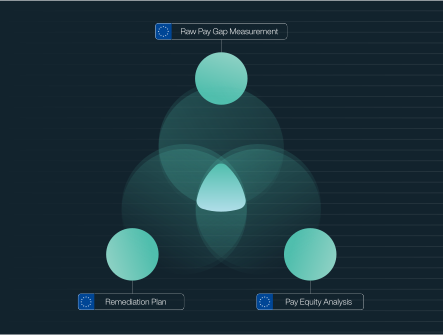
The EUPTD makes it clear that unjustified pay differences between men and women within categories of workers performing the same work or work of equal value need to be rectified, suggesting that pay equity should be your primary focus. That said, while pay adjustments based on a pay equity analysis will reduce reported pay gaps, they are not a safeguard against individual equal pay claims. Individual employees may still fall below their predicted pay levels, which remains a point of potential legal exposure for an organization, highlighting the importance of driving for pay alignment over time.
How Trusaic Can Help
At Trusaic, we provide employers across the EU with solutions to comply confidently with the Directive.
Our Complete EU Pay Transparency Solution enables compliant pay systems, ensures gender-neutral job evaluations, and automates complex reporting obligations to keep you one step ahead of EU pay transparency enforcement.
- PayParity® analyzes your rewards data (compensation/benefits in kind) and quickly identifies any potential unjustified inequities. It enables you to more easily comply with Article 7 (right to information) and Article 6 requirements (pay setting and progression policy).
- Our Remediation Optimization Spend Analysis (R.O.S.A.) works as PayParity’s remediation engine to find the most cost-effective way to close nominal pay gaps to ensure compliance.
- Automated RTI workflows: Our bi-directional integrations with global HCM platforms allow pay equity data to flow securely from the Trusaic platform back into the HCM. Employees can then access their RTI reports directly within their existing HR systems. This eliminates manual report generation and reduces compliance risk.
- For organizations that prefer platform-based access, RTI reports can also be generated and delivered securely through the PayParity platform, with role-based permissions and full auditability.
- Salary Range Finder® ensures equitable pay at the point of hire to prevent any increases in pay gap and enables you to easily comply with the Directive’s salary range disclosure and salary history ban requirements.
- Pay Decisions: Generate fair, competitive offers instantly from Workday.
- Regulatory and Pay Transparency Reporting™ captures your pay equity findings and generates compliant reports.
Trusaic is GDPR compliant and can assist any organization in any EU state in meeting its obligations under both the EU Corporate Sustainability Reporting Directive and the EU Pay Transparency Directive.
Visit our always updated Member State Transposition Monitor to stay on top of the latest EU Pay Transparency Directive developments.