















This is the third blog of our EU Directive in Practice series. Access the first blog on pay equity and second blog on Article 7 Right to Information.
As discussed in an earlier blog, a key requirement of the EU Pay Transparency Directive (EUPTD) is that covered employers must report gender pay gaps — the difference in average pay between women and men — for each category of workers. These “worker categories” are groups performing the same work or work of equal value.
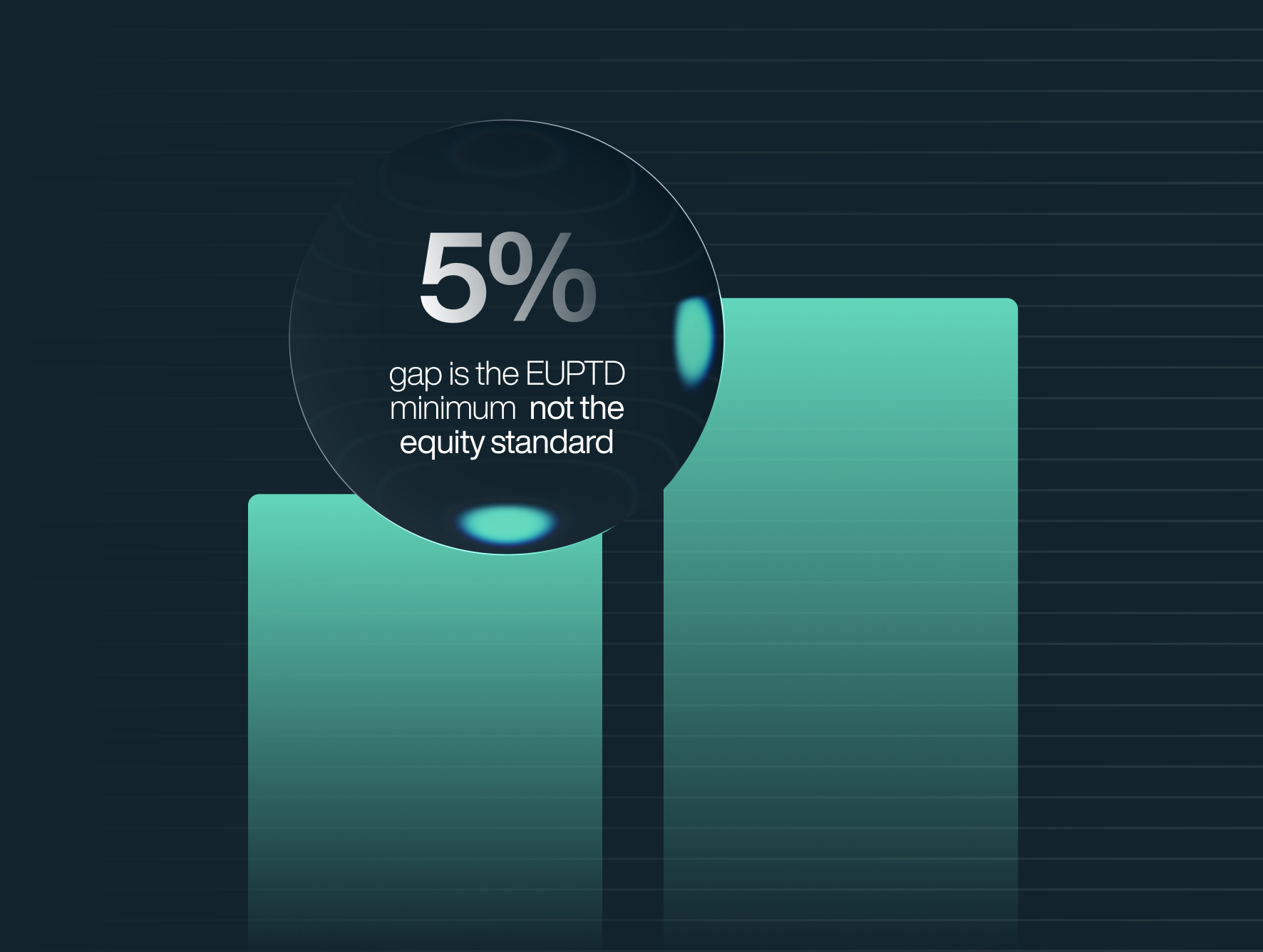
The directive identifies a 5% pay gap or greater as a trigger for a “joint pay assessment” that is to be carried out with workers’ representatives. A joint pay assessment involves the following:
- Analysis of the proportion of female and male workers in each category
- Information on average pay levels (base and variable) for female and male workers
- Differences in average pay between female and male workers within each category
- Identification of objective, gender-neutral reasons for any pay differences, agreed jointly
- Share of female and male workers receiving pay increases after returning from leave (maternity, paternity, parental, or carers)
- Actions to address unjustified pay differences
- An evaluation of the effectiveness of previous joint pay assessments
A joint pay assessment can be avoided if the employer can objectively explain pay differences based on objective, gender-neutral factors, or if unexplained pay differences above the 5% threshold are remediated within six months of submitting the gender pay gap report.
Access the first blog in the series for insights on how to evaluate pay gaps by worker category and addressing unexplained pay gaps exceeding the 5% threshold.
A 5% Pay Gap Is Not the End Goal
While it’s understandable that EU employers are focused on avoiding unjustified pay gaps above the 5% threshold, this should not be viewed as the finish line.
Ask yourself if you would be comfortable telling your workforce:
“We’ve conducted a thorough investigation of compensation between men and women and have ensured that women are paid at least 95% of what men earn for doing work of equal value.”
This message likely wouldn’t inspire confidence. Moreover, the directive itself acknowledges that the 5% rule is a minimum standard, allowing Member States, and by extension, organizations, to go further than the requirements in the directive.
A Better End-Goal
In working with Trusaic clients to prepare for the EUPTD, we encourage them to treat the 5% threshold as a floor, not a ceiling. To do this effectively, we distinguish between statistical significance and practical significance.
Statistical Significance
Traditionally, pay equity reviews rely on statistical significance to identify unjustified pay differences (or “pay disparities”). The statistical significance of a pay disparity is typically measured using a 5% significance level. This means that if there were truly no pay difference, there’s a 5% or smaller chance of observing a disparity this large (or larger) purely by random variation — in other words, the disparity is very unlikely to be due to chance.
Importantly, the 5% significance level doesn’t refer to the size of the disparity. It indicates how confident we can be that the observed pay disparity reflects a real underlying difference.
Practical Significance
Practical significance, by contrast, focuses on whether a pay disparity is large enough to matter in real-world terms, regardless of its statistical significance. The EUPTD’s 5% pay gap threshold is about practical significance. It implies that women should earn at least 95% of what men earn for work of equal value.
In practice, we recommend going beyond a 5% practical significance threshold for a few reasons.
- The EUPTD is using a 5% pay disparity as a legal trigger to compel action on the part of employers, not to signal that an employer is paying fairly.
- A 5% pay disparity does not demonstrate a strong commitment to pay equity.
- A 5% pay disparity may raise questions as to whether an employer is discriminating against women.
Options for Consideration
When helping organizations define their pay equity objectives, we recommend several approaches for their consideration:
- Statistical Significance Only — Ensure all pay disparities are no longer statistically significant at the 5% (or more conservatively, 10%) level.
- Practical Significance Only — Ensure all pay disparities are below a specified practical significance threshold, such as ensuring women are paid at least 99% of what men are paid.
- Covering All Bases — Address all statistically significant pay disparities and ensure all pay disparities are below a specified practical significance threshold.
- Hybrid — Select different remediation objectives for different employee groups. For example, focus on statistical significance in the U.S. and practical significance in Europe.
Final Thoughts
Even after eliminating unjustified pay differences, the overall gender pay gap may persist due to structural and societal factors.
Recall from an earlier blog that the gender pay gap consists of two parts. One part is the explained pay gap, which reflects the extent to which pay differs by demographic group due to differences in compensable factors such as occupation, career level, education, and experience.
The second part is the unexplained pay gap, which has been the focus of this blog article, and reflects pay disparities that are directly attributable to demographic factors, such as gender.
According to research by the European Parliament, the primary causes of the gender pay gap include:
- Part-time work — 28% of women in the EU work part-time vs. 8% of men (2022).
- Career breaks for caregiving responsibilities — One-third of employed women in the EU had a work interruption for childcare reasons, compared to 1.3% of men (2018).
- Working in a low-paying sector — Roughly 30% of women in the EU work in lower-paying sectors like education, health, and social work, compared to 8% of men.
- Low representation in manager roles — Women hold on average about 35% of managerial positions in the EU (2021). Moreover, female managers in the EU earn less than male managers.
Eliminating unjustified pay differences is a critical milestone, but achieving true pay equity requires addressing the broader structures that shape women’s career opportunities and earnings.