












ESRP assessments under IRC §4980H are issued to the Applicable Large Employer. Not to the AI-wrapped ACA compliance platform, not to the vendor who licensed it, not to the algorithm that generated the eligibility report.
In ACA enforcement, organizational accountability is non-delegable, and that principle doesn’t change because an AI-platform produced the filing.
How Is ACA Liability Different From Other Compliance Risk Executives Already Manage?
Most executives managing compliance risk across financial audits, SOX reporting, and legal sign-off understand a foundational principle: using a third-party platform or firm doesn’t transfer legal accountability to that vendor. The financial statement is still the company’s. The regulatory filing is still the company’s.
The same principle governs ACA, but it’s less consistently applied.
An AI-wrapped compliance platform that generates 1095-C forms doesn’t accept ESRP liability if those forms are wrong. A platform that calculates affordability thresholds doesn’t absorb a penalty assessment if the calculation is incorrect.
There’s a gap between what AI-driven compliance platforms market as capability (“end-to-end ACA management”) and what they actually transfer in terms of accountability. Filing a return on an employer’s behalf is a service.
Accepting responsibility for the accuracy of what’s in that return is a different commitment and most AI-wrapped platforms are not making it.
How Does the IRS Assign ACA Penalty Liability?
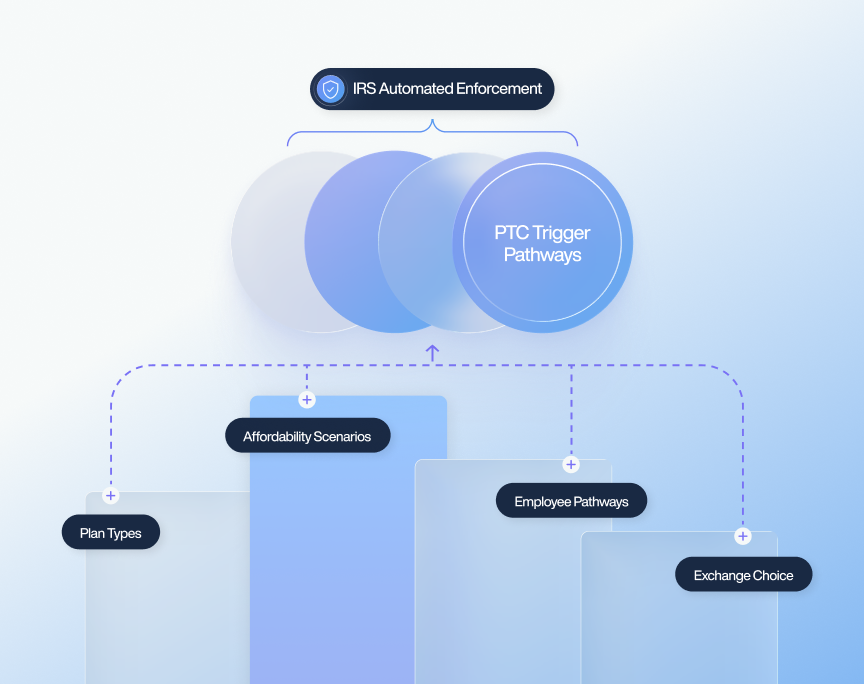
The IRS enforcement process runs through the IRS AIR System, which automatically cross-references employer Form 1094-C and 1095-C submissions against employee tax returns and exchange enrollment data.
When the system detects a discrepancy — a missing or miscoded form, a coverage offer that didn’t clear the affordability threshold, an employee who received a Premium Tax Credit (PTC) — it generates Letter 226J: a proposed Employer Shared Responsibility Payment (ESRP) addressed to the employer. However, enhanced PTCs expired January 1, 2026, reducing that trigger’s prevalence for the current plan year.
Penalties scale in two directions under §4980H:
- 4980H(a): If an ALE fails to offer Minimum Essential Coverage (MEC) to at least 95% of its full-time workforce and any employee receives a PTC, the penalty applies to the entire workforce minus the first 30 employees. At $3,780 per employee annually for 2027, a workforce of 500 generates a potential exposure of $1,776,600 from a single coverage gap.
- 4980H(b): If coverage is offered but fails the affordability or minimum value standard, the penalty applies per employee who receives a PTC — $5,670 annually for 2027.
The burden of proof in any dispute rests entirely with the employer.
The IRS doesn’t audit the platform that produced the filing. It audits what the employer certified. What the vendor’s system generated is not the IRS’s concern — what the employer submitted is.
What Does “Organizational Accountability” Mean When an AI-Wrapped Platform Gets It Wrong?
When an employer contests an ESRP assessment or responds to Letter 226J, the IRS expects specific documentation. Not a system-generated summary — a defensible audit trail:
- Measurement period documentation: Evidence that the Look-Back or Monthly Measurement Method was correctly applied to every employee flagged in the assessment
- Eligibility determination records: A documented rationale for each classification decision — not just the output of an automated calculation
- Affordability calculation methodology: Proof that the applicable safe harbor (W-2 Wage, Rate of Pay, or Federal Poverty Line) was correctly applied to the right employee, in the right plan year, using the right data
- Offer-of-coverage evidence: Documentation that a compliant offer was extended to each affected employee and their dependents
This is where the AI-wrapped platform gap becomes concrete. These platforms are built to produce outputs efficiently — eligibility reports, coded 1095-C forms, transmission receipts.
They are not built to maintain the determination-level audit trail the IRS requires when those outputs are contested.
When Letter 226J arrives, the employer needs to answer for decisions the platform made. If those decisions were never documented at the point of determination, reconstructing them within the 90-day response window is a significant operational problem.
The documentation standard the IRS applies in that window isn’t the platform’s problem to solve — it’s the employer’s. Which raises the question of which vendor model is actually structured to address it.
What Can Transfer Execution Accountability and What Can’t?
There’s a structural difference between a vendor who delivers a filing and a partner who owns what’s in it.
An AI-wrapped ACA compliance platform produces outputs. The methodology behind those outputs — how eligibility was determined, which safe harbor was selected, how measurement periods were configured — lives in the platform’s logic, not in a reviewable record the employer controls.
When the IRS asks for documentation, the employer is accountable for decisions the platform made using reasoning the employer may not be able to reconstruct or explain.
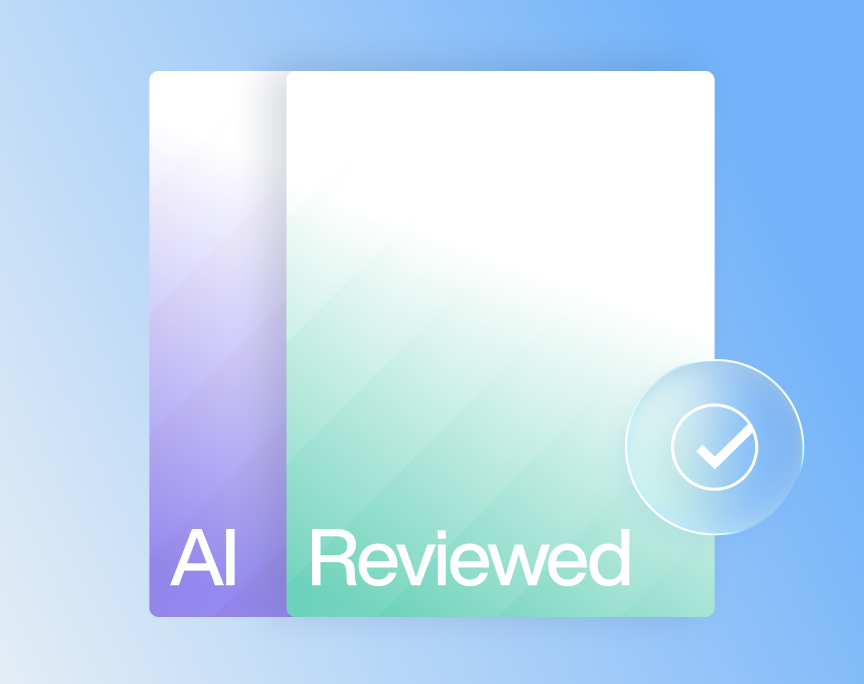
Execution accountability requires more than process automation. It requires humans who are accountable for the output — who reviewed the determination, documented the methodology, and can stand behind the result when the IRS asks.
That’s a function, not a feature. It’s not one an AI-wrapped platform can provide.
When ACA Liability Is Non-Delegable, the Audit Trail Has to Be Yours
The IRS assigns ESRP liability to the employer by statute — and that accountability doesn’t transfer to the platform that filed on their behalf. The question for executives isn’t whether the AI-wrapped platform looks capable. It’s whether anyone with documented accountability reviewed what it produced before the IRS did.
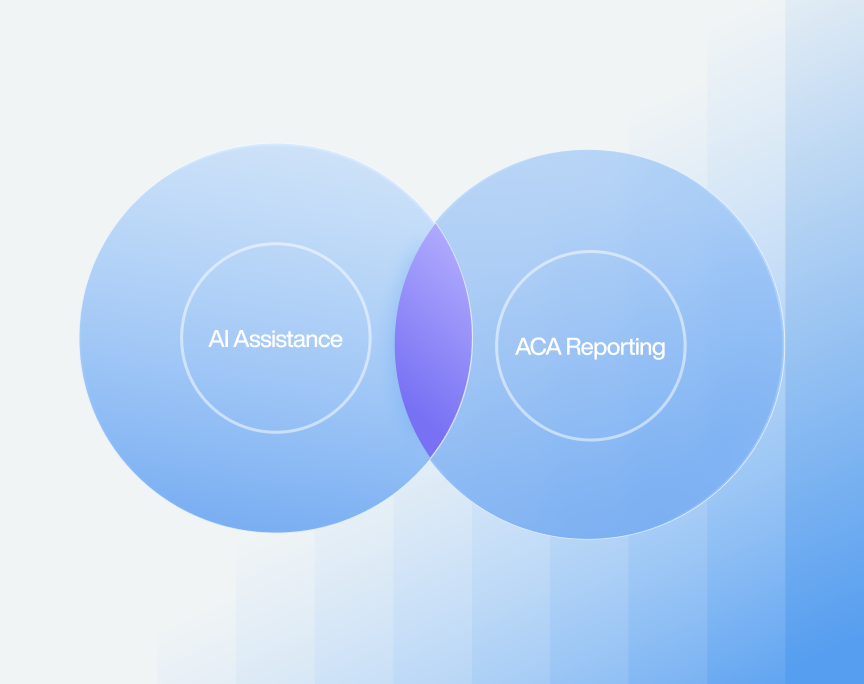
AI that augments human review — data validation, anomaly detection, eligibility flagging — strengthens the audit trail. AI that replaces it creates the documentation gap the IRS asks about.
ACA Complete® provides what an AI-wrapped filing platform cannot: human expert review at the determination level, a maintained audit trail, and defense that holds through an ESRP response. Liability is the employer’s by statute. The documented audit trail that defends it is the partner’s by design.