


















A logistics company can pass a federal worker classification review and still get hit with a state penalty for the same driver. If you reclassify one owner-operator fleet wide, it could result in a $3,780 ACA penalty per driver, per year; retroactive to every year the misclassification is covered.
That’s before a single state mandate even enters the picture. Trucking and supply chain employers are carrying two separate ACA risks right now, and solving one does not solve the other.
How Does Owner-Operator Reclassification Create ACA Liability?
Owner-operators are the backbone of the trucking industry. Most carriers rely on independent contractor agreements to keep fleets flexible and avoid the overhead of a full time employee roster. That structure works only as long as the classification holds up.
If a contractor is later reclassified as an employee, the ACA Employer Mandate applies retroactively. The employer owes a “failure to offer” penalty under IRC Section 4980H(a) for every month that the worker should have received a coverage offer and did not. For 2027, that penalty is $3,780 per year, or $315.00 per month, multiplied by the total full-time headcount minus 30.
It applies regardless of how many workers actually received a premium tax credit, and applies to every year the reclassification covers.
Reclassification across a large owner-operator fleet, spanning several tax years, can turn into a large liability fast.
Does the Department of Labor’s 2026 Proposal Reduce That Risk?
On Feb. 26, 2026, the Department of Labor proposed rescinding the 2024 independent contractor rule and restoring a two-factor economic reality test built around worker control and opportunity for profit or loss. If finalized, the rule would likely make federal contractor classification easier to satisfy.
That proposal addresses classification under the Fair Labor Standards Act only. It has no effect on California’s AB5 or the ABC tests other states use, which apply independently of federal law.
Trucking has already lost this fight at the state level. The Ninth Circuit ruled in 2021 that AB5 is not preempted by federal transportation law, the Supreme Court declined to review that ruling in 2022, and a California district court reaffirmed AB5’s enforceability against motor carriers in March 2024. Carriers should treat AB5 as settled, enforceable law in California, not a question a friendlier federal contractor test might still resolve.
What Do State Individual Mandates Require From Multi-State Carriers?
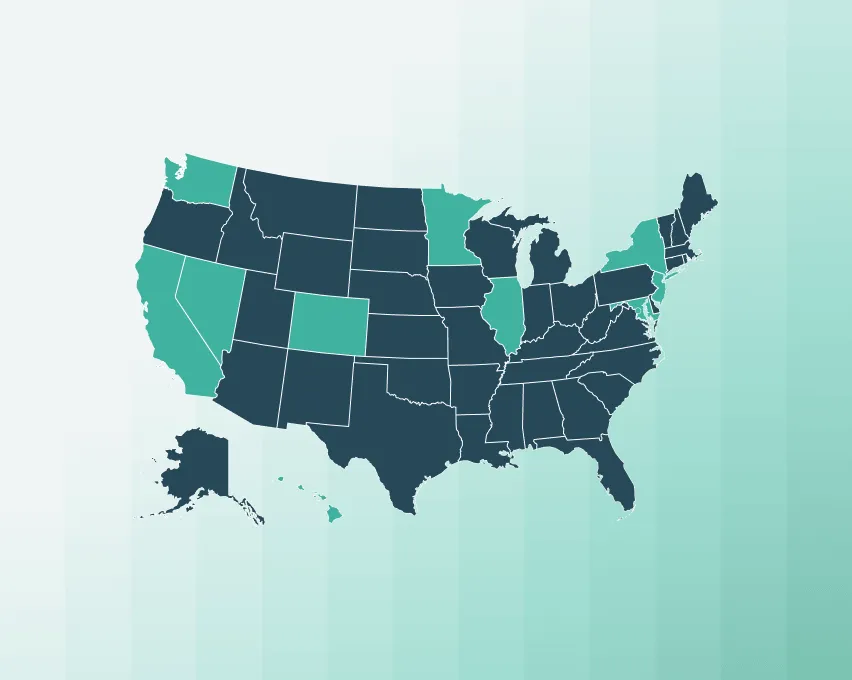
A driver based in Texas who reports to a California headquarters creates a compliance question that federal filing alone does not answer. California, New Jersey, Rhode Island, Massachusetts, and the District of Columbia each maintain their own individual mandate, and each requires separate health coverage reporting for residents.
These obligations follow the employee’s home address, not the location of the truck, the terminal, or the corporate office.
Massachusetts adds another complication. It relies on its own MA 1099-HC form rather than the state 1095-C process used by California, New Jersey, Rhode Island, and D.C. Carriers with Massachusetts-based drivers should confirm MA 1099-HC filing separately, since it falls outside the standard state 1095-C process.
Deadlines vary by state as well. Some states align with the federal March 31 filing date, while others set their own separate schedule, so a compliance calendar built around the IRS deadline alone will miss them. Auditing the driver roster by home zip code, not terminal or dispatch location, is what surfaces which drivers fall under a state mandate.
Two Compliance Questions, Two Different Answers
A driver’s classification and a driver’s home address answer two separate compliance questions. Neither one resolves the other. A federal contractor test will not satisfy California’s AB5. A correctly filed federal 1095-C will not satisfy individual state mandates.
Closing both gaps takes visibility into where drivers actually live and work, not just where the company is headquartered. A single carrier operating across five states shouldn’t need five separate compliance processes.
Trusaic’s ACA compliance solution consolidates classification tracking and mandate filing across California, New Jersey, Rhode Island, and D.C. into one system, built for carriers who can’t audit every driver’s home address by hand. If you operate in the trucking business, contact us today to see how we can help you navigate the various ACA compliance complexities you are likely to encounter.