















For executive leaders in retail, hospitality, and food service, managing the predictable surges of seasonal ramp-ups is a balancing act of workforce scheduling and data precision. Every new hire added to the floor during a holiday peak or spring dining expansion carries a compliance obligation under the ACA Employer Mandate — one that standard scheduling software is structurally unable to manage alone.
Expanding payrolls with part-time and variable-hour workers is operationally routine. The regulatory consequences of misclassifying those workers are not. For Applicable Large Employers (ALEs), a single data gap between scheduling and benefits platforms — combined with an incorrect box checked on Form 1094-C — can quietly convert the entire population of part-time seasonal hires into a multi-million-dollar Employer Shared Responsibility Payment.
Why Do Shifting Schedules Break Traditional ACA Measurement Frameworks?
To maintain compliance during peak operational seasons, ALEs with variable workforces should flawlessly deploy the Look-Back Measurement Method — a structured framework that tracks cumulative hours over a defined measurement period to determine whether a variable-hour employee qualifies for an offer of coverage.
The problem is that seasonal workforces are engineered to fluctuate, and standard systems may not be built to track the fluctuation in real time.
Three structural data gaps consistently drive compliance failures in high-volume industries:
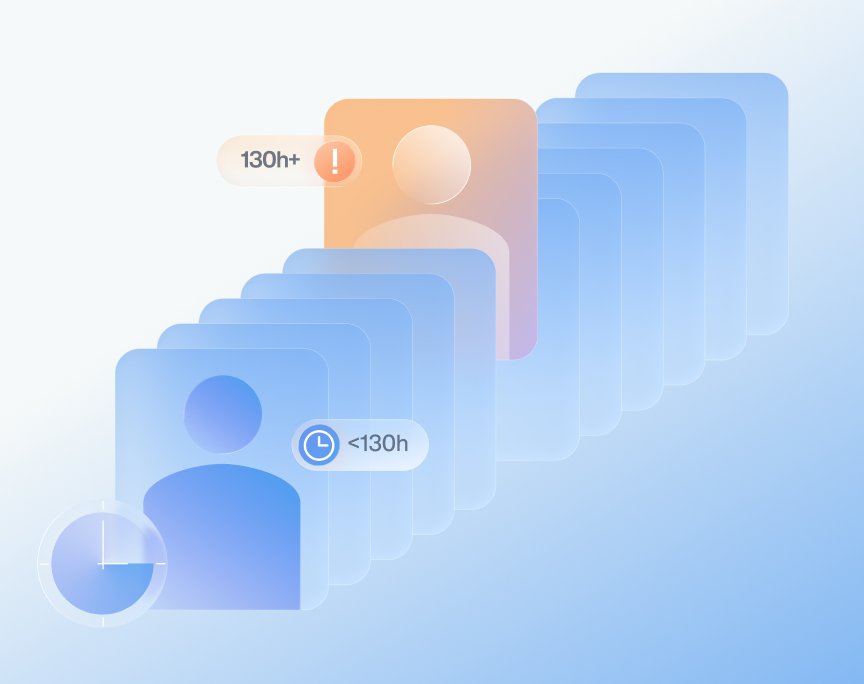
- Fluctuating staffing nodes: An employee working 15 hours during a slow week may spike to 45 hours during a holiday peak or vacation surge. Without continuous look-back tracking, that cumulative average crosses the 130-hour monthly threshold without triggering any compliance alert.
- Disconnected systems: Standard point-of-sale (POS) scheduling tools track shift hours. Disconnected benefits platforms do not. When these systems fail to communicate, there is no automated mechanism to flag when a worker’s cumulative hours alter their eligibility status during an active measurement period.
- Multi-location shifts: In retail chains and restaurant groups operating as an Aggregated Group, employees who share hours across entities (i.e. locations) distort standalone payroll records at each location. Neither facility registers the combined hours, and no coverage offer is generated — even when the employee qualifies as full-time in aggregate.
How One Seasonal Worker Can Trigger an Enterprise-Wide Penalty
The Scenario: A national hotel group expands its banquet and housekeeping staff in March ahead of spring tourism season. One worker, coded as part-time in the HRIS, averages 32 hours per week from March through August — well above the ACA’s 130-hour monthly threshold. Because the scheduling platform and the benefits administration system are not integrated, no eligibility flag is generated and no coverage offer is extended.
The Trigger: In the fall, that worker purchases insurance through the ACA exchange and claims a Premium Tax Credit (PTC). The PTC is reported by the Exchange and the worker to the IRS in their respective tax filings.
The Consequence: The IRS AIRS System performs an automated data-matching scan, cross-referencing the PTC claim against the employer’s Form 1095-C. The filing reflects no offer of coverage for an employee who crossed the full-time threshold.
Under Section 4980H(a), the penalty is not assessed against the one worker — it scales across the entire eligible workforce, minus the first 30 employees. For an ALE with 400 full-time employees, the automated Letter 226J proposes an 2026 annualized ESRP exceeding $1.2 million.
This is not an edge case. It is the direct consequence of data fragmentation in high-turnover, variable-hour industries.
How Does System Integration Eliminate Variable-Hour Scheduling Risk?
Siloed data across POS scheduling tools, payroll engines, and benefits platforms creates structural data gaps that no manual review process can reliably close at scale. The only methodology that catches moving measurement boundaries before year-end transmission is an integrated data stack that continuously reconciles scheduling, payroll, and benefits data into a single audit-ready compliance record.
For multi-location operators, employees sharing hours across an Aggregated Group must be tracked at the enterprise level. Without cross-entity data visibility, full-time status in aggregate remains invisible until the IRS finds it first.
A Proactive ACA Solution for High-Volume Employers
Navigating the shifting demands of peak hospitality and retail seasons requires sophisticated automation, not backward-looking spreadsheets. Trusaic’s ACA Complete® platform is purpose-built to eliminate the variable-hour data gaps that drive IRS penalty assessments in high-volume industries.
ACA Complete® provides:
- Continuous look-back calculations: Automated, rolling measurement period tracking for every variable-hour employee — updated throughout the year as hours fluctuate across peak and off-peak seasons.
- Pre-transmission validation: Systematic identification of Form 1094-C and 1095-C coding errors before data enters the IRS AIRS System, eliminating the risk of an automated filing rejection triggered by a data mismatch.
- Federal and state compliance: Comprehensive filing management for both federal IRS requirements and all applicable 1095-C state-level individual mandates, ensuring that employees in California, New Jersey, Rhode Island, and Washington D.C. are filed with separate filing agencies.
Seasonal hiring cycles are predictable. The ACA penalties they generate should not be.