














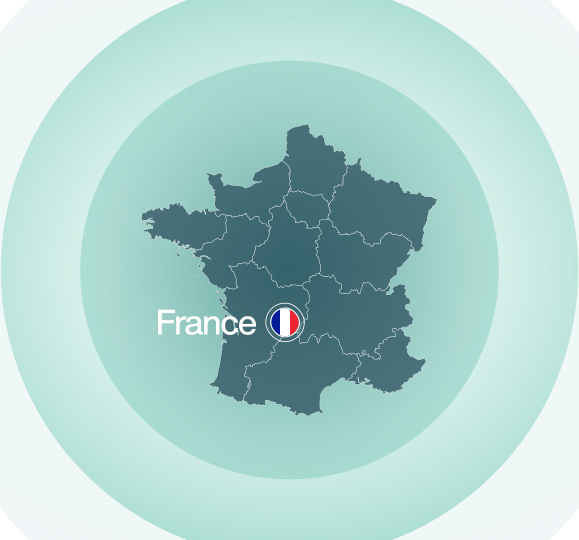
On 10 September 2026 France’s EU Pay Transparency Directive transposition bill was officially presented to the Council of Ministers. The same day, it was signed by the Prime Minister and deposited at the Senate as PJL n° 944, under accelerated parliamentary procedure (procédure accélérée), and referred to the Committee on Social Affairs (la commission des affaires sociales).
This advances the bill past the consultation stage and moves it into Parliament. Here’s what employers need to know about where France stands as it moves toward full transposition.
France Will Replace the Professional Equality Index
The bill confirms that France’s current Professional Equality Index will be replaced one year after promulgation by the seven indicators set out in the Directive.
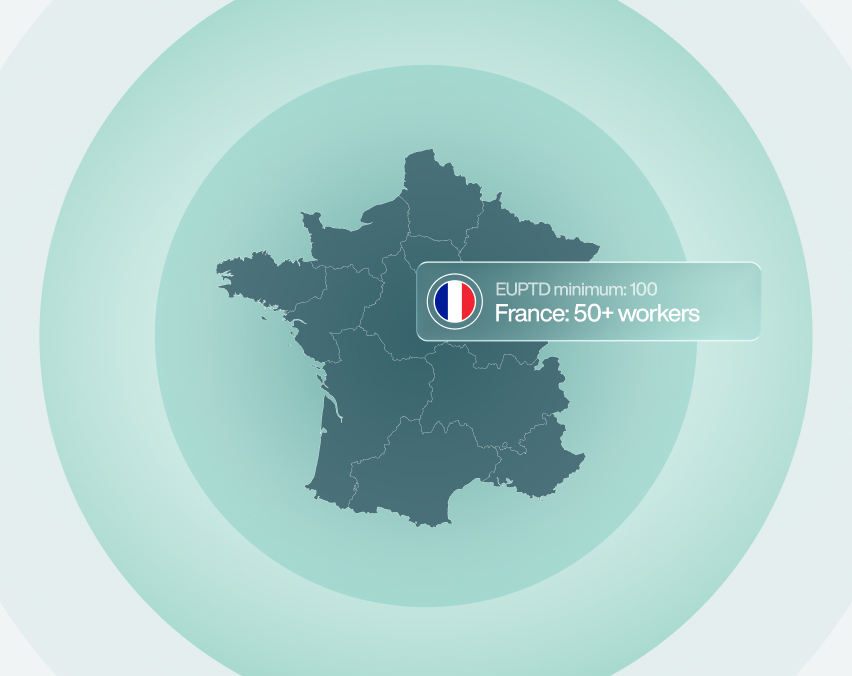
Reporting obligations apply to employers with 50 or more employees. The first six company-wide indicators will be automatically pre-calculated and published annually by the government, using data employers already file through the Déclaration Sociale Nominative (DSN). Only the seventh indicator, the pay gap by worker category, requires manual calculation and declaration by the employer, because it depends on the employer first defining categories of jobs of equal value. The seventh indicator must be transmitted to employees and to the social and economic committee (CSE), or only to CSE members bound by confidentiality obligations where privacy concerns are implicated.
Declaration frequency scales with company size. Employers of 50 to 249 employees declare the first six indicators annually and the seventh indicator every three years, while employers of 250 or more declare all seven indicators annually.
Special Provisions for Employers with 50 to 99 Employees
Smaller employers benefit from a lighter regime. They may negotiate an exemption from reporting the seventh indicator by collective agreement, and they are exempt from the joint pay assessment procedure.
Where corrective action is needed, it is taken through the ordinary mandatory negotiation on professional equality rather than a separate assessment.
Key Items Addressed in France’s Bill
Right to Information
Employees have the right to request their own pay level and the average pay levels, broken down by sex, of the employees in the same category, for the previous year. The government’s press kit provides an example of how an employer may respond to an RTI request, stating that an employer must respond with averages based on the previous calendar year (de l’année civile antérieure), although this reference period is not in the draft legislation itself. Employers must respond within two months.
Work of Equal Value
The bill broadens the existing Labour Code criteria for evaluating work of equal value. Beyond professional knowledge attested by a title, diploma, or professional practice, capacities derived from acquired experience, responsibilities, and physical or nervous load, the criteria now include technical skills, soft skills, and working conditions. The list is non-exhaustive.
Worker Categories
Each professional branch must open negotiations within six months of promulgation on a common categorization method. Ultimately, categories are to be negotiated at company level by collective agreement. Failing that, the employer may set them by unilateral decision after consulting the CSE. Each categorization is valid for a maximum of three years.
Initial Pay Transparency
Employers must include an initial pay range and the relevant collective-agreement provisions in all job postings. Where there is no posting, this information must be provided in writing to the candidate before or during the hiring interview.
Entry Into Force for the Private Sector
With limited exceptions, Title I of the bill, covering the private sector, will enter into force on a date set by decree and no later than one year after promulgation. The right to information takes effect once a collective agreement on worker categories is reached, or categories are set by unilateral employer decision, and at the latest on the date fixed by decree. Reporting on the first six indicators begins on a date set by decree, within one year of promulgation.
Declaration of the seventh indicator is phased in by workforce size, on dates set by decree:
- Employers with 150 or more employees: within one year of promulgation
- Employers with 100 to 149 employees: within three years of promulgation
- Employers with 50 to 99 employees: within six years of promulgation
What Comes Next?
Because the bill was filed under accelerated procedure, each chamber conducts a single reading, compressing the usual legislative timeline.
The Committee on Social Affairs will examine the bill first, ahead of debate in the Senate. No date has yet been set for its consideration.
With the Directive’s 7 June 2026 transposition deadline already passed, the pace of the Senate’s review will determine how soon these obligations take effect.
How Trusaic Can Help
At Trusaic, we provide employers across the EU with solutions to comply confidently with all of the components of the Directive.
Our Complete EU Pay Transparency Solution enables compliant pay systems, ensures gender-neutral job evaluations, and automates complex reporting obligations to keep you one step ahead of EU pay transparency enforcement.
- PayParity® analyzes your rewards data (compensation/benefits in kind) and quickly identifies any potential unjustified inequities. It enables you to more easily comply with Article 7 (right to information) and Article 6 requirements (pay setting and progression policy).
- Our Remediation Optimization Spend Analysis (R.O.S.A.) works as PayParity’s remediation engine to find the most cost-effective way to close nominal pay gaps to ensure compliance.
- Automated RTI workflows: Our bi-directional integrations with global HCM platforms allow pay equity data to flow securely from the Trusaic platform back into the HCM. Employees can then access their RTI reports directly within their existing HR systems. This eliminates manual report generation and reduces compliance risk.
- For organizations that prefer platform-based access, RTI reports can also be generated and delivered securely through the PayParity platform, with role-based permissions and full auditability.
- Salary Range Finder® ensures equitable pay at the point of hire to prevent any increases in pay gap and enables you to easily comply with the Directive’s salary range disclosure and salary history ban requirements.
- Pay Decisions: Generate fair, competitive offers instantly from Workday.
- Regulatory and Pay Transparency Reporting™ captures your pay equity findings and generates compliant reports.
Trusaic supports GDPR compliance and can assist any organization in any EU state in meeting its obligations under both the EU Corporate Sustainability Reporting Directive and the EU Pay Transparency Directive.
Visit our always updated Member State Transposition Monitor to stay on top of the latest EU Pay Transparency Directive developments.