











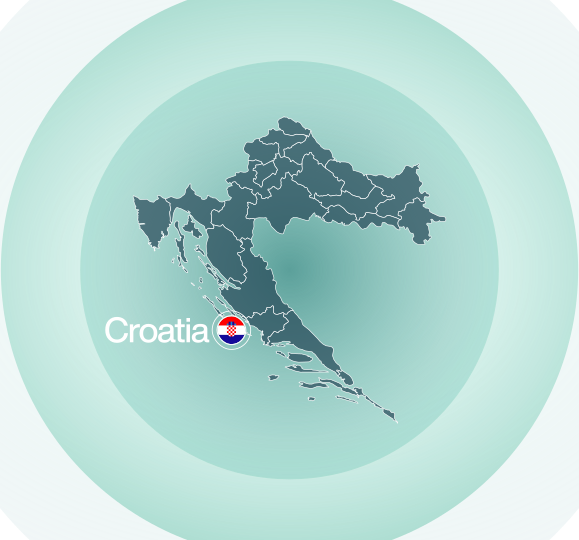
On 2 November 2026, Croatia’s Ministry of Labour, Pension System, Family and Social Policy opened a public consultation on a draft bill amending the Labour Act to transpose the EU Pay Transparency Directive (EUPTD). The draft bill is a broader legislative effort, which also harmonizes the Labour Act with 14 other European directives.
The consultation period closes on 2 December 2026, with a consultation report expected to be published by 2 January 2027.
What Does Croatia’s Draft Bill Propose?
Beyond equal pay for equal work principles and protections added elsewhere throughout the Labour Act, Article 23 of the draft bill adds an entirely new Chapter 17, Articles 139a through 139s, dedicated to “Pay Transparency and the Exercise of the Right to Equal Pay for Men and Women.” This dedicated chapter governs Croatia’s core EUPTD employer obligations, including pre-employment transparency, right to information (RTI), and a new national pay reporting system.
How Will Pre-Employment Pay Transparency Work for Job Applicants?
Under Article 139e, a job applicant will be entitled to request information on the amount of salary and the type of remuneration they would receive in the role. Employers must provide this information to applicants no later than before the job interview.
What Does the Right to Information Entail?
Article 139f sets out Croatia’s RTI framework, with several notable procedural details:
- In addition to information on the employee’s pay level and the average pay level of men and women who perform work of equal value, an employer must also provide information on the annual amount of receipts referred to in Art. 90a of the Labour Act and on the average annual amount of the receipts received by men and women in the category to which that worker belongs.
- Employers must respond to RTI requests within 60 days, with any additional explanation required where a response is incorrect or incomplete to be provided within 30 days of a request.
- Hourly pay calculations are to be reached by dividing an employee’s annual gross salary by their number of working hours in a particular calendar year.
- Requests may be made through the works council, a trade union commissioner, or an equality body, in addition to directly by the employee.
- Employers must provide annual reminders of the right to information no later than 31 May each year.
- Where requested by the employer, RTI information may only be used for the purpose of exercising the right to equal pay, though employers may also proactively provide this information without a request.
- Enterprises engaging temporary workers must provide the necessary information to temporary employment agencies so those agencies can respond to RTI requests on their behalf.
In regard to data protection, if an RTI response risks disclosing an identifiable employee’s pay, the employer must instead entrust that data, at the employee’s request, to the works council, trade union commissioner, or equality body. These bodies may advise the employee on exercising their right to equal pay, including judicial protection of that right, but may not disclose the salary level of an individual worker performing equal work or work of equal value.
How Will Croatia’s National Salary Transparency System Work?
Articles 139g through 139j govern the reporting requirements and establish the National Salary Transparency System (NSTP), which will collect and process reported pay data to calculate pay gaps and prepare completed reports for each employer.
Data will be drawn primarily from Croatia’s Centralized Payroll System, supplemented by direct submissions from employers who pay any part of employee compensation outside that system. Submitted data must include:
- Basic or contracted salary
- Information on allowances
- Information on other pay, except where that pay is determined the same way for all employees regardless of criteria
- Data on employment-based receipts, excluding reimbursements incurred due to employment
Employers must submit this data to the NSTP and verify its accuracy no later than their final data submission for the calendar year, with submissions due by 7 June for the prior calendar year. The Ministry must prescribe the procedure for collecting and processing this data through an implementing ordinance within six months of the Act’s entry into force.
The NSTP will prepare completed reports for each employer and the Financial Agency will notify the employer that the report has been prepared, after which the employer must download the report within 15 days. The report will cover the seven reporting metrics under Article 9 of the Directive, as well as the following metrics related to employment-based receipts: (1) the gender gap in employment-based receipts, expressed as a percentage of the average amount of receipts of men; (2) the gender gap in receipts, expressed as a percentage of the median amount of receipts of men; (3) the proportion of men and women who received receipts; (4) the proportion of men and women in each receipts quartile band; and (5) the gender gap in receipts by categories of workers.
Employers must provide reasoned responses to questions from workers, the works council, the labour inspectorate, and equality body about their report within 30 days, and remediate any unjustified pay gaps within six months.
What Are the Entry Into Force and Transitional Timelines?
Under Articles 35 and 36 of the draft bill, the Act would enter into force eight days after publication. From there, employers face a layered set of transitional deadlines:
- Employers must align their internal employment rules with the Act’s provisions within four months of entry into force.
- Employers must offer employees an amendment to their employment contracts within five months of entry into force, to align contract terms with the new pay transparency requirements.
- Employers must provide RTI data on average pay levels for the relevant worker category no later than six months after entry into force. No such delay is applicable to individual pay levels.
- Reporting obligations take effect in 2028 for employers with 150 or more employees, with first reports due by 7 June 2028, and in 2031 for employers with 100 to 149 employees.
How Trusaic Can Help
At Trusaic, we provide employers across the EU with solutions to comply confidently with the Directive.
Our Complete EU Pay Transparency Solution enables compliant pay systems, ensures gender-neutral job evaluations, and automates complex reporting obligations to keep you one step ahead of EU pay transparency enforcement.
- PayParity® analyzes your rewards data (compensation/benefits in kind) and quickly identifies any potential unjustified inequities. It enables you to more easily comply with Article 7 (right to information) and Article 6 requirements (pay setting and progression policy).
- Our Remediation Optimization Spend Analysis (R.O.S.A.) works as PayParity’s remediation engine to find the most cost-effective way to close nominal pay gaps to ensure compliance.
- Automated RTI workflows: Our bi-directional integrations with global HCM platforms allow pay equity data to flow securely from the Trusaic platform back into the HCM. Employees can then access their RTI reports directly within their existing HR systems. This eliminates manual report generation and reduces compliance risk.
- For organizations that prefer platform-based access, RTI reports can also be generated and delivered securely through the PayParity platform, with role-based permissions and full auditability.
- Salary Range Finder® ensures equitable pay at the point of hire to prevent any increases in pay gap and enables you to easily comply with the Directive’s salary range disclosure and salary history ban requirements.
- Pay Decisions: Generate fair, competitive offers instantly from Workday.
- Regulatory and Pay Transparency Reporting™ captures your pay equity findings and generates compliant reports.
Trusaic supports GDPR compliance and can assist any organization in any EU state in meeting its obligations under both the EU Corporate Sustainability Reporting Directive and the EU Pay Transparency Directive.
Visit our always updated Member State Transposition Monitor to stay on top of the latest EU Pay Transparency Directive developments.
