












France has circulated draft legislation to transpose the EU Pay Transparency Directive into national law, shedding light on how it intends to align its existing pay transparency framework with the Directive’s transparency and reporting requirements.
On March 6, 2026, the French government sent the draft transposition to labor unions and lawmakers ahead of a consultation meeting scheduled for March 19. As of now, no date has been set for when Parliament will begin examining the bill.
The March 6 draft includes only provisions related to private-sector employers (Title One). A separate section addressing public-sector employers (Title Two) is still being finalized.
France already operates one of the EU’s most established pay transparency regimes through its Professional Gender Equality Index, which applies to companies with 50 or more employees. Under current law, employers must calculate and publish their Index annually by March 1.
The Index is composed of four or five indicators, depending on company size:
- The gender pay gap
- Differences in the distribution of individual salary increases
- Differences in promotion rates (only for companies with more than 250 employees)
- The number of employees receiving a raise after returning from maternity leave
- Gender parity among the company’s ten highest earners
Employers that fail to publish the Index, implement corrective measures, or demonstrate the effectiveness of those measures may face financial penalties of up to 1% of annual payroll. The same potential penalties remain under the revised compliance framework.
France’s draft transposition leverages this existing framework while incorporating the Directive’s broader pay transparency requirements.
Salary Ranges Required in Job Postings
Going beyond the minimum requirements of the Directive’s pre-employment transparency provisions, the draft legislation requires employers to include salary ranges in job postings. In the absence of a job posting, employers must provide this information in writing before or during a recruitment interview.
This requirement is designed to ensure that job candidates have access to pay information before entering employment discussions, helping prevent gender-based pay disparities from emerging during the hiring process.
Employers will need to ensure that salary ranges in job advertisements align with objective, gender-neutral pay-setting policies and internal compensation structures.
Reporting Threshold Maintained at 50 Employees
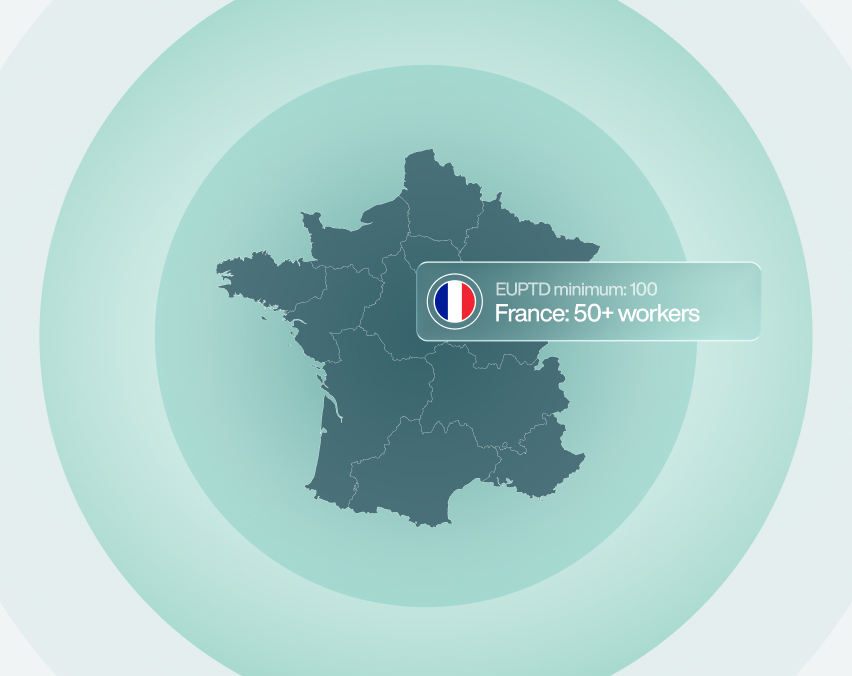
A notable element of France’s proposal is that it maintains the country’s existing 50-employee threshold for pay reporting, which is lower than the Directive’s minimum threshold of 100 employees.
Under the draft legislation, companies with at least 50 employees will be required to report seven gender equality indicators. While the draft states that indicators will be made public on the Ministry of Labour’s website, these can be expected to align with the Directive’s seven required reporting elements.
Employers with 50–99 Employees
While employers with 50 to 99 employees will be subject to the new reporting requirements, their compliance framework differs in certain respects from larger employers.
Key provisions include:
- Reporting the seven pay equality indicators
- Collective agreements may override the requirement to report gender pay gaps by worker category
- Employers must take corrective actions under existing mechanisms if pay gaps exceed a threshold defined by future decree
Additionally, companies with 50 to 249 employees will be required to report pay gaps by worker category every three years, while larger companies must report these metrics annually. The remaining indicators will need to be reported annually.
Employers with 100 or More Employees
For companies with 100 or more employees, the draft legislation introduces additional transparency and governance requirements.
Employees, the Social and Economic Committee (CSE), and trade union representatives will have the right to request clarification on reported indicators, including detailed explanations of gender pay gaps by worker category.
The CSE must also be consulted and provide an opinion to the administrative authority on:
- The justification for pay gaps exceeding thresholds set by decree
- Whether remediation measures have successfully addressed those gaps within six months
These provisions reflect France’s emphasis on worker representation in workplace governance.
Role of Social and Economic Committees (CSEs)
The draft legislation gives Social and Economic Committees (CSEs) a broader role than the Directive’s minimum requirements.
In addition to consultation rights, depending on the size of the employer and the size of reported pay gaps, the CSE’s formal opinion on pay gap reporting and remediation efforts must be filed with the administrative authority alongside the employer’s reporting submissions. A few key areas the CSE must be consulted on:
- Data used for calculation in reporting, methodology, and results of each of the seven required indicators. (50 employees or more) The CSE’s opinion must be provided to the administrative authority. (100 employees or more)
- Where gender pay gap by worker category exceeds a percentage defined by decree, the employer, within a reasonable time, must initiate negotiation on professional equality under Art. L. 2242-1 to reduce the gap. In the absence of agreement, measures shall be determined through an action plan under Art. L. 2242-3. (50-99 employees)
- Employees, the social and economic committee, or the company’s union representatives may request clarification and justification from the employer regarding gender pay gaps by worker category. The employer must provide a reasoned response. (Art. 1142-8-1) (100 employees or more)
- The employer must consult the CSE on the justifications for reported pay gaps where at least one pay gap is above a percentage set by decree. The opinion of CSE must be transmitted to administrative authority. (Art. L. 1142-8-3)
- Where an entire gap cannot be justified, the employer has six months to remedy by collective agreement or by unilateral decision on appropriate and relevant corrective measures. (Art. L. 1142-8-4)
- Once these remedial measures have been applied, the employer must again report the pay gap indicator within six months of first report, after consulting with CSE on the accuracy of the data and the justifications of the pay gaps. The CSE opinion must be transmitted to administrative authority. (Art. L. 1142-8-5)
This requirement reinforces the involvement of employee representation bodies in evaluating pay equity outcomes and proposed corrective measures.
Worker Categories and Equal Value of Work
The Directive requires employers to categorize employees performing work of equal value for pay transparency analysis.
France’s draft legislation establishes the following hierarchy for determining worker categories:
- Worker categories may be defined by company-level collective agreements
- If no company agreement exists, industry-wide agreements apply
- If neither exists, employers may determine categories unilaterally, but only after consulting the CSE
Regardless of the approach used, worker categorization must comply with the Directive’s principles for objective and gender-neutral evaluation of work of equal value.
Joint Pay Assessments
The Directive requires employers to conduct Joint Pay Assessments (JPA) when a gender pay gap in a worker category is 5% or higher and cannot be justified or remediated within six months.
Under France’s draft legislation:
- Threshold to be set by decree
- The specific timetable and content of a JPA will be defined in a future decree
- JPAs must be filed with the administrative authority within 12 months of the report that triggered the assessment
- The assessment must also be made available to employees, the CSE, and trade union representatives
Once completed, a JPA will remain valid for three years. For employers with 250 or more employees, this means the JPA would typically cover two reporting cycles following the report that triggered the requirement.
During this period:
- Employers must still submit updated reports annually
- Updated reports must still be provided to the CSE
Reporting Frequency and Indicators
France’s draft legislation also clarifies how reporting obligations will evolve under the Directive framework.
- The first six indicators must be reported annually
- Pay gaps by worker category must be reported every three years for companies with 50–249 employees
- Companies with 250 or more employees must report that indicator annually
Several technical details related to reporting remain unresolved and will be clarified through future decrees.
Additional Requirements to Be Defined by Decree
France defers a number of implementation details to future decrees, including:
- The pay gap thresholds that will trigger additional mandatory employer corrective actions
- Confidentiality thresholds tied to worker category sizes
- Detailed requirements for Joint Pay Assessments
It also remains unclear whether the government will authorize the automatic calculation of certain indicators using data submitted through France’s Déclaration Sociale Nominative (DSN) payroll reporting system, as had previously been expected.
Preparing for France’s Implementation of the Directive
France’s draft legislation shows how Member States with existing pay transparency regimes are adapting those systems to comply with the Directive while maintaining national labor governance structures.
For employers operating in France, the proposed rules highlight several priorities:
- Salary range transparency in job postings
- Continued pay reporting starting at 50 employees
- Increased involvement of employee representation bodies such as the CSE
- Structured remediation requirements when pay gaps exceed defined thresholds
Organizations with French workforces should begin reviewing their pay transparency practices now to prepare for the Directive’s broader implementation across the EU.
How Trusaic Can Help
At Trusaic, we provide employers across the EU with solutions to comply confidently with the directive.
Our Complete EU Pay Transparency Solution enables compliant pay systems, ensures gender-neutral job evaluations, and automates complex reporting obligations to keep you one step ahead of EU pay transparency enforcement.
- PayParity® analyzes your rewards data (compensation/benefits in kind) and quickly identifies any potential unjustified inequities. It enables you to more easily comply with Article 7 (right to information) and Article 6 requirements (pay setting and progression policy).
- Our Remediation Optimization Spend Agent (R.O.S.A.) works as PayParity’s remediation engine to find the most cost-effective way to close nominal pay gaps to ensure compliance.
- Automated RTI workflows: Our bi-directional integrations with global HCM platforms allow pay equity data to flow securely from the Trusaic platform back into the HCM. Employees can then access their RTI reports directly within their existing HR systems. This eliminates manual report generation and reduces compliance risk.
- For organizations that prefer platform-based access, RTI reports can also be generated and delivered securely through the PayParity platform, with role-based permissions and full auditability.
- Salary Range Finder® ensures equitable pay at the point of hire to prevent any increases in pay gap and enables you to easily comply with the Directive’s salary range disclosure and salary history ban requirements.
- Pay Decisions: Generate fair, competitive offers instantly from Workday.
- Regulatory and Pay Transparency Reporting™ captures your pay equity findings and generates compliant reports.
Trusaic is GDPR compliant and can assist any organization in any EU state in meeting its obligations under both the EU Corporate Sustainability Reporting Directive and the EU Pay Transparency Directive.
Visit our always updated Member State Transposition Monitor to stay on top of the latest EU Pay Transparency Directive developments.