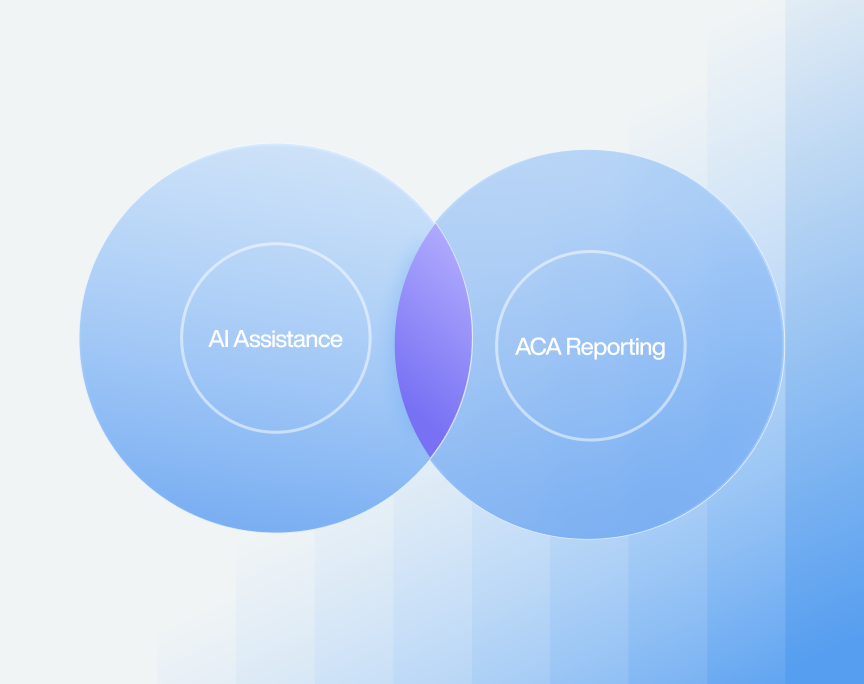














The IRS issued its first formal AI guidance on June 24, 2026, and it draws a distinction most employers have not made: automating ACA filings through an AI-powered platform is not the same as managing ACA compliance.
For enterprise organizations, AI-driven systems are already embedded in eligibility tracking, affordability calculations, and benefits workflows. The question isn’t whether those systems are sophisticated. It’s whether they produce outputs the IRS can ask a question about and get a defensible answer.
What Does an AI Hallucination Look Like in ACA Compliance Data?
“Hallucination” is an AI industry term for a confident but incorrect output. In ACA compliance, these errors show up in places that look like clean data.
When an AI-wrapped compliance platform makes a flawed determination, the errors rarely announce themselves:
- A variable-hour employee classified as ineligible based on incomplete data aggregation.
- An affordability calculation that misapplies the W-2 Wage Safe Harbor — applying prior-year Box 1 wages when the safe harbor requires current-year data.
- A Form 1095-C coded with a Line 14 indicator that doesn’t match the underlying offer documentation.
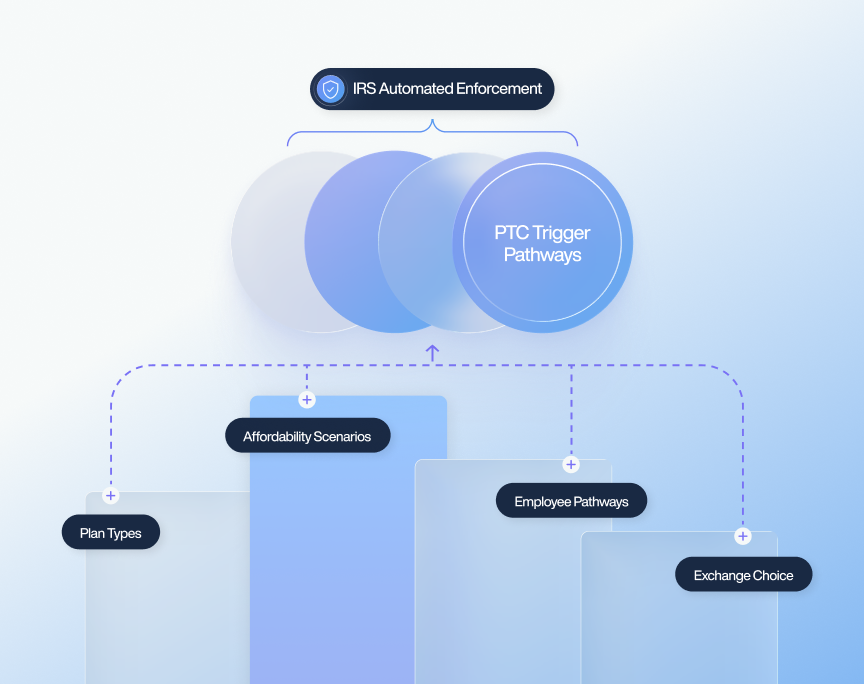
The IRS AIR System catches these discrepancies through automated data-matching. It cross-references your 1095-C submissions against Premium Tax Credit (PTC) records, exchange enrollment data, and prior-year filings.
When the data doesn’t align, Letter 226J follows. At that point, the employer carries the full burden of explaining and defending every determination that produced the error and “the platform generated it” is not a response the IRS accepts.
Is Your ACA Platform Operating Without Human Review?
In practice, FTE calculations, measurement period tracking, eligibility determinations, and safe harbor selection could surface as, “the platform’s recommendation,” with no indication of whether a qualified reviewer was in that workflow at all.
Here’s where that gap frequently appears:
- Measurement period tracking: No documented confirmation that underlying hours records were validated before the AI-generated eligibility determination was applied.
- FTE and ALE determination: No interpretive sign-off on aggregation logic across multiple EINs or controlled groups — only an automated output.
- Safe harbor selection: No recorded rationale for which safe harbor method was selected at the determination level, or why.
- Form 1095-C line code assignment: No reviewed compliance determination in the record — only a calculation output that became the filed code.
What Does the IRS’s New Standard Require From Employers?
The OPR Alert 2026-19 issued June 24, 2026 didn’t create new rules.
It confirmed that existing Circular 230 standards — the regulatory framework governing professional conduct before the IRS — already apply to AI-generated work.
The implication is direct: “blind reliance on AI may constitute unreasonable reliance” under Circular 230. AI-produced outputs must be reviewed, verified, and defensible before they reach the IRS.
For ACA specifically, that accountability obligation belongs to the employer — not the AI-wrapped platform, not the vendor. The IRS doesn’t audit the service; it audits the filing.
A documented chain of human review must exist between what an AI-driven system generates and what gets submitted to the IRS AIR System. Someone in the organization has to own it.
What Questions Should Executives Be Asking Their ACA Vendors Right Now?
This is a governance question, not a technical one. Four questions that belong at the leadership level:
- Does our ACA platform use AI in eligibility determinations and where does automated logic end and human review begin?
- If your vendor cannot describe that boundary with specificity, a documented human review layer likely isn’t part of the process.
- If we received a Letter 226J today, could our vendor produce the documented methodology behind every eligibility determination?
- If the answer describes what the system generated rather than what a reviewer confirmed, the platform files — it doesn’t defend.
- What is our vendor certifying when they submit our 1095-C filings — that the data was transmitted accurately, or that every determination behind it is defensible?
- Transmission confirmation and compliance accountability are not the same commitment — most platforms can document the former; few can stand behind the latter.
- Is there a verification layer built into our process or is the IRS AIR System the first review by default?
- If pre-transmission validation isn’t described as a structural step, the IRS AIR System is likely performing the first review.
What AI Filing Platforms Don’t Provide in an IRS Audit
Automation and accountability aren’t the same capability and the IRS’ standard makes that distinction enforceable. AI-wrapped platforms are built to file. They aren’t built to document the reasoning behind every determination or stand behind those outputs when the IRS asks.
AI that augments that review chain — data validation, anomaly detection, pre-transmission flagging — is where the technology strengthens compliance. AI that substitutes for the review is what OPR Alert 2026-19 addresses.
ACA Complete® provides the human review, documented methodology, and audit defense that a filing platform doesn’t. You keep the decisions; the partner owns the execution.