











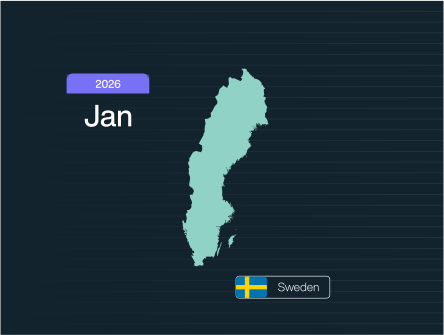
Sweden is on track to become the first EU Member State to fully transpose the EU Pay Transparency Directive (EUPTD).
According to recent updates from Sweden’s autumn budget committee, the government intends to finalize transposition by January 2026. As a refresher, Sweden’s proposed amendments expand on the EUPTD’s minimum requirements, applying obligations to employers with 10 or more employees — going beyond the EU threshold of 100 employees.
Below is an overview of Sweden’s current pay equity obligations, and the new requirements employers should prepare for.
Pay Transparency Before Employment
Current Requirements
- Employers must conduct an annual pay survey for organizations with 10 or more employees, analyzing pay differences between men and women performing equal or equivalent work.
- For employers with 25+ employees, documentation must also include a report, cost estimate, and a plan to remedy gender pay differences within three years.
Proposed Changes
- Employers must disclose the current salary or starting salary range for applicants and include any applicable collective agreement provisions.
- Salary history questions are banned, preventing employers from asking about prior compensation.
- Applicants denied a role, promotion, or training opportunity may request details about the qualifications of the selected candidate.
Article 6 Requirements: Gender-Neutral Pay Systems and Progression
Current Requirements
- Employers with 20+ employees must establish formal pay systems in collaboration with worker representatives.
- Employers must investigate and analyze pay structures for equal or equivalent work, particularly in female-dominated roles.
Proposed Changes
- All employers, regardless of size, must establish formal, gender-neutral pay systems.
- Pay systems must be based on objective job evaluation criteria, including:
- Skills (including social-emotional skills)
- Effort
- Responsibility
- Working conditions
- Employers with 50+ employees must also define and document pay progression criteria, such as merit increases or tenure-related adjustments.
Right to Information
New Rights for Workers
- Employees can request, in writing, a comparison of their pay against the average salary by gender for comparable roles.
- Employers must provide this information within two months of the request.
- Employees must be notified annually of these rights and the process to request pay information.
- Pay secrecy clauses will be prohibited. While employees may share their own pay, broader use of colleagues’ data is limited to enforcement of equal pay rights.
Gender Pay Gap Reporting
Current Requirements
- Employers with 10+ employees must conduct annual pay surveys.
- Employers with 25+ employees must also report progress on remedial measures.
Proposed Changes
Employers with 10+ employees must prepare a salary chart and payroll report that includes:
- Wage differences between men and women, including supplements and variable allowances
- Median wage differences (base and variable pay)
- Proportion of men and women receiving supplements or allowances
- Proportion of men and women in each salary quartile
- Analysis of wage differences and a timeline for adjustments
If a 5% or greater unexplained pay gap is identified, employers must justify the difference with objective, gender-neutral factors or implement corrective measures within a defined timeframe.
Active Measures and Anti-Discrimination Safeguards
Sweden’s proposed amendments also reinforce the “active measures” required under current law, covering:
- Working conditions
- Pay and terms of employment
- Recruitment and promotion
- Education and training
- Reconciliation of work and parenthood
Employers must investigate and remedy discrimination in these areas.
Why It Matters
Sweden’s decision to move ahead of the EU’s transposition deadline underscores its commitment to advancing pay equity. With obligations applying to employers with just 10 employees, the impact will be broad, extending to small and mid-sized organizations as well as large enterprises.
Employers in Sweden should begin preparing now by:
- Reviewing job evaluation frameworks for gender neutrality.
- Establishing or updating pay systems to comply with Article 6 criteria.
- Training HR and managers on the new pay transparency rights and obligations.
- Auditing pay structures for unexplained gender pay gaps.
How Trusaic Can Help
Our software enables compliant pay systems, gender-neutral job evaluations, and automates complex reporting obligations to keep you one step ahead of EU pay transparency enforcement in Sweden.
- PayParity® analyzes your rewards data (compensation/benefits in kind) and quickly identifies inequities to determine if your adjusted gender pay gap is above 5%. It enables you to easily comply with Article 7 (right to information) and Article 6 requirements (pay setting and progression policy).
- Our Remediation Optimization Spend Agent (R.O.S.A.) works as PayParity’s AI remediation partner to find the most cost-effective way to close nominal pay gaps above 5% to ensure compliance.
- Salary Range Finder ensures equitable pay at the point of hire to prevent your pay gap from rising above 5% and enables you to easily comply with the Directive’s salary range disclosure and salary history ban requirements.
- Regulatory Pay Transparency Reporting™ captures your pay equity findings and generates compliant, one-click reports across all EU jurisdictions.
- Our Pay Transparency Agent answers all your pay transparency reporting questions instantly
- Our Communications Agent crafts perfect contextual narratives in any EU language to support your annual pay reports.
Trusaic is GDPR compliant and can assist any organization in any EU state in meeting its obligations under both the EU Corporate Sustainability Reporting Directive and the EU Pay Transparency Directive.
Visit our always updated Member State Transposition Monitor to stay on top of the latest EU Pay Transparency Directive developments. Visit our Global Pay Transparency Center – Sweden for the latest updates and guidance.