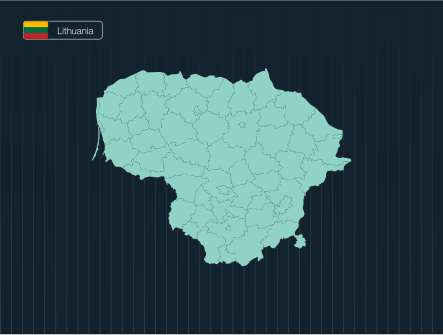














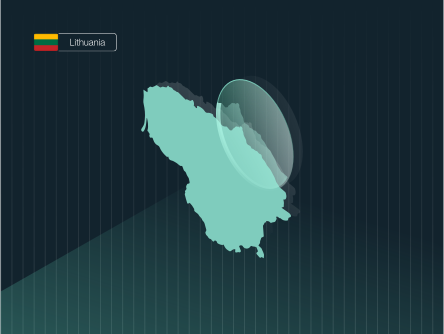
Lithuania is poised to amend its Labor Code to include elements that align with the EU Pay Transparency Directive.
These changes, expected to be approved during the fall parliamentary session, impose expanded obligations on employers aimed at strengthening pay transparency and enforcing equal pay for equal work or work of equal value.
On May 27, 2025, draft proposals for transposing the EUPTD were presented to the Tripartite Council of Lithuania’s Ministry of Social Security. The amendments proposed in the original draft are largely expected to be approved.
In this blog we’ll break down what the amendments address and how that compares to what is already required in Lithuania.
Pay Transparency Before Employment
The amendments address the pay transparency elements of the EU Pay Transparency Directive, including a salary history ban and salary range disclosures on job postings.
Existing Requirements:
- Employers must include base salary or salary ranges in all job advertisements.
New Obligations:
- Employers must provide applicable collective agreements before contract discussions or signing.
- Asking candidates about their current or past salary history is prohibited.
These changes aim to eliminate practices that perpetuate pay inequities and ensure candidates understand compensation terms upfront.
Article 6 Requirements: Pay Progression and Gender-Neutral Approaches
The new amendments will require all employers to establish a structured pay system that is based on objective, gender-neutral job evaluation criteria.
Existing Requirements:
- Employers with 20+ employees must collaborate with worker representatives to establish formal pay systems that cover:
- Base pay bands
- Variable compensation principles
- Pay indexation procedures
New Requirements:
- All employers, regardless of size, must now have formal pay systems.
- Pay structures must be built on gender-neutral job categorization criteria, such as:
- Skills (including social-emotional skills)
- Effort
- Responsibility
- Working conditions
- Employers must define salary increase procedures (optional for organizations with fewer than 50 employees).
Employers are encouraged to involve employee representatives (if applicable) in the creation of such job architecture to enhance transparency and trust in the compensation practices.
Right to Information
Article 7 of the EUPTD requires employers to comply with right to information requests from employees or employee representatives. This means providing access to comparative pay data for employees performing the same work or work of equal value, broken down by gender.
There are no existing “right to information” obligations for Lithuanian employers, thus, this represents a significant change in process.
New Rights for Workers:
- Employees can request written data on:
- Their individual pay.
- Average pay, by gender, for comparable roles or roles of equal value.
- Workers may request clarifications if information provided is incomplete.
- Employers must notify employees annually of these rights and explain how to exercise them.
- Employees cannot be prohibited from disclosing their pay to enforce equal pay rights.
- Employers may restrict broader use of pay data but not for equality enforcement purposes.
Trusaic’s PayParity® enables you to easily comply with Article 7’s requirements. Upon the completion of your pay equity analysis, you can instantly generate reports in any EU language, refresh data to provide the most updated pay details, and assign role-based access and permissions to ensure data security and privacy.
Gender Pay Gap Reporting
Lithuania has an existing pay gap reporting system in place, but the amendments expand on it to align with the EUPTD. Employee representatives have the right to receive detailed information on pay gaps within the company, including by job category.
Existing Framework:
- Lithuania’s Social Security institution already publishes raw gender pay gap data monthly.
New Requirements:
- Employees or their representatives can request annual pay gap data broken down by job category.
- Employers must provide explanations and resolve unjustified pay disparities within six months.
- Pay gap transparency at the job-category level complements institutional reporting and may trigger joint pay assessments under future procedures.
This framework creates both top-down (institutional) and bottom-up (employee-driven) mechanisms for tackling pay inequities.
How Trusaic Can Help
Trusaic offers a complete solution for EU Pay Transparency Directive compliance.
Our Pay Equity Software Suite enables compliant pay systems, ensures gender-neutral job evaluations, and automates complex reporting obligations to keep you one step ahead of EU pay transparency enforcement.
- PayParity® analyzes your rewards data (compensation/benefits in kind) and quickly identifies inequities to determine if your adjusted gender pay gap is above 5%. It enables you to easily comply with Article 7 (right to information) and Article 6 requirements (pay setting and progression policy).
- Our Remediation Optimization Spend Agent (R.O.S.A.) works as PayParity’s AI remediation partner to find the most cost-effective way to close nominal pay gaps above 5% to ensure compliance.
- Salary Range Finder ensures equitable pay at the point of hire to prevent your pay gap from rising above 5% and enables you to easily comply with the Directive’s salary range disclosure and salary history ban requirements.
- Regulatory Pay Transparency Reporting™ captures your pay equity findings and generates compliant, one-click reports across all EU jurisdictions.
- Our Pay Transparency Agent answers all your pay transparency reporting questions instantly
- Our Communications Agent crafts perfect contextual narratives in any EU language to support your annual pay reports.
Trusaic is GDPR compliant and can assist any organization in any EU state in meeting its obligations under both the EU Corporate Sustainability Reporting Directive and the EU Pay Transparency Directive.
Visit our always updated Member State Transposition Monitor to stay on top of the latest EU Pay Transparency Directive developments.