



















A federal district court in Florida has ruled that IRS Letter 226J constitutes valid certification for assessing an Employer Shared Responsibility Payment — directly contradicting a 2025 Texas ruling that reached the opposite conclusion.
The result is an active district court split on a question that touches every Applicable Large Employer (ALE) that has received, or may receive, a Letter 226J. Until an appellate court resolves the disagreement, employers should treat Letter 226J as legally operative and respond within the statutory deadline.
What Did the Florida Court Rule in Supreme Linen Services v. United States?
In February 2025, Supreme Linen Services, Inc. sued the federal government after the IRS assessed an ESRP and denied the company’s refund request (No. 1:25-cv-20723, S.D. Fla.). The dispute centered on a procedural ACA requirement: before an ESRP can be assessed, an employer must receive certification that at least one full-time employee enrolled in an ACA exchange plan and received a premium tax credit (PTC).
Supreme Linen argued that certification had to come from the Department of Health and Human Services or a health insurance exchange — not the IRS — and that Letter 226J did not qualify.
The court disagreed. Because IRC §4980H contains no express delegation of certification authority to another agency, the IRS has authority to issue it directly. Letter 226J qualifies, and the court entered judgment for the IRS.
How Does This Conflict With the Faulk Company Ruling?
In April 2025, the U.S. District Court for the Northern District of Texas reached the opposite conclusion in Faulk Company, Inc. v. Becerra et al. (No. 4:24-cv-00609-P). Judge Mark T. Pittman ruled that HHS — not the IRS — holds exclusive certification authority under ACA §1411.
Because that authority cannot be validly delegated, Letter 226J does not satisfy the certification requirement. The court ordered the IRS to refund $205,621.71 in ESRP and declared the 2013 HHS regulation establishing that delegation (45 C.F.R. §155.310(i)) void and unenforceable.
The government has appealed to the Fifth Circuit (USCA5 No. 25-10773), and that appeal remains pending.
What Is the Legal Question at the Center of This Split?
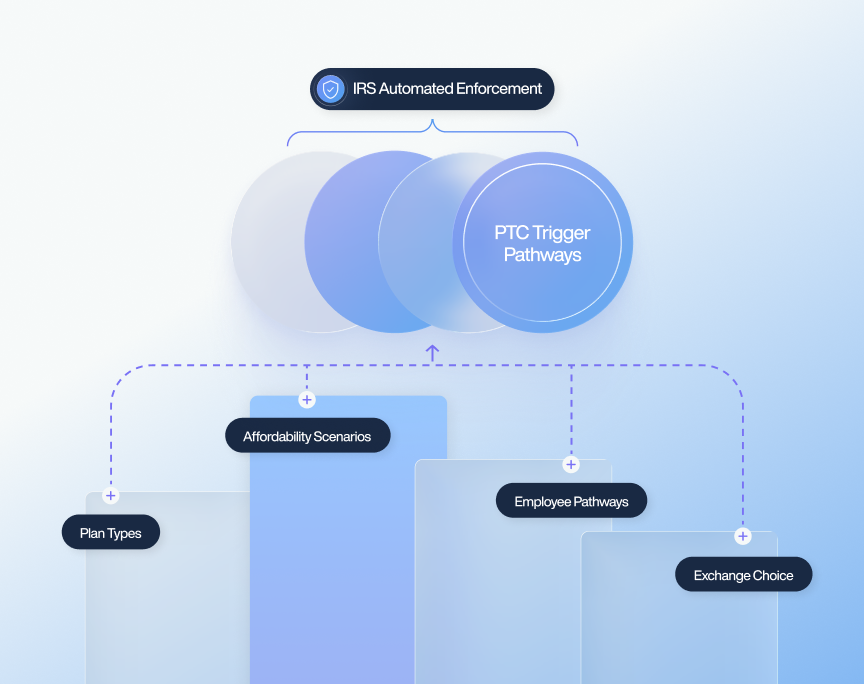
Both courts agreed on the underlying mechanics. An ESRP under IRC §4980H is triggered when an ALE fails to offer minimum essential coverage to 95% or more of the full-time employees, and at least one of those employees enrolls in a marketplace plan and receives a premium tax credit.
What divided them is which agency must certify that condition before the IRS can assess. IRC §4980H is silent on this point — it does not name the certifying agency. The Florida court read that silence as giving the IRS room to act. The Texas court read ACA §1411 as giving HHS exclusive authority that cannot be delegated away.
What Should ALEs Do While the Courts Resolve This?
Both decisions are district-level rulings; neither creates binding nationwide precedent. The Fifth Circuit’s ruling in the Faulk appeal will be the next significant development to watch. For now, employers should keep three priorities in mind:
- Treat Letter 226-J as legally operative
- The 90-day response window under the Employer Reporting Improvement Act applies regardless of how appellate courts ultimately resolve the certification question. Missing that deadline converts a proposed assessment into an assessed liability.
- Consult legal counsel if you have an active or pending ESRP assessment
- Either ruling may create additional options depending on your jurisdiction and circumstances.
- Maintain your compliance documentation
- The certification dispute is procedural. The underlying obligation to offer affordable, minimum essential coverage to full-time employees under IRC §4980H is unchanged by either court’s reasoning.
How Can Year-Round ACA Monitoring Reduce Your ESRP Exposure?
The district court split is a procedural question — it doesn’t change what triggers an ESRP assessment. Offer-of-coverage gaps, affordability miscalculations, and 1095-C coding errors produce exposure regardless of how any court rules on certification authority. Year-round monitoring catches those issues before the IRS does.
For employers already holding a Letter 226J, Trusaic’s Penalty Response Service has helped clients reduce or eliminate more than $1 billion in proposed ESRP assessments. For employers who want to stay ahead of enforcement activity, ACA Complete® provides regular, monthly compliance reporting compliance monitoring across payroll, HR, and benefits data — producing the kind of audit-ready record that holds up regardless of how any court ultimately rules.