















For every Applicable Large Employer (ALE), Form 1095-C is the document the IRS AIRS System uses to assess Employer Shared Responsibility Payment (ESRP) penalties — a single coding error or missing form is all it takes to trigger an automated Letter 226J worth millions of dollars.
What Is ACA Form 1095-C?
Form 1095-C is the annual health coverage reporting document every ALE must file with the IRS and make available to eligible employees. It records whether each full-time employee was offered Minimum Essential Coverage (MEC), whether that coverage met Minimum Value (MV), and whether the employer’s contribution met ACA affordability standards.
When the IRS AIRS System finds a gap in this data, it generates an automated Letter 226J — without human review.
What Information Does Form 1095-C Contain?
Form 1095-C is organized into three parts:
- Identifying Information: Employee and employer details, including name, Social Security number, address, and Employer Identification Number (EIN).
- The Compliance Record: Lines 14, 15, and 16 document the coverage type offered, the employee’s required contribution, and any applicable safe harbor code — month by month. For ICHRA employers, Line 17 captures the applicable zip code the IRS uses to verify plan affordability. Mismatched or missing codes across Lines 14 and 16 are among the primary drivers of automated ESRP assessments.
- Individual Coverage Detail (self-insured employers only): Documents each covered individual — employee, spouse, and dependents — and the specific months of enrollment.
Who Is Required to Receive Form 1095-C?
ALEs must furnish Form 1095-C to every full-time employee for any month they were employed during the calendar year — whether or not the employee accepted the coverage offer.
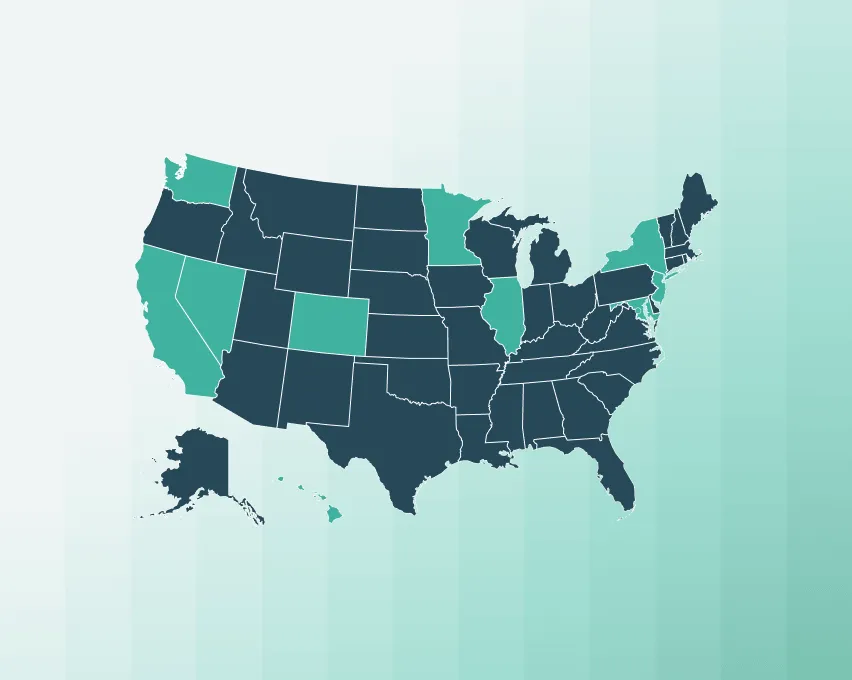
State-Level Individual Mandates add a separate layer of obligation based on where the employee resides, not where the employer is headquartered:
- California
- Massachusetts
- New Jersey
- Rhode Island
- Washington D.C.
Missing state-level deadlines or submitting conflicting data generates separate, stacking financial penalties on top of federal ESRP exposure.
What Changed Under the Paperwork Burden Reduction Act?
Two laws signed in December 2024 — the Paperwork Burden Reduction Act (PBRA) and the Employer Reporting Improvement Act (ERIA) — changed how ALEs satisfy their 1095-C furnishing obligations.
Under the PBRA, employers may post a website notice stating forms are available upon request, instead of mailing them automatically. Requirements:
- Must be posted by the annual furnishing deadline (typically March 2).
- Must remain accessible through October 15 of the following year.
- Must include an email address, physical mailing address, and phone number.
- Requested forms must be provided within 30 days or by January 31 — whichever is later.
Critical exception: The PBRA does not apply in California, Massachusetts, New Jersey, Rhode Island, or Washington D.C. — those states still require direct form furnishing under state law.
Under the ERIA, prior electronic consent carries forward without annual renewal — and neither law changes the annual March 31 AIRS filing deadline.
Does Form 1095-C Need to Be Filed With Anything Else?
Yes. Every Form 1095-C must be submitted alongside Form 1094-C, the transmittal cover sheet. Form 1094-C captures:
- ALE identifying information and total employee headcount.
- Months of MEC coverage offered across the workforce.
- Whether the ALE is part of an Aggregated Group under IRC Section 414.
- Certification that the ALE met the 95% MEC offer threshold for the year.
An incorrect box-check on that last certification triggers a 4980H(a) penalty across the entire workforce minus the first 30 exemption slots — the scaling mechanism that turns a single data entry error into an IRS assessment.
What Are the Penalties for Failing to File or Furnish Form 1095-C?
Two separate penalty provisions apply — a single defective return can trigger both:
- IRC Section 6721: Failure to file correct information returns with the IRS.
- IRC Section 6722: Failure to furnish correct statements to employees.
Penalty amounts (adjusted annually for inflation):
- Failure to file or furnish correctly: Up to $340 per return, capped at $4,098,500 annually (2025 tax year).
- Intentional disregard: Significantly elevated per-return amounts, no annual cap.
Penalty notice types:
- Letter 5005-A: Issued when an ALE fails to file Forms 1094-C and 1095-C with the IRS entirely.
- Letter 972CG: Issued for late filing or furnishing.
How Do You Code Form 1095-C Correctly?
Coding Lines 14, 15, and 16 month-by-month requires data that precisely reflects each employee’s offer status, contribution amount, and applicable safe harbor. Common error patterns:
- Variable-hour misclassification: Employees not correctly tracked during a Look-Back Measurement period result in incorrect Line 14 codes.
- Line 14 and Line 16 conflicts: Missing or contradictory safe harbor codes pass AIRS transmission but surface as direct penalty exposure when the IRS cross-references your data against employee tax returns.
- Affordability calculation drift: Safe harbor elections on Line 16 that do not account for hourly rate changes across pay periods produce incorrect affordability determinations.
When Payroll Software Isn’t Enough
Standard payroll software formats existing data — it does not validate whether that data will survive IRS cross-matching. By the time a Letter 226J arrives, the window for proactive correction has closed.
Trusaic’s ACA Complete® platform integrates fragmented HRIS, payroll, and benefits data into a unified record, then validates every form against IRS business rules before transmission.