


















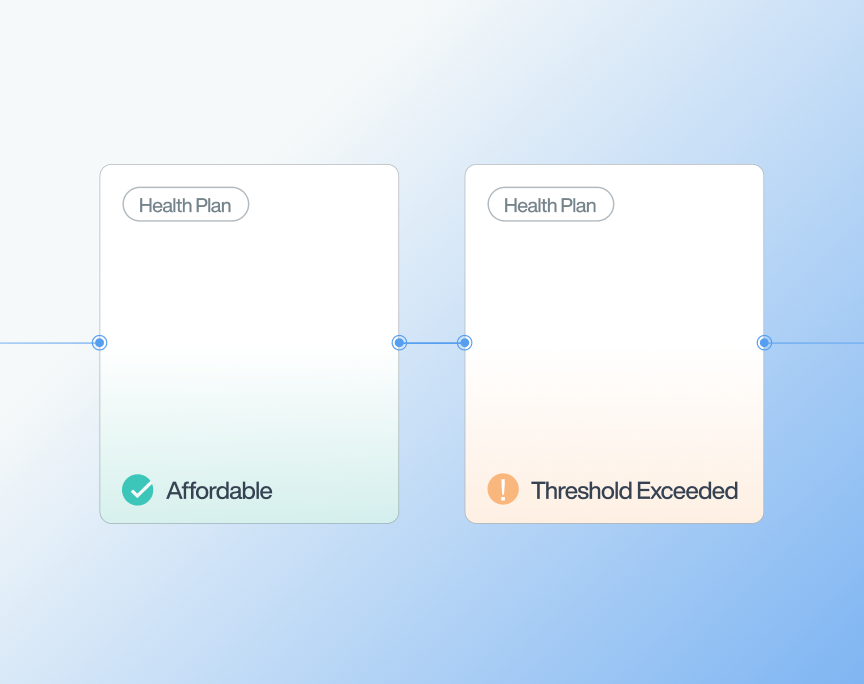
For corporate officers managing supermarkets, hotel chains, and restaurant networks, the ACA Employer Mandate creates a financial pressure that increases with every variable-hour hire: healthcare coverage must be both offered and mathematically affordable for a workforce whose wages and hours shift constantly.
In low-wage, high-turnover industries, executing that dual obligation without the right data infrastructure creates exposure under two separate provisions of the tax code.
What Penalties Do Affordability and Furnishing Failures Trigger?
Under the ACA Employer Mandate, ALEs must satisfy two tests simultaneously: coverage must be offered to at least 95% of full-time workers, and the required employee contribution for the lowest-cost, self-only plan must be affordable.
For the 2026 tax year, the IRS defines affordable as a required contribution not exceeding 9.96% of the employee’s household income.
When that threshold is passed for even a subset of the workforce, the financial consequences are assessed individually. The 4980H(b) Employer Shared Responsibility Payment was $4,460 per affected employee for 2024 and $4,350 for 2025 — triggered for each full-time worker who received a Premium Tax Credit (PTC) on an ACA exchange after being offered coverage that failed the affordability test. Both tax years remain under active IRS audit.
Note: The expanded marketplace subsidies that broadened PTC eligibility from 2021–2025 expired at year-end 2025, narrowing — but not eliminating — this exposure for 2026.
Form 1095-C furnishing failures carry separate per-form penalties under IRC 6722 for every employee who does not receive their required statement. In high-turnover sectors, where transient workers are difficult to reach and wages shift continuously, both exposures operate independently of each other.
How Does the IRS Evaluate Affordable Coverage for a Variable-Wage Workforce?
The IRS evaluates plan affordability using an annually indexed percentage of household income. For the 2026 tax year, that threshold is 9.96% — meaning the required employee contribution for the lowest-cost, self-only coverage cannot exceed 9.96% of the employee’s household income for a plan to qualify as affordable.
Because employers cannot independently verify individual household incomes, the IRS provides three approved Safe Harbor frameworks: the W-2 Wage Safe Harbor, the Rate of Pay Safe Harbor, and the Federal Poverty Line Safe Harbor.
In low-wage sectors, where hourly schedules fluctuate and wage classifications shift between tipped and non-tipped positions, all three carry calculation risks that static payroll tools will not surface on their own.
Three structural vulnerabilities drive affordability failures in high-volume operations:
Rate of Pay Volatility
The Rate of Pay Safe Harbor calculates maximum affordability based on an employee’s hourly rate multiplied by 130 hours — the IRS standard multiplier for full-time status. For tipped workers, only the base hourly wage is included in that calculation; gratuities cannot be counted.
When workers shift between tipped and non-tipped wage classifications during a plan year, or when multiple pay rates apply across a single measurement period, a static employee contribution formula can breach the 9.96% threshold for portions of the workforce without generating an alert.
Spreadsheet Limitations
Manual spreadsheets cannot dynamically recalculate individual premium contributions against variable month-to-month earnings. When wage rates and hours fluctuate — a structural constant in food service and retail — static tools return fixed outputs for a workforce that is not fixed, leaving affordability failures undetected and increasing the organization’s actual exposure to 4980H(b) penalties.
Undeliverable Mail
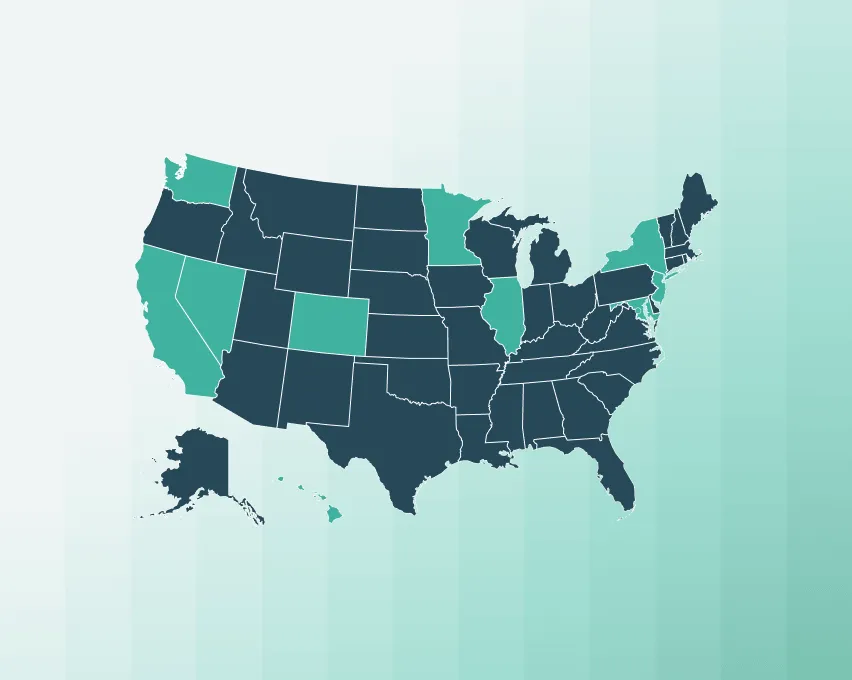
The Paperwork Burden Reduction Act introduced a website notice alternative to direct annual mailing, but that option does not override state-level individual mandates. Employers with workers residing in California, New Jersey, or Rhode Island must still furnish forms directly to those employees — including individuals who have already separated.
Transient workers relocate frequently. When HRIS address records aren’t maintained, employers may lack a defensible last-known address — and without documented furnishing attempts, demonstrating compliance in an audit becomes difficult. Electronic furnishing with employee consent eliminates this exposure entirely.
How a Compliant Health Plan Can Trigger a 4980H(b) Penalty
A national supermarket chain designs its employee health contribution structure around a standard 40-hour workweek assumption — setting a fixed employee premium that, for a full-time worker, falls within the 9.96% W-2 Wage Safe Harbor.
The oversight: a segment of variable-hour workers averaged 31 hours per week, earning lower Box 1 W-2 wages than the 40-hour model assumed. When the fixed employee contribution is tested against those lower current-year Box 1 wages — as the W-2 Wage Safe Harbor requires — it exceeds 9.96% of those wages for this worker segment, invalidating the safe harbor.
When several of these workers exit and purchase subsidized coverage through an ACA exchange — claiming a Premium Tax Credit (PTC) — the IRS AIR System cross-references the PTC data against the employer’s Form 1095-C filing.
The result is a Letter 226J proposing an Employer Shared Responsibility Payment under Section 4980H(b), assessed at $4,460 per affected employee for 2024 and $4,350 for 2025 — both years currently under active IRS audit. For 2026, the marketplace subsidies that broadened exchange eligibility from 2021–2025 have expired, meaning fewer employees are expected to claim PTCs on the exchange — narrowing, but not eliminating, this trigger.
What Does It Take to Prevent Affordability Drift and Furnishing Failures at Scale?
Relying on out-of-the-box payroll software or end-of-year tax vendors cannot solve the challenges of dynamic affordability tracking and transient workforce form delivery. Both require infrastructure that operates continuously.
Achieving compliance requires a connected data stack that continuously reconciles payroll engines, benefits administration files, and active address registries into a single, audit-ready compliance record. Only then can enterprise risk managers identify affordability drift mid-year — and adjust employee contribution structures before a Safe Harbor failure is locked into a year-end filing.
A penalty risk assessment executes this function systematically: it surfaces affordability failures at the individual employee level before data is finalized, and flags address discrepancies before the furnishing cycle begins.
How Can Variable-Wage Employers Prevent Affordability Drift?
The 4980H(b) penalty isn’t triggered by what you file in March — it’s triggered by the month a variable-wage worker’s required contribution quietly exceeded 9.96% and nobody recalculated.
The furnishing failure isn’t a January problem; it happens the moment a transient worker relocated and the address in the HRIS didn’t update with them.
Both exposures are preventable with the same continuous data infrastructure — ACA Complete® handles both — affordability recalculation and documented form delivery for every worker, active or departed.