











The employer is liable for ACA errors regardless of what platform filed them. In most organizations, that principle doesn’t change how ACA compliance gets evaluated at the leadership level and it should.
An AI-wrapped platform gets checked against a feature list and signed. The operating model questions (Who owns the function? Who carries the methodology? Who answers the IRS when the output is wrong?) are rarely asked.
What Is an AI-Wrapped Platform?
An AI-wrapped platform places a service layer on top of a third-party AI vendor’s engine. The vendor’s model does the underlying work, such as processing eligibility data, generating coding logic, producing forms, and the platform’s interface surfaces the output.
Accountability doesn’t change with the interface. An ACA employer would still own the liability for every determination the platform generates. When the IRS questions a decision, the employer must answer for it.
What Is AI-Augmentation in ACA Compliance?
Rather than delegating compliance logic to an external model, AI augmentation uses AI capabilities such as anomaly detection, cross-system data validation, and pattern recognition at scale, to support the teams accountable for compliance decisions.
Examples of how this would work in practice:
- An agent flags inconsistent hours data before a measurement period closes
- An agent identifies employees approaching eligibility thresholds
- An agent validates 1095-C codes against workforce records across thousands of entries simultaneously
The team (or vendor) responsible for ACA compliance applies institutional knowledge to interpret and act on what the data shows. AI is utilized to improve the efficiency of the analysis but the decision stays with the human responsible for ACA compliance.
How Do Executives Already Think About Managed vs. AI-Driven Operations?
Most C-suite leaders have already navigated this in other domains. In IT, finance, and legal, experienced executives distinguish between a software platform that supports a function and a partner that owns it.
The same discipline applies to ACA compliance with one distinction that raises the stakes. In IT or legal outsourcing, a vendor that underdelivers creates an operational problem the organization can correct.
In ACA compliance, a platform that generates wrong outputs and can’t document the reasoning behind them creates an IRS enforcement problem. The IRS doesn’t audit the vendor. It audits the filing and expects the employer to explain every determination in it.
What Are the Three Operating Models for ACA Compliance?
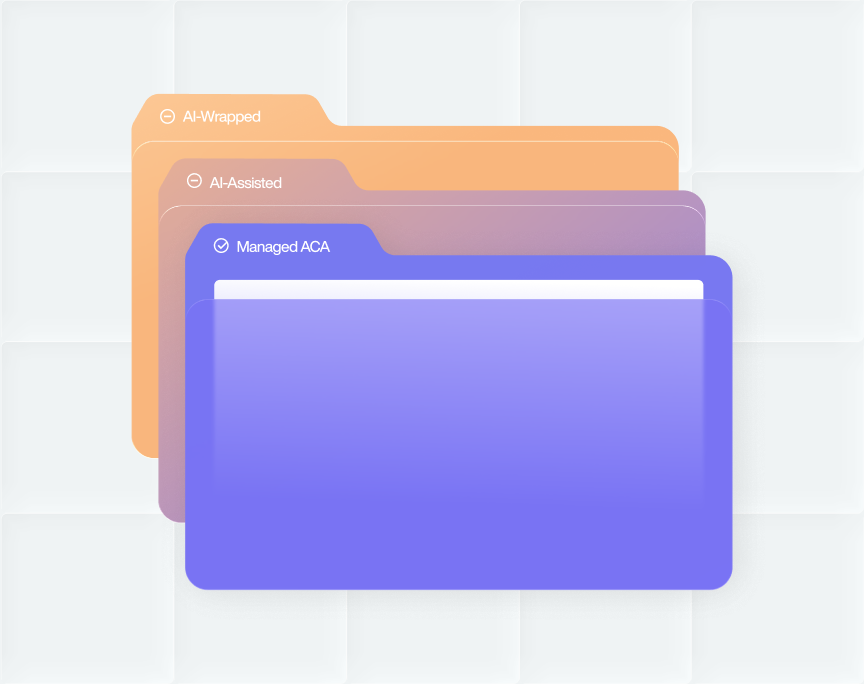
Three models exist, each with a different allocation of resource requirements, compliance ownership, and accountability:
In-house: The employer owns eligibility tracking, measurement period calculation, 1095-C coding, and IRS filing internally. Full control, full accountability. AI augmentation tools can reduce manual review without shifting compliance ownership.
- Best fit: Organizations with dedicated compliance staff, a stable salaried workforce, a single-state footprint, and the internal ACA expertise to verify and defend every determination.
AI-wrapped platform: The vendor’s system handles data processing and form generation. Manual effort decreases, but all compliance accountability remains with the employer. AI-generated outputs that result in ACA non-compliance are the employer’s responsibility.
- Best fit: Organizations that meet the same staffing and workforce criteria as the in-house model, with the internal capacity to verify what the platform produces.
Managed services: A specialist partner who owns the compliance function end to end: data integration, eligibility monitoring, human expert review, filing, and audit defense. The employer retains strategic decisions. The partner owns execution and the documented methodology.
- Best fit: Organizations with variable-hour or shift-based workforces, multi-state operations, recent M&A activity, or a prior Letter 226J. These conditions increase the risk of errors the employer cannot independently catch or defend.
Managed services is the only model where execution accountability transfers to the partner. An AI-wrapped platform can work, but verification and defense of every output stays with the employer. In-house remains appropriate for organizations with a stable workforce and dedicated compliance staff.
How Does Workforce Complexity Affect Which ACA Compliance Model Fits?
Workforce complexity determines how quickly an AI-wrapped platform’s vulnerabilities become a problem, not whether those vulnerabilities exist.
An in-house or AI-wrapped model may work when the organization has a stable, salaried workforce, a single-state footprint, and dedicated internal compliance staff with the ACA expertise to verify what the platform produces and defend it.
Without that internal verification capacity, reduced manual effort isn’t a compliance solution; it’s a filing service with unreviewed outputs.
The managed services model becomes the appropriate fit when workforce complexity increases the risk of errors the employer cannot catch or defend:
- Variable-hour or shift-based workforces: Look-Back Measurement requires precise hours aggregation across systems; errors don’t surface until Letter 226J arrives.
- Multi-state operations: State individual mandate filings draw on the same underlying workforce data as federal 1095-C transmittals. An error in either creates exposure across both.
- Recent M&A activity: Acquired entities bring inherited ACA liabilities and data fragmentation that AI-driven logic isn’t equipped to reconstruct.
- Prior IRS penalty notice: Receiving a Letter 226J reveals a documentation gap that requires structural resolution, not just process improvement.
Which ACA Compliance Model Closes the Accountability Gap?
Selecting a vendor that files efficiently doesn’t establish who owns the compliance function, who maintains the methodology, or who the IRS holds accountable when the output is wrong. An AI-wrapped ACA platform only answers one of those questions.
ACA Complete® is the operating model answer. The embedded compliance function that owns execution, maintains the audit trail, and answers the IRS when it asks. The employer keeps the decisions. The partner owns what gets filed.