

















Introduction
Complying with the ACA’s Employer Mandate is one thing; proving it to the IRS is another.
While Form 1095-C reports on your employees, Form 1094-C reports on you.
Many organizations treat the 1094-C as a cover sheet. This is a mistake. Form 1094-C is the authoritative source the IRS uses to determine if your organization owes “Penalty A” (Employer Shared Responsibility Payment). A single error on this form can flag a compliant company for an audit or trigger millions of dollars in proposed penalties.
What is Form 1094-C?
Form 1094-C is the transmittal form that summarizes an Applicable Large Employer’s (ALE) health coverage offers and employee counts.
The Authoritative Transmittal
You may file multiple 1094-C forms for a single EIN (for example, if you have different payroll centers), but only one of these forms can be designated as the Authoritative Transmittal (Line 19).
- The Rule: This specific form must aggregate the data for the entire EIN.
- The Risk: If you file multiple forms marked Authoritative, or if you file none, the IRS considers your filing incomplete and may reject your entire submission.
The Audit Switch: You must check this box on ONE (and only one) 1094-C filing per EIN. If you leave this unchecked, the IRS considers your entire filing incomplete.
How to code ACA Form 1094-C
Below are three common scenarios showing how different organizational structures affect your coding strategy.
Scenario 1: The Standard Filer
(Using the 98% Offer Method)
- Employer: Johnny’s Pizza Parlor
- Profile: Single EIN, 100 Full-Time Employees, steady workforce, offers coverage to virtually everyone.
Form Analysis:
- Line 19: Checked as Authoritative Transmittal.
- Line 22 (Certifications): Johnny’s checks Box D (98% Offer Method). This signals to the IRS that they offered affordable coverage to at least 98% of their full-time employees.
- Part III, Column (a): Yes for all 12 Months.
- Part III, Column (b): Left Blank.
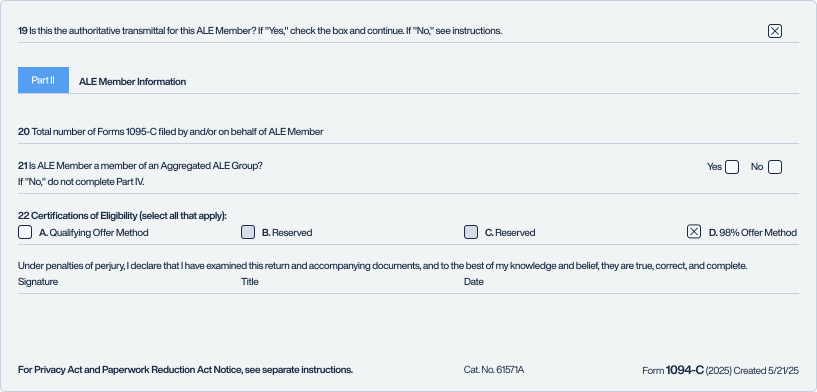
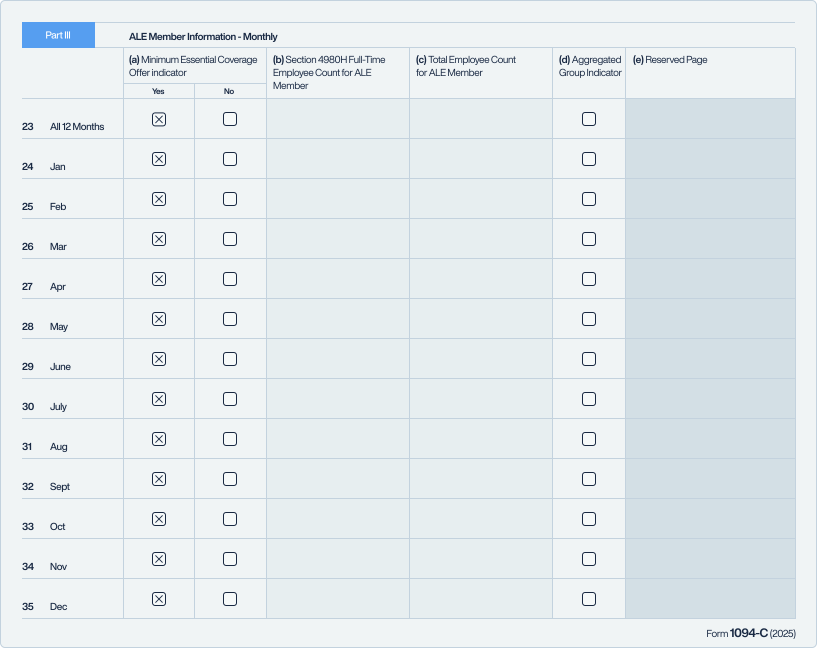
Pro Tip: Because Johnny’s Pizza Parlor certified the 98% Offer Method, they are not required to calculate or report the monthly Full-Time Employee counts in Column (b). This significantly reduces administrative burden and eliminates the risk of data entry errors in the penalty calculation column.
ACA Penalty Risk: Low. By checking Yes in Column (a) and utilizing the 98% Offer Method, Johnny’s Pizza Parlor effectively insulates itself from the §4980H(a) penalty.
The Efficiency Tip: By checking Box D (98% Offer Method) on Line 22, you are allowed to leave Column (b) blank. This saves you from calculating monthly full-time counts and removes a massive data-entry risk.
Scenario 2: The Aggregated Group
(Controlled Group)
- Employer: Ralph’s Construction Group (Parent) and Ralph’s Supplies (Subsidiary)
- Profile: Two separate EINs that are treated as a single employer under IRS Section 414.
Form Analysis:
- Line 21: “Is ALE Member a member of an Aggregated ALE Group?” is checked Yes.
- Part III, Column (d): The box is checked (Aggregated Group Indicator) for every month the relationship existed.
- Part IV (Other ALE Members): This is the critical section. Ralph’s Construction must list the Name and EIN of Ralph’s Supplies.

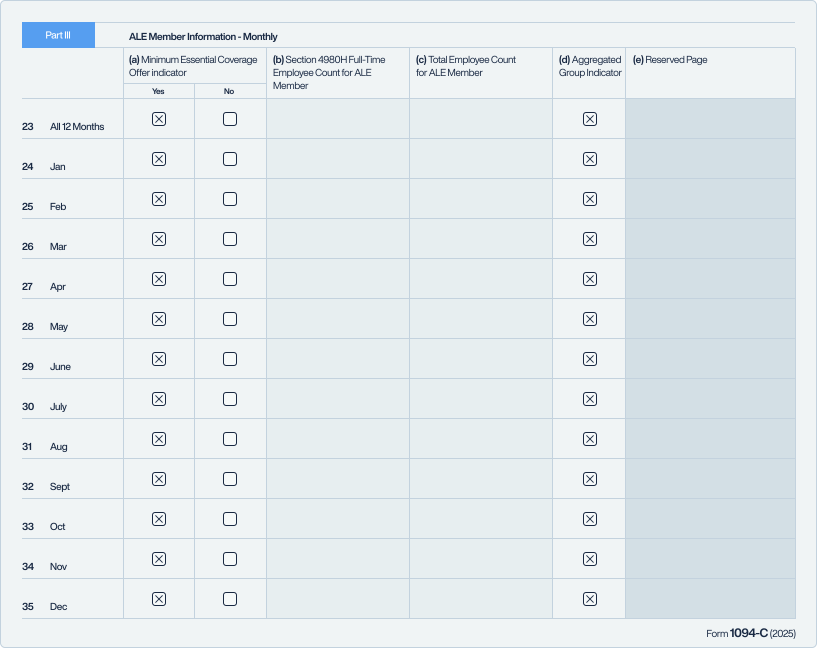
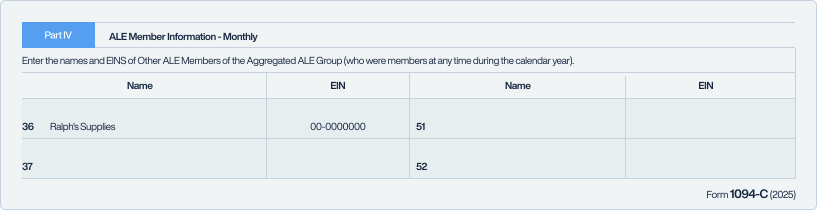
Why This Matters: This is a reciprocal requirement. Ralph’s Construction lists Ralph’s Supplies, and Ralph’s Supplies must list Ralph’s Construction. If the cross-referencing isn’t reciprocal, the IRS automated system flags the return for inconsistency. You must explicitly link the EINs so the IRS views your workforce as a single collective entity.
The Link: You must list the names and EINs of the other members of your controlled group here. Critical: Ensure your subsidiary files their own 1094-C and lists you in return to prevent orphan records.
Scenario 3: The Risky Filer
- Employer: ART Corporation
- Profile: Staffing agency with a high variable-hour workforce. Due to an administrative error, they missed offering coverage to their eligible staff in January and February.
Form Analysis:
- Part III, Column (a): No is checked for Jan and Feb. Yes is checked for Mar-Dec.
- Part III, Column (b): Accurately reports the Full-Time counts for those months.
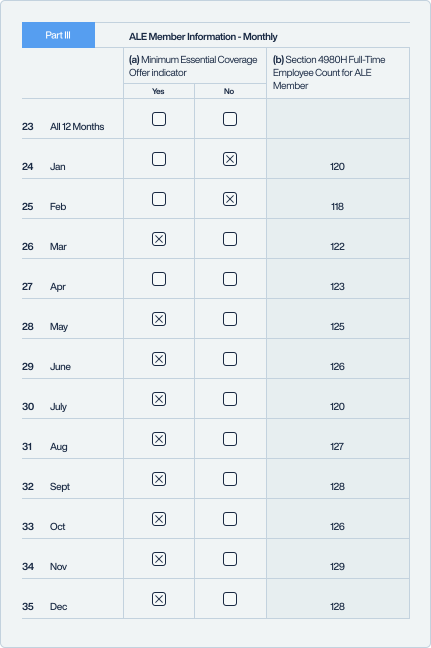
ACA Penalty Risk: High. Checking No in Column (a) removes your shield against the §4980H(a) penalty.
- The Trigger: If even a single full-time employee triggers a Premium Tax Credit during Jan or Feb, the IRS will automatically assess the A Penalty across your entire full-time workforce (minus the 30-employee reduction).
Audit Defense: While the penalty is likely owed, accurate coding here prevents a larger surprise later. If ART Corporation had falsely checked Yes, they would be liable for perjury and potentially steeper fraud penalties upon audit.
The Red Flag: Checking No in Column (a) admits you did not meet the 95% threshold. This is often necessary for accuracy, but it leaves you exposed to the maximum penalty assessment.
1094-C Coding Glossary
- Line 19 (Authoritative Transmittal): The master filing for the EIN. It must be checked on one (and only one) 1094-C per EIN.
- Line 22, Box D (98% Offer Method): A certification that you offered coverage to at least 98% of your full-time employees. Using this allows you to leave Part III, Column (b) blank.
- Part III, Column (a) (MEC Offer Indicator): The “Shield.” Did you offer Minimum Essential Coverage to 95% of your full-time employees? Answering No removes your protection against the §4980H(a) penalty.
- Part III, Column (b) (Full-Time Employee Count): The count of Section 4980H Full-Time employees (30+ hours/week). This is the number used to calculate the penalty amount.
- Part III, Column (c) (Total Employee Count): The total headcount, including part-time, seasonal, and variable hour staff. The IRS uses this to verify your ALE status, but strictly speaking, it is not used to calculate the penalty amount.
- Part IV (Aggregated ALE Group): The section where you must list the names and EINs of related companies (Parent-Subsidiary or Brother-Sister groups) to prevent file fragmentation.
How Trusaic can help with Form 1094-C
Form 1094-C is not a simple cover sheet — it is the authoritative source the IRS uses to assess Employer Shared Responsibility Payments. A single coding error can expose your organization to millions in penalties.
Through ACA Complete®, Trusaic acts as your proactive compliance partner, combining enterprise-grade technology with human expertise to ensure your Form 1094-C is correct prior to transmission.
- Forensic Data Validation: We automatically catch logic errors and ensure complex requirements are perfectly aligned before you file.
- Real-Time Margin Tracking: Our engine continuously evaluates your workforce data, alerting you to compliance gaps so you can confidently secure the 98% Offer Method.
- Expert-Led Filing Strategy: A designated ACA specialist navigates tricky corporate structures to ensure your final Authoritative Transmittal is coded for maximum penalty protection.
- Proven Audit Defense: If the IRS initiates an inquiry, our Penalty Response Service takes over all correspondence. We utilize your historically validated data to aggressively reduce or completely eliminate proposed ESRP assessments — having already prevented over $1 billion in ACA penalties for our clients.
Stop risking your bottom line on manual 1094-C coding.