
















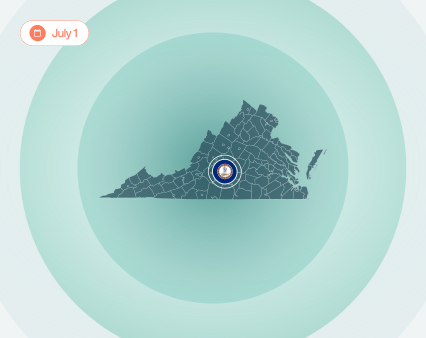
Virginia’s new pay transparency law takes effect July 1, 2026, and employers operating in the Commonwealth should confirm their job postings and hiring practices are ready.
Virginia Gov. Abigail Spanberger signed into law SB 215 and HB 636, identical companion bills that require covered employers to disclose the wage or salary range in public and internal job postings. The bills were enacted April 22, 2026. Notably, Virginia pairs its salary range disclosure requirement with a salary history ban and anti-retaliation protections — making this more than a job-posting rule.
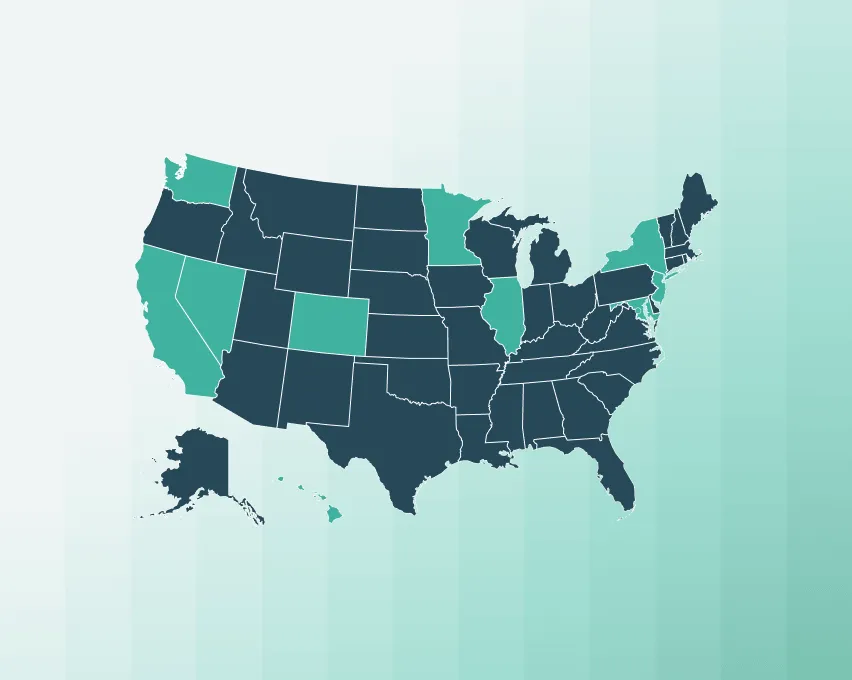
Virginia joins a growing list of U.S. states and jurisdictions — including California, Colorado, Hawaii, Illinois, Maryland, Minnesota, New Jersey, New York City, Vermont, Washington, and Washington, D.C. — that require salary ranges on job postings.
What Do Employers Need to Know?
The law takes effect July 1, 2026. Here are the basics:
- No size threshold. The law applies broadly to any “employer” doing business in or operating within the Commonwealth that employs one or more individuals. Unlike many state laws that apply only above an employee-count threshold, Virginia’s covers employers of all sizes.
- Posting disclosure. Employers may not fail or refuse to disclose, in each public and internal posting for each job, promotion, transfer, or other employment opportunity, the wage, salary, or wage or salary range for the position.
- Good-faith ranges. Employers must set the range in good faith. The law defines a wage or salary range as the minimum and maximum wage or salary for the position, set in good faith by reference to any applicable pay scale, any previously determined range for the position, the actual range of wages or salaries for persons currently holding equivalent positions, or the budgeted amount available for the position. Any analysis of whether a range was set in good faith will consider, among other things, the breadth of the range. The law does not separately define “wage” or “salary.”
- Salary history ban. Employers may not seek a prospective employee’s wage or salary history, rely on it when considering the individual for employment, or rely on it when determining pay upon hire. A limited exception applies when an applicant voluntarily provides salary history without the employer’s prompting — in which case the employer may rely on it to support a higher-than-initial offer only to the extent doing so does not create an unlawful pay differential under Virginia’s Equal Pay Act or federal law, and may seek to confirm that history to support that higher offer.
- Anti-retaliation. Employers may not refuse to interview, hire, employ, or promote — or otherwise retaliate against — a prospective or current employee for declining to provide wage or salary history or for requesting a wage or salary range.
- No benefits disclosure required. Unlike some other state laws, Virginia does not require the disclosure of benefits information.
The statute does not state whether the posting requirement is limited to positions physically based in Virginia, so multistate employers should take a cautious, consistent approach across postings.
What Are the Penalties, and How Will the Law Be Enforced?
Virginia adopted a dual-enforcement structure:
- Civil penalties. The attorney general may bring a civil action to enforce the law. An employer that violates the provisions is subject to a civil penalty of up to $1,000 for a first violation and up to $5,000 for any subsequent violation, with penalties paid into the general fund. A court may award any other legal and equitable relief it deems appropriate.
- Private right of action. An aggrieved prospective employee or employee may bring an action within one year of the alleged violation and may recover actual damages along with any other legal and equitable relief the court deems appropriate.
- A cure window for postings. For the job-posting disclosure and good-faith range requirements, employers have an opportunity to correct a deficiency before an action may be brought. The aggrieved person must provide written notice that a posting does not comply. If the employer corrects the posting at its original posting locations within 15 business days of receiving notice, no action for that violation may be brought. A single written notice constitutes adequate notice for the duration of that posting as to any prospective employee.
In advance of the July 1, 2026 effective date, covered employers should review all public-facing and internal job postings and advertisements to confirm they include the required compensation information, and should contact any recruiters or third-party agencies that post opportunities on the employer’s behalf to ensure they will comply.
How Can Employers Set Accurate, Equitable Salary Ranges?
This new requirement poses a familiar challenge: how do you determine and disclose salary ranges that are both market-competitive and aligned with internal equity — and that will withstand a good-faith review?
Posting a range is straightforward in form, but the “good faith” standard means the breadth of and rationale behind each range matter. Ranges that are excessively wide or disconnected from internal pay structures can invite scrutiny, deter qualified candidates, and undermine credibility. Getting this right requires reliable pay data, defensible pay structures, and a clear methodology for building ranges at the point of hire.
Why Does Virginia’s Law Matter?
Pay transparency laws in the U.S. are quickly becoming the norm rather than the exception. Virginia adds to a fast-expanding patchwork of state and local requirements, and its combination of salary range disclosure, a salary history ban, anti-retaliation protections, and a private right of action signals that these laws are growing both broader and more enforceable.
For multistate employers, the practical takeaway is that compliance can no longer be handled jurisdiction by jurisdiction at the last minute. Now is the time to assess your job postings, evaluate your compensation structures, and ensure you are ready to meet Virginia’s requirements — while staying ahead of the next wave of laws taking effect across the country.
How Trusaic Can Help
Trusaic’s PayParity® and Salary Range Finder® solutions work in tandem to help employers comply with pay transparency requirements while advancing meaningful pay equity.
- PayParity® identifies pay inequities across gender, race/ethnicity, age, and more using intersectional, regression-based analyses. It also supports remediation planning, ensuring your compensation decisions are both fair and legally-defensible.
- Our Remediation Optimization Spend Analysis (R.O.S.A.) works as PayParity’s remediation engine to find the most cost-effective way to close pay gaps.
- Salary Range Finder® empowers HR and compensation teams to create data-driven salary bands that are competitive, equitable, and transparent. Real-time guidance ensures new hire offers are aligned with both market rates and your internal pay structures — helping you attract talent while maintaining trust within your workforce.
- Pay Decisions: Generate fair, competitive offers instantly from Workday.
With real-time pay guidance, managers, recruiters, and HR teams can make fair and competitive pay decisions faster — reducing time-to-hire, improving offer acceptance rates, and ensuring salary offers are aligned with your pay equity goals.