













ACA filing responsibility shows up a few different ways. Last year’s headcount crossed 50 employees for the first time, triggering ALE status this year. A new payroll or HCM platform took over, and the prior vendor no longer handles ACA filing. Or someone new to the role discovers the company never built an ACA process. However it happened, you now own this with no existing process to follow.
Two dates matter: coverage has to be in place by April 1 to preserve the first-year non-assessment period, and Forms 1094-C and 1095-C are due March 31 if filed electronically. The e-file threshold now sits at 10 or more returns, so that applies to nearly every employer. Everything below is the sequence to work through between now and those dates.
Have You Actually Calculated Your ALE Headcount?
The math is specific. Add your full-time employees, which under ACA rules are those averaging 30 or more hours a week, for each month of the prior calendar year. Then add your full-time equivalents, calculated by taking the total monthly hours worked by everyone else, capping each individual at 120 hours, and dividing by 120. Add the two monthly totals together across all 12 months and divide by 12.
For example, a company with 40 full-time employees and 15 part-time employees averaging 60 hours a month each has an FTE count of 15 times 60, divided by 120, or 7.5 FTEs. This holds if those hours stay consistent across all 12 months; if they vary, calculate FTEs for each month separately and average the 12 results.
Combined with the 40 full-time employees, that puts the company at 47.5, just under the threshold. Add five more part-time hires at similar hours, and the company reaches 50.
Controlled group rules extend this math across commonly owned entities. When two companies share ownership, their headcounts combine. One company with 30 full-time employees and another with 25 add up to 55, so both become ALEs, even though neither reaches 50 on its own. In this scenario, each entity still calculates and owes its own penalty separately if one is ever assessed.
A parent or holding company with no employees of its own is still counted for aggregation purposes, but generally isn’t an ALE Member itself, since that status requires employees to report on.
A new company, one that did not exist the prior year, is judged differently. The IRS looks at whether it reasonably expects to average 50 or more, and whether it actually does by year end, and the expectation alone does not lock in ALE status if the actual average comes in under 50.
Should You Use the Monthly Measurement Method or Look-Back Measurement?
This decision must happen before data collection starts, because switching methods retroactively for employees already inside a measurement period creates rework.
The monthly measurement method works best when the workforce is stable and salaried. Each month, the employer checks whether the employee averaged 30 or more hours, and that status applies to that month alone.
The look-back measurement method fits variable-hour, seasonal, or part-time staff whose schedules change. It uses a measurement period of up to 12 months, followed by an administrative period of up to 90 days to enroll eligible employees, then a stability period that locks in status regardless of hours worked during that stretch.
If more than a small share of the workforce has fluctuating hours, look-back measurement is usually the right call, even though it takes longer to set up.
What Data Do You Need and Which System Actually Has It?
Four data points drive the filing: hire and termination dates, hours worked per pay period, enrollment status, and the employee’s monthly required contribution.
Hire and termination dates typically live in the HRIS while hours worked live in payroll. Enrollment status and contribution amounts live in the benefits administration platform. These three systems rarely share data automatically for a first-time filer.
Confirm where each data point actually lives and whether it exports cleanly. Do this before the measurement period closes, not after.
How Do Line 14 and Line 16 Actually Get Coded?
Line 14
Line 14 states what was offered. Code 1A means a qualifying offer, meeting minimum value at or under the mainland federal poverty line affordability threshold, with coverage also offered to spouse and dependents.
Code 1E means minimum essential coverage providing minimum value was offered to the employee, spouse, and dependents, without meeting the stricter 1A affordability test.
Line 16
Line 16 states what happened with that offer. Code 2C means the employee enrolled, and it takes priority over a safe harbor code for any month the employee actually enrolled. If the employee did not enroll, one of three safe harbor codes documents why the offer was still affordable: 2F for the W-2 safe harbor, 2G for the federal poverty line safe harbor, or 2H for the rate of pay safe harbor.
The codes have to be consistent. Code 1A on line 14 leaves lines 15 and 16 blank entirely, since the qualifying offer already establishes affordability. Pairing 1A with a safe harbor code is a coding error the IRS AIR System flags directly.
A different risk shows up with 1E. Line 16 isn’t mandatory, but leaving off a safe harbor code when the employee declined coverage means there’s no documented affordability defense on file.
That gap doesn’t surface until a specific employee receives a Premium Tax Credit, at which point the same IRS AIR System checks for a safe harbor code and finds none, and proposes a 4980H(b) assessment for that employee.
One detail catches first-time filers most often: the W-2 safe harbor is tested against the employee’s current-year Box 1 wages, not the prior year’s.
Applying last year’s wage figures produces a coding error that will not surface until the IRS scans the filing against the employee’s own tax return.
What’s Your Actual Filing Calendar From Today?
Federal deadlines apply to every ALE, regardless of where employees live:
- Compliant coverage in place by April 1, to preserve the non-assessment period.
- Employee copies of Form 1095-C furnished by March 2.
- Forms 1094-C and 1095-C e-filed with the IRS by March 31, required once an employer files 10 or more returns.
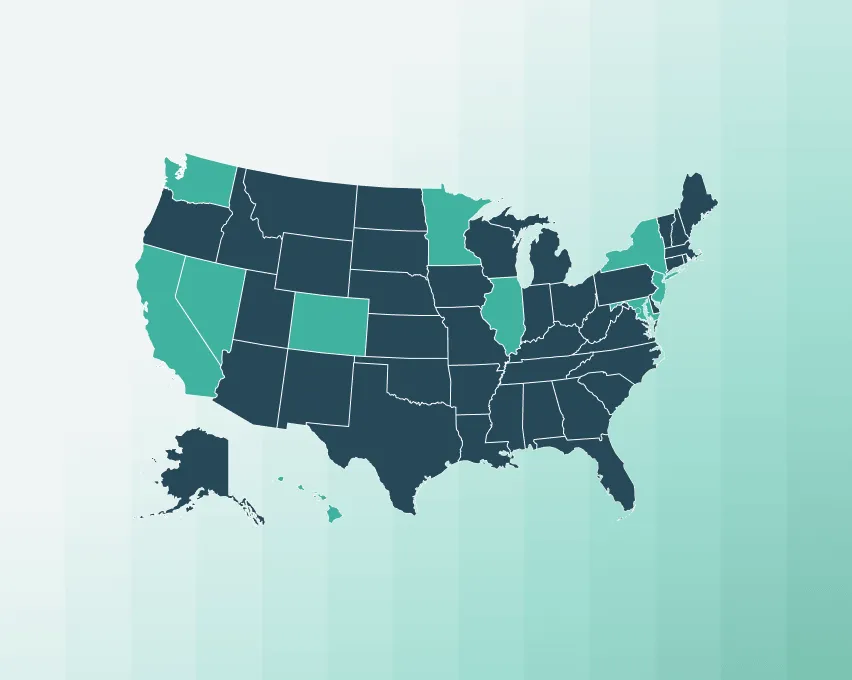
State filing adds a separate obligation if any employee lives in California, Massachusetts, New Jersey, Rhode Island, or Washington D.C., regardless of where the company itself is based. One remote employee in any of these jurisdictions is enough to trigger it:
- California: furnish to employees by Feb. 1, file electronically with the Franchise Tax Board by March 31 (an automatic extension to May 31 is available).
- Massachusetts: applies only if the employer self-insures (insurers handle fully insured plans); furnish Form MA 1099-HC to employees by Jan. 31, file electronically with the Department of Revenue by March 31.
- New Jersey: furnish by Feb. 1 (30-day extension to March 2), file with the Division of Taxation by March 31.
- Rhode Island: furnish by Feb. 1 (30-day extension to March 2), file with the Division of Taxation by March 31.
- Washington D.C.: furnish by Feb. 1 (30-day extension to March 2), file with the Office of Tax and Revenue by April 30.
Work backward from the earliest date on this list, not the latest. Coding depends on clean data from every system named above, so data collection should start well before year-end closes, not once the forms are already due.
What Should You Ask Your Payroll or HRIS Vendor Before Filing Season Starts?
Three questions are worth asking now.
- Does the system support bi-directional data flow for hours, enrollment, and eligibility, so records update in both directions instead of requiring manual re-entry?
- Can it apply the measurement method chosen above automatically?
- Can it generate 1095-C codes directly from that data, rather than requiring the filer to derive Line 14 and Line 16 codes by hand for every employee?
Getting a clear answer to these three questions now is what prevents the manual-export bottleneck that otherwise defines a first filing year.
What Separates a Clean First-Year Filing From a Corrected One?
The employers who file cleanly the first time are the ones who lock in the headcount math, the measurement method, and the data pipeline before the measurement period closes, not after. Everything downstream, including the Line 14 and 16 coding, depends on getting those three decisions right early.
Trusaic’s ACA compliance solution connects payroll and HRIS data directly, applies the chosen measurement method automatically, and generates 1095-C codes from validated data instead of manual entry.