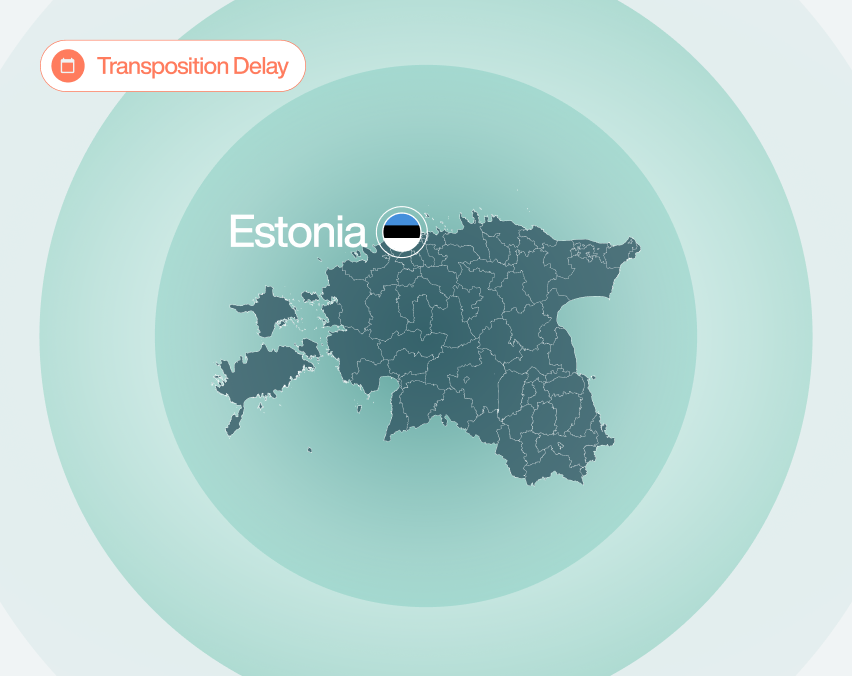














Estonia has followed through on the plan it announced in April: rather than transposing the EU Pay Transparency Directive (EUPTD) in full, the country has moved forward with a partial transposition covering select pre-employment transparency rights, while seeking renegotiation or postponement of the remaining obligations.
The Act on Amendments to the Employment Contracts Act and Amendments to Other Associated Acts entered into force on 13 July 2026, giving legal effect to the approach Estonia’s government outlined earlier this year.
What Has Estonia Transposed?
The new law transposes three discrete EUPTD requirements:
- Initial pay transparency: Employers must share the salary or salary range for a position with applicants, in writing, before the job interview. Where a collective agreement includes pay-related provisions relevant to the role, employers must share those as well.
- Pay history ban: Employers may not ask applicants about their previous or current pay.
- Ban on pay secrecy clauses: Employees cannot be prevented from disclosing the amount of their own pay.
The legislation also amends the Employment Contracts Act to add an explicit principle of equal pay, requiring employers to ensure equal pay for the same work or work of equal value for women and men. This principle already existed under Estonia’s Gender Equality Act; codifying it in the Employment Contracts Act removes any ambiguity within core labor law.
What Is the Palgapeegel (Pay Mirror) Tool?
The legislation formally establishes the Palgapeegel (Pay Mirror) tool in law. Pay Mirror is a voluntary digital service that helps employers analyze their own pay gaps.
At an employer’s request, Statistics Estonia can calculate pay gap indicators using data the employer has already submitted to the state, including data from the register of taxable persons, the Health Insurance Fund database, the social protection information system, and official statistics submissions. Because the tool is voluntary, use of Pay Mirror does not amount to a reporting obligation, and the resulting pay gap indicators are not stored in the database.
What Hasn’t Estonia Transposed?
Everything else under the Directive remains outstanding. This includes:
- Right to Information (RTI)
- Pay gap reporting
- Joint Pay Assessments (JPAs)
Estonia’s position, as previewed in April, is to pursue renegotiation or postponement of these remaining requirements rather than transpose them on the Directive’s original timeline.
What Does This Mean for Employers With Estonian Operations?
Estonia’s approach creates a narrower, but immediate, compliance obligation. Employers hiring in Estonia should already be prepared to:
- Disclose salary or salary range information to applicants in writing before the interview stage
- Remove salary history questions from interview and application processes
- Ensure employment contract provisions and internal policies do not restrict employees from discussing their own pay
Because the Directive lacks horizontal direct effect against private employers, the absence of transposed RTI, reporting, and JPA requirements means that there are no private-sector obligations in those areas today. That said, Estonia’s pursuit of renegotiation introduces uncertainty for multinational employers trying to build a single compliance timeline across Member States — Estonia’s posture here has more in common with Sweden’s than with Member States that have moved, or are continuing to move, toward full transposition, such as Malta and Slovakia.
Employers should also treat Estonia as a two-track jurisdiction going forward: a live compliance obligation for pre-employment transparency today, and an open question for reporting-related infrastructure that may resolve only through further EU-level negotiation.
How Trusaic Can Help
At Trusaic, we provide employers across the EU with solutions to comply confidently with the Directive.
Our Complete EU Pay Transparency Solution enables compliant pay systems, ensures gender-neutral job evaluations, and automates complex reporting obligations to keep you one step ahead of EU pay transparency enforcement.
- PayParity® analyzes your rewards data (compensation/benefits in kind) and quickly identifies any potential unjustified inequities. It enables you to more easily comply with Article 7 (right to information) and Article 6 requirements (pay setting and progression policy).
- Our Remediation Optimization Spend Analysis (R.O.S.A.) works as PayParity’s remediation engine to find the most cost-effective way to close nominal pay gaps to ensure compliance.
- Automated RTI workflows: Our bi-directional integrations with global HCM platforms allow pay equity data to flow securely from the Trusaic platform back into the HCM. Employees can then access their RTI reports directly within their existing HR systems. This eliminates manual report generation and reduces compliance risk.
- For organizations that prefer platform-based access, RTI reports can also be generated and delivered securely through the PayParity platform, with role-based permissions and full auditability.
- Salary Range Finder® ensures equitable pay at the point of hire to prevent any increases in pay gap and enables you to easily comply with the Directive’s salary range disclosure and salary history ban requirements.
- Pay Decisions: Generate fair, competitive offers instantly from Workday.
Trusaic is GDPR compliant and can assist any organization in any EU state in meeting its obligations under both the EU Corporate Sustainability Reporting Directive and the EU Pay Transparency Directive.
Visit our always updated Member State Transposition Monitor to stay on top of the latest EU Pay Transparency Directive developments.