













Healthcare organizations manage incredibly complex workforces. Between tracking PRN nurses, rotating per diem aides, and full-time staff, the volume of workforce data is massive. To handle this, organizations rely on specialized software: one system for clinical scheduling, another for payroll, and a third for benefits administration.
While single-purpose software optimizes daily operations, it creates a massive vulnerability for Affordable Care Act (ACA) reporting. Applying strict ACA regulations to a dynamic healthcare workforce requires seamless data synchronization.
When workforce data is trapped in disconnected silos, HR teams are blind to shifting compliance requirements. We explore why fragmented systems expose healthcare employers to severe IRS penalties and how to centralize your compliance strategy.
What Causes HR Data Silos in Healthcare Organizations?
In a typical healthcare setting, scheduling software handles the surges and shifting hours of variable-hour staff. A separate payroll system processes wages, while a third-party portal manages benefits. For day-to-day operations, this separation works. For ACA compliance, it is a liability.
To accurately complete a Form 1095-C, you need data from all three systems to align. If an employee picks up extra shifts in the scheduling system, that data must inform the benefits system if they cross the ACA eligibility threshold. When these systems do not communicate natively, HR teams are forced to rely on manual data exports to bridge the gap between platforms.
How Disconnected HR Systems Trigger IRS Penalties
Consider a large regional clinic managing its workforce across three disconnected HR platforms:
- Time and Attendance: A per diem aide consistently picks up extra shifts to cover staff turnover, averaging over 130 hours a month during their measurement period.
- HR and Payroll: The payroll system registers the increased wages but maintains the employee’s official job classification as part-time.
- Benefits Administration: Because the benefits portal only triggers alerts based on the static part-time classification in payroll — rather than the actual hours logged in the scheduling system — no offer of coverage is ever generated.
The Compliance Reality: The clinic failed to offer coverage to an employee who legally qualified as full-time under the ACA. Because the critical data points were siloed, the HR team was unaware of the missed offer until the IRS assessed a severe Employer Shared Responsibility Payment (ESRP).
What Data Is Required to File Form 1095-C?
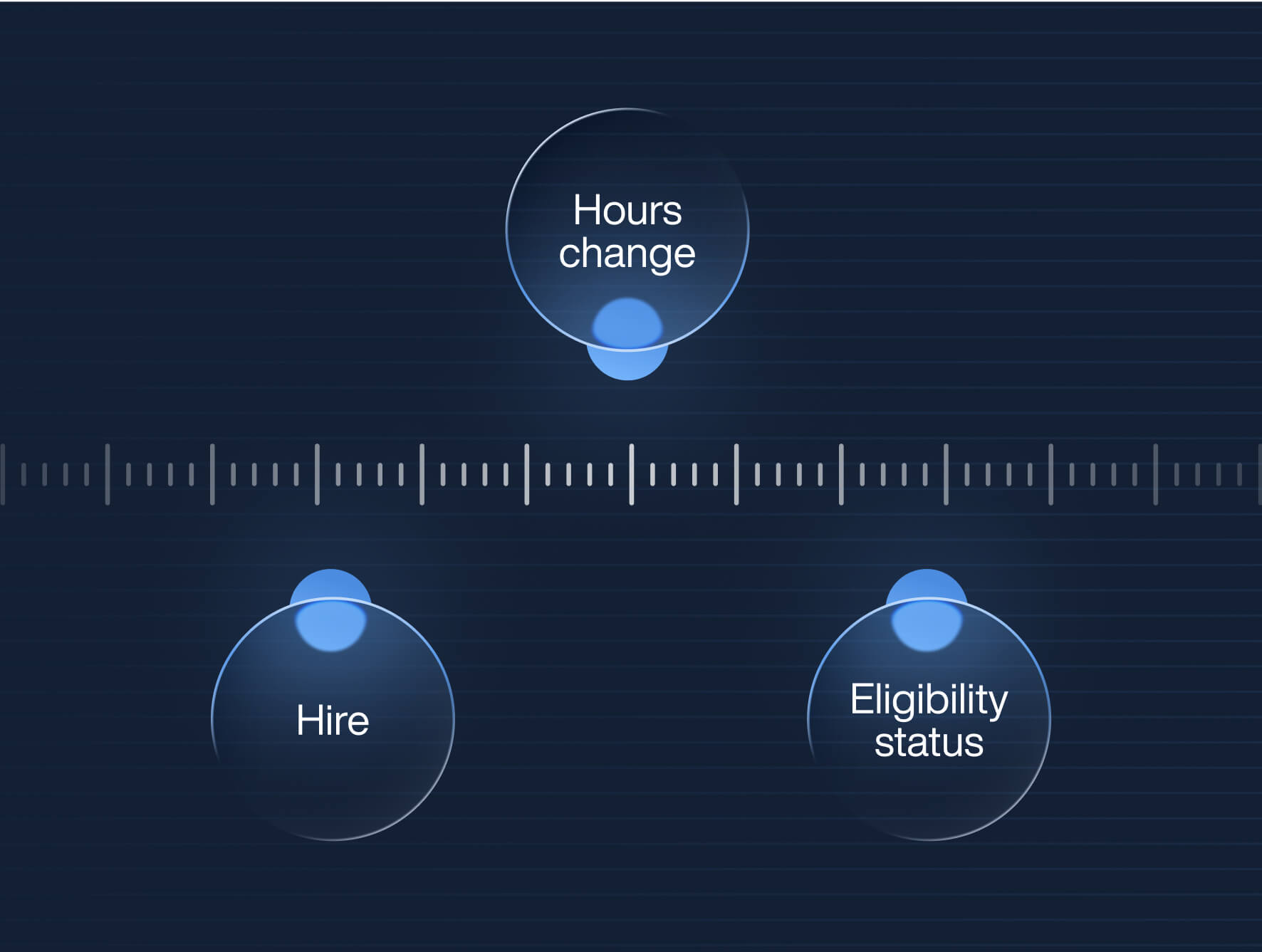
Effective ACA reporting requires cross-functional data integration. To prove compliance for a single variable-hour worker, an organization must synchronize three distinct streams of data.
First, time and attendance data provide the exact hours of service. This must account for fluctuating PRN shifts and unpaid leaves of absence, which may require specialized hours-crediting rules under the ACA.
Second, HR and payroll data supplies transition dates and the exact wage information necessary to prove health plan affordability using IRS Safe Harbors. Finally, benefits administration data provides the formal documentation of which specific health plan tier was offered and whether the employee accepted or declined coverage.
How to Automate ACA Compliance and Eliminate HR Data Silos
When software platforms do not natively communicate, HR teams often resort to manual aggregation. They pull disparate CSV files from scheduling, payroll, and benefits, attempting to align them using VLOOKUPs and manual data entry.
In healthcare, this manual approach is fundamentally unsustainable. The continuous rotation of PRN nurses and variable-hour staff creates a constantly shifting dataset. Manual aggregation significantly increases the likelihood of formatting inconsistencies, missing data points, and hidden logic errors.
Furthermore, this retroactive approach means errors are often discovered during the chaotic filing season, leaving administrators with no time to proactively resolve them before IRS submission.
A Proactive ACA Solution for Healthcare Employers
Managing complex IRS regulations alongside healthcare’s operational demands requires a unified data foundation. Trusaic’s ACA Complete® serves as a centralized compliance hub by integrating directly with your enterprise HRIS, payroll, and benefits systems to automatically aggregate disparate workforce data and track fluctuating hours.
By replacing manual spreadsheets with intelligent software, ACA Complete provides continuous data validation for ACA healthcare employers. Missing data and logic errors are proactively flagged and resolved on a monthly basis. Partner with Trusaic to eliminate the burden of data silos, mitigate IRS penalty risks, and keep your focus on delivering exceptional patient care.