
















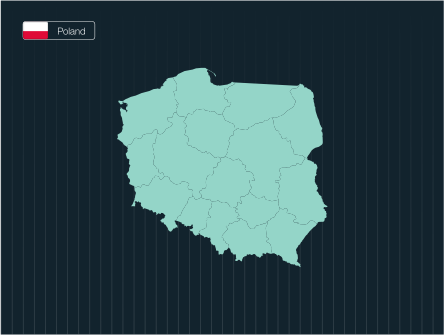
Note: On 4 May 2026, Poland published an updated draft transposition of remaining requirements based on comments received on the December 2025 consultation draft. While the draft continues to move through the legislative process, employers should not expect immediate compliance deadlines. A delayed entry into force is now confirmed: 6 months after publication. Stay on top of the latest developments with our Member State Monitor.
Poland reporting requirements
Who needs to report?
Under the EU Pay Transparency Directive, employers across all EU Member States — including Poland — will be required to comply based on company size:
- Employers with 250 or more employees must begin reporting in 2027 (for 2026 data).
- Employers with 150–249 employees will report starting 2027.
- Employers with 100–149 employees will report starting 2031.
Employers with fewer than 100 employees will not be subject to mandatory reporting under the Directive.
What to report?
Employers will be required to publish gender pay gap information and provide internal transparency to employees. Key reporting elements will include:
- The gender pay gap (difference in average pay levels) for total pay and for complementary or variable components of pay
- The median gender pay gap for total pay and for complementary or variable components
- The proportion of female and male workers receiving complementary or variable pay (e.g. bonuses)
- Distribution of male and female workers across pay quartiles
- The gender pay gap between workers, by categories of workers, broken down by ordinary basic wage or salary and complementary or variable components.
In cases where an unjustified gender pay gap of at least 5% is detected within a category of workers, and persists for more than six months, employers will be required to perform a Joint Pay Assessment with worker representatives.
Where and when to report?
Regulatory Filing
Public disclosure of gender pay gap reports will be required. Poland’s transposing legislation is expected to designate a specific public platform or registry for submitting reports.
Internal Disclosure
Employees must be granted access to:
- Gender pay gap data;
- Explanations for any differences;
- Actions taken or proposed to reduce those differences.
Deadlines and Cadence
Employers will be required to publish reports annually (or triennially, depending on employer size), aligned with Poland’s future implementation schedule.
Poland pay transparency requirements
Although Poland does not currently mandate job posting transparency, the EU Pay Transparency Directive will require employers to:
- Provide pay range or initial pay level in job postings or prior to interviews.
- Avoid requesting salary history from job applicants.
- Use gender-neutral job titles and descriptions.
Employment equity standards
The Polish Labour Code guarantees the principle of equal pay for equal work, prohibiting direct and indirect discrimination based on gender. However, these protections currently lack the reporting and transparency mechanisms required under the EU Pay Transparency Directive.
The upcoming legislative changes will move Poland toward a more proactive approach to pay equity enforcement.
The risks of non-compliance
Once implemented, enforcement of Poland’s transposed Directive is expected to include:
- A shift in burden of proof to the employer in discrimination claims.
- Strengthened worker rights to compensation and redress.
- Financial penalties and legal remedies for employers found non-compliant, as mandated by the Directive.
National enforcement bodies — likely including Poland’s State Labour Inspectorate — will be empowered to monitor compliance and issue penalties.
Poland’s EU Directive legislation
Poland amended its Labour Code to include the pre-employment pay transparency elements of the EU Directive, which take effect Dec. 24, 2025.
Poland’s pay transparency amendments to its Labour Code emphasize a fair and gender-neutral approach during the hiring process. The new provisions include:
- Pay range transparency: Employers must provide applicants with information on the starting salary or pay range (based on objective and neutral criteria). Additionally, if the position is covered by a collective bargaining agreement, or the employer has specific rules about pay, it must be disclosed to the applicant.
- Salary range information on job postings: Employers must provide pay range information on all job postings, ahead of an interview, or before entering an employment relationship. Job postings must use gender-neutral language and gender-neutral job titles, and employers must conduct the recruitment processes in a non-discriminatory manner.
- Salary history ban: Employers are not allowed to ask applicants about their current or prior salary.
How can Trusaic assist with Poland gender pay gap reporting compliance?
1. Comply – Use RAPTR™ to complete required reporting by compliance deadlines.
Stay ahead of evolving regulations with Trusaic’s Regulatory Pay Transparency Reporting™ solution, designed to help you determine applicability, meet deadlines, and submit compliant reports across EU jurisdictions with the click of a button.
Our Pay Equity Software Suite ensures your pay systems are legally defensible, gender-neutral, and future-proof — automating complex reporting and enabling GDPR-compliant data sharing through certified integrations with major HCM platforms.
2. Correct – Use PayParity® to understand, explain and resolve pay disparities:
Use PayParity to identify, explain, and resolve pay disparities across gender, race, age, and more. Whether you’re conducting proactive assessments or responding to compliance triggers like the EU Directive’s Joint Pay Assessment requirement, PayParity delivers defensible, data-driven insights. Our Remediation Optimization Spend Agent (R.O.S.A.) works as PayParity’s AI remediation partner to ensure you lower your pay gap below 5% while maximizing the ROI of your remediation budget.
3. Communicate – Use the Pay Equity Product Suite to communicate narratives and share salary ranges with confidence.
Comply confidently with the EU Directive’s pay range transparency mandates using Trusaic’s Salary Range Finder, which provides data-driven guidance for equitable pay ranges that can be shared with candidates and employees.
Our Pay Transparency Agent answers reporting questions instantly, and our Communications Agent crafts context-specific narratives — in any language — to support your public disclosures and internal communications.
How to Prepare to Comply with the EU Directive
The EU Pay Transparency Directive, approved in 2023, gives Member States until June 7, 2026 to transpose its provisions. Poland must adopt these requirements into law by that deadline.
Employers in Poland should begin preparing now by:
- Conducting pay audits and internal assessments
- Reviewing compensation structures and job architecture
- Preparing HR and legal teams for employee data requests
- Updating hiring practices to comply with upcoming salary posting and history ban requirements
Trusaic is GDPR compliant and can support organizations operating in any EU Member State with both EU Pay Transparency Directive and EU Corporate Sustainability Reporting Directive obligations.
FAQs
-
When do Poland’s new pay transparency rules take effect?
Poland’s amended Labour Code was passed on June 4, 2025. The pay transparency provisions will take effect December 24, 2025.
-
Are employers in Poland currently required to report gender pay gap data?
No. At present, there are no mandatory gender pay gap reporting requirements for private employers in Poland. However, the EU Pay Transparency Directive requires all member states to implement gender pay gap reporting legislation by June 2026. First reports will be due in 2027.
-
Which employers will be required to report under the EU Pay Transparency Directive?
Reporting will be phased in based on employer size:
- Employers with 250 or more employees: Reports due starting in 2027
- Employers with 150–249 employees: Reports due starting in 2027
- Employers with 100–149 employees: Reports due starting in 2031
- Employers with fewer than 100 employees: Exempt from reporting, unless specified by local requirement.
-
What data will employers need to report?
While Poland has not yet finalized its national reporting rules, the EU Directive requires employers to report the following metrics:
- Mean and median gender pay gaps
- Bonus pay gaps by gender
- Distribution of male and female employees across pay quartiles
- Proportion of male and female employees receiving bonuses and benefits-in-kind
- Explanations for pay differences and any corrective measures being taken
-
What happens if the gender pay gap exceeds 5%?
If an employer identifies an unexplained pay gap of 5% or more in any category of workers and fails to rectify it within six months, they will be required to conduct a Joint Pay Assessment in cooperation with employee representatives.
-
What new obligations take effect in December 2025?
The December 2025 amendments focus on pay transparency. Key obligations include:
- Requirement to provide salary ranges in job postings or before the first interview
- Prohibition on requesting applicants’ salary history
-
Will employers have to submit gender pay gap reports to a government authority?
While the official submission process has not been confirmed, the EU Directive requires employers to report pay gap data to a designated public authority and make it accessible to the public. Details are expected to be outlined in future Polish legislation.
-
What penalties could employers face for non-compliance?
Enforcement mechanisms are still under development. Under the EU Directive, employers could face:
- A shift in the burden of proof in discrimination cases
- Compensation obligations to affected employees
- Fines or other administrative penalties
- Investigations or actions from enforcement authorities
-
How can employers prepare for Poland’s future reporting requirements?
To prepare, employers should:
- Review and revise job descriptions and classifications
- Establish internal processes to analyze pay equity
- Include salary ranges in job postings
- Remove salary history questions from recruitment processes
- Conduct proactive pay equity audits to identify and address disparities
-
How can Trusaic help with compliance?
Trusaic provides end-to-end support to help organizations comply with Poland’s upcoming requirements and the broader EU Directive, including:
- Determining employer applicability and tracking deadlines
- Conducting pay equity audits and risk assessments
- Streamlining data extraction and validation
- Generating compliant reports for internal and public use
- Providing communication tools for pay range transparency and workplace equity narratives